

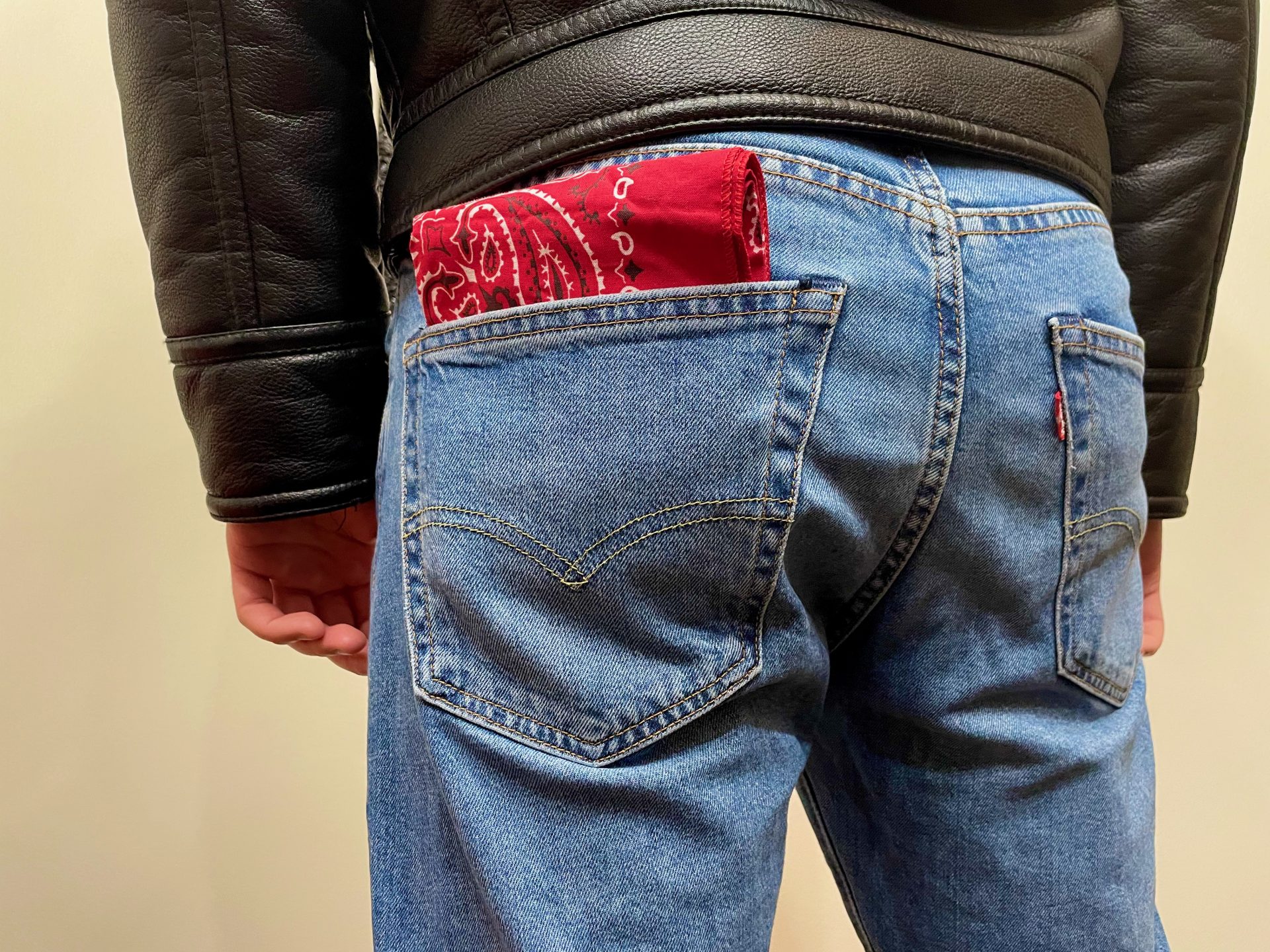
A square of fabric is an admirably low-maintenance communication device. No battery, no notification settings, no man announcing that he is “rarely on here” while remaining permanently online.
The hanky code used color and placement to communicate sexual interests. In its account of the practice, Queer History Boston describes bandanas worn in back pockets among queer men in the 1970s and 1980s, with printed decoder cards distributed by shops and bars. The material was ordinary. The shared reading made it useful.
That is the design story worth paying attention to: not an exhaustive color chart, but an everyday object acquiring an additional layer of meaning. The bandana does not need a screen because the person looking supplies the decoder. To someone outside the convention, it can remain a bandana. To somebody who recognizes the signal, it can begin a conversation.
There is pleasure in that economy. An accessory becomes both part of an outfit and a piece of information. It can be removed, changed, folded down or made more conspicuous. The wearer has a kind of immediate control that a permanently circulating profile photograph cannot quite offer.

The printed cards are just as important as the cloth. Queer History Boston notes that businesses supplied lists alongside bandanas and that bars used the cards to advertise their locations. So the system was not purely spontaneous, whispered knowledge. It had a small publishing and distribution infrastructure. Someone had to make the convention readable, and someone had to put that explanation where interested people could find it.

That commercial detail does not cancel the culture. It makes the culture tangible. Shops, bars and printers helped circulate the vocabulary. Desire needed places to meet, and those places needed people to know they existed. A pocket-sized key could do more than one job.
It is tempting to turn this into a nostalgic claim that communication used to be simpler. It was not necessarily simple, universal or safe. A code depends on context, and different readers may not share the same assumptions. The sensible modern lesson is not that a piece of cloth can replace a conversation. It is that communities can make meaning out of things that were not sold to them as communication platforms.
For the same reason, a bandana is not proof of anyone’s orientation or preferences. Even within a scene, a signal is an opening, not consent. Outside it, the accessory may be doing nothing more complicated than keeping hair out of somebody’s face. The distinction is not a prudish footnote; it is what keeps the design from being mistaken for a machine that can read people.
The best part of the hanky code is its modesty as an object. A little cloth, a shared convention, a possibility of recognition. It does not need to know your location continuously. It only asks whether somebody nearby understands what you chose to show.
Not every interface needs a venture-capital round.
sources
Queer History Boston: The Hanky Code, J. Raúl Cornier.
Leather Hall of Fame: 2019 induction booklet, Samois history. Documents how printed color-code cards circulated and were adapted; no claim of one universal chart.
Image credits: red bandana, OiYoiYoink (2024); colored bandanas, Muzzlesf (2009), both CC0. Historical Boston Eagle/L&L Shop card reproduced by Queer History Boston.


leave a reply