

A new essay revisiting Andrew Schwegler’s “A Social Network of 5,” published on Pale Panda on May 25, 2012.
Five people is a terrible number if you are selling a social network. It is a perfectly respectable number if you want to have a conversation.
That was the useful part of Pale Panda’s 2012 defense of Google+. The service did not need to contain everybody. It needed to contain a few interesting people, some worthwhile links, and a way to stop the rest of the room from interrupting. The original piece called this a better signal-to-noise ratio. A less technical description would be: a website that occasionally knew when to shut up.
The old post’s follow recommendations belong to their moment. The underlying question travels rather well. How many people does a social network actually need before it becomes useful to the person using it?
the room and the stadium
A public network and a small conversation solve different problems. A public network can help a person find work, circulate an investigation, locate an audience, or discover something outside their existing circle. Reach matters for those things. Pretending it never matters is its own kind of smugness.
But reach becomes a strange standard for judging every interaction. A joke between friends does not improve because strangers can grade it. A recommendation does not become more useful because ten thousand people have already repeated it. Sometimes the interesting part is knowing which person recommended the thing, and knowing what their terrible taste in other things tells you.
The 2012 essay described a mix: public posts and news sources alongside smaller circles organized by relationship or subject. Its appeal was not total retreat. It was being able to change the size of the room without leaving the building.

small can still be annoying
There is no automatic virtue in a tiny group. Five people can be exhausting. A private conversation can become a little court with its own rules, grudges, and compulsory opinions. Familiarity makes context easier; it does not make everybody thoughtful.
So the useful distinction is not simply big versus small. It is whether the space leaves room for ordinary participation. Can someone post a link without turning it into a performance? Can a conversation end? Can a person disappear for a few days without returning to an administrative task disguised as friendship?
Those are modest expectations. They also make a better checklist than asking which service is winning.
the business has other questions
Of course, a pleasant corner of a website does not guarantee a viable website. Google’s own 2018 shutdown announcement cited limited consumer adoption and the challenges of maintaining the product. In December it moved the planned consumer shutdown to April 2019. A useful small circle and a successful mass-market product were different measurements.
This is the tension the old post accidentally preserved. The person using the service wanted a manageable feed. The company needed a reason to keep operating it. Neither requirement disappears because the other one is inconvenient.
That is a reason to keep contact information and copies of anything important outside a single platform. It is also a reason to stop treating a service’s size as a complete review of its social value.

five is allowed to be enough
A good small network does not have to become the next anything. It can be a group that sends each other songs. A few people who know a lot about an obscure subject. Friends whose updates are worth reading even when nothing particularly marketable has happened to them.
The original essay was enthusiastic about a specific product. The durable idea is less glamorous: a social space should be judged partly by the conversations it makes possible, and partly by the noise it lets people avoid.
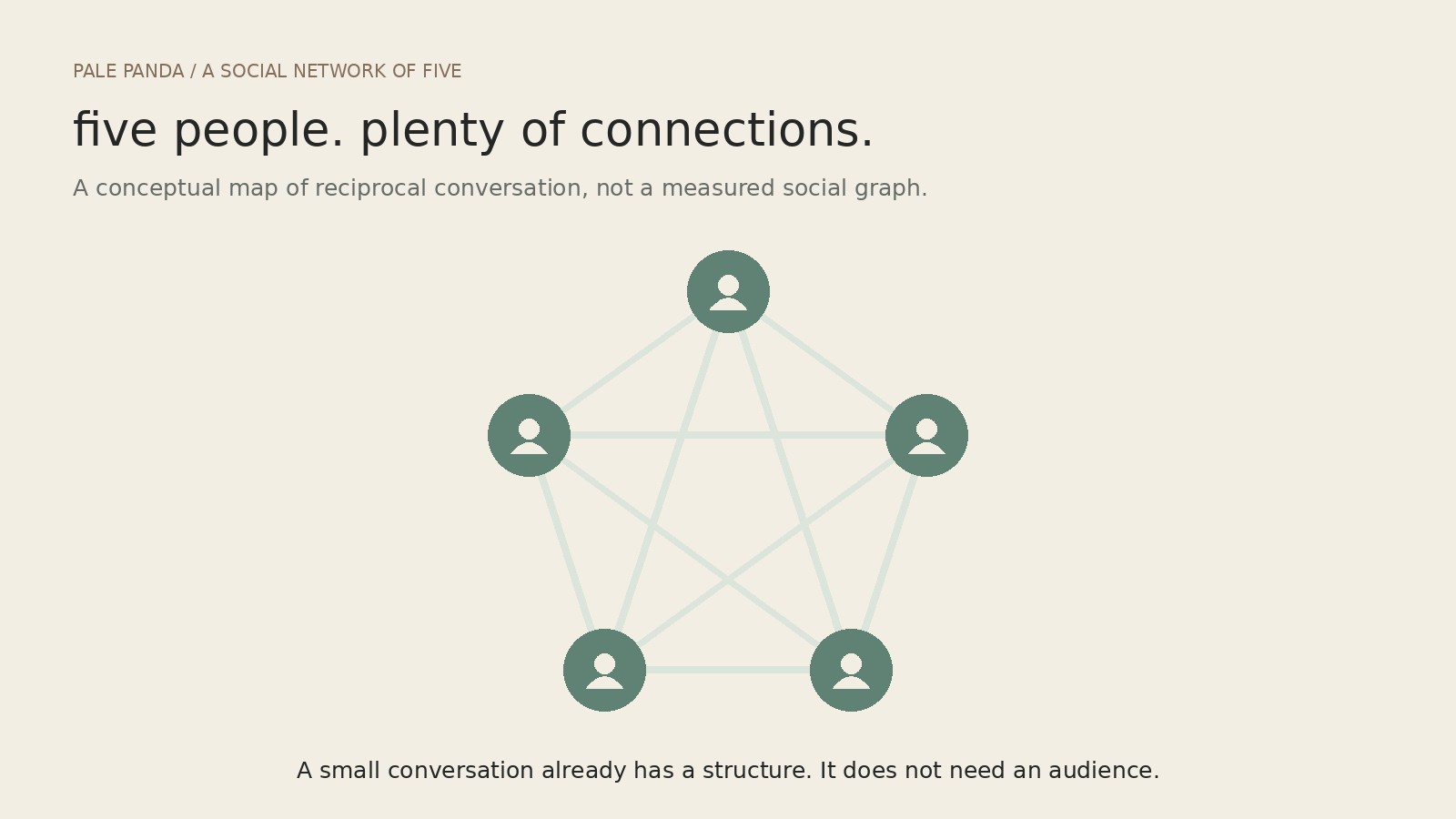
Five people talking to each other is already a social network. It does not need a growth strategy to count.
archive and sources
Original: Andrew Schwegler, “A Social Network of 5”, May 25, 2012, recovered from the author’s WordPress export. This adaptation retains the original premise rather than presenting its old platform recommendations as current advice. Historical context checked October 24, 2026.
image credits
Original editorial diagrams prepared for tacobout: a five-person conversation network and the room and the stadium. These are conceptual illustrations, not historical screenshots or measured data. Google+ wordmark and circles: Google branding, restored from the image accompanying the original 2012 article, reproduced here to identify the historical service. No affiliation or endorsement is implied.


leave a reply