
Telly

  • 4
    the hanky code was an interface you could put in your pocket

    the hanky code was an interface you could put in your pocket

    A square of fabric is an admirably low-maintenance communication device. No battery, no notification settings, no man announcing that he is “rarely… Read more

    A square of fabric is an admirably low-maintenance communication device. No battery, no notification settings, no man announcing that he is “rarely on here” while remaining permanently online.

    The hanky code used color and placement to communicate sexual interests. In its account of the practice, Queer History Boston describes bandanas worn in back pockets among queer men in the 1970s and 1980s, with printed decoder cards distributed by shops and bars. The material was ordinary. The shared reading made it useful.

    That is the design story worth paying attention to: not an exhaustive color chart, but an everyday object acquiring an additional layer of meaning. The bandana does not need a screen because the person looking supplies the decoder. To someone outside the convention, it can remain a bandana. To somebody who recognizes the signal, it can begin a conversation.

    There is pleasure in that economy. An accessory becomes both part of an outfit and a piece of information. It can be removed, changed, folded down or made more conspicuous. The wearer has a kind of immediate control that a permanently circulating profile photograph cannot quite offer.

    Several differently colored bandanas tucked into the back pockets and waistband of blue jeans.

    The printed cards are just as important as the cloth. Queer History Boston notes that businesses supplied lists alongside bandanas and that bars used the cards to advertise their locations. So the system was not purely spontaneous, whispered knowledge. It had a small publishing and distribution infrastructure. Someone had to make the convention readable, and someone had to put that explanation where interested people could find it.

    A blue printed hanky-code card from the Boston Eagle/L&L Shop, arranged in Color, Left and Right columns.

    That commercial detail does not cancel the culture. It makes the culture tangible. Shops, bars and printers helped circulate the vocabulary. Desire needed places to meet, and those places needed people to know they existed. A pocket-sized key could do more than one job.

    It is tempting to turn this into a nostalgic claim that communication used to be simpler. It was not necessarily simple, universal or safe. A code depends on context, and different readers may not share the same assumptions. The sensible modern lesson is not that a piece of cloth can replace a conversation. It is that communities can make meaning out of things that were not sold to them as communication platforms.

    For the same reason, a bandana is not proof of anyone’s orientation or preferences. Even within a scene, a signal is an opening, not consent. Outside it, the accessory may be doing nothing more complicated than keeping hair out of somebody’s face. The distinction is not a prudish footnote; it is what keeps the design from being mistaken for a machine that can read people.

    The best part of the hanky code is its modesty as an object. A little cloth, a shared convention, a possibility of recognition. It does not need to know your location continuously. It only asks whether somebody nearby understands what you chose to show.

    Not every interface needs a venture-capital round.

    sources

    Queer History Boston: The Hanky Code, J. Raúl Cornier.

    Leather Hall of Fame: 2019 induction booklet, Samois history. Documents how printed color-code cards circulated and were adapted; no claim of one universal chart.

    Image credits: red bandana, OiYoiYoink (2024); colored bandanas, Muzzlesf (2009), both CC0. Historical Boston Eagle/L&L Shop card reproduced by Queer History Boston.

    Fediverse Reactions
  • the export button is not a time machine

    the export button is not a time machine

    From the Pale Panda archive: a new essay built from Andrew Schwegler’s “The Social Media Underdogs,” published October 13, 2009, with background… Read more

    From the Pale Panda archive: a new essay built from Andrew Schwegler’s “The Social Media Underdogs,” published October 13, 2009, with background from “Virb Gives Up On Trying to be Facebook,” 2010. The original observations belong to those dates; the preservation discussion below is new.

    In 2009, Pale Panda surveyed Yahoo! Meme, Posterous, Vox, Virb and Hi5. The question was familiar: surely there had to be something beyond the handful of sites everybody already used.

    Read the roundup now and the interesting part is how many different jobs those sites were supposed to do. Posterous was described as a way to publish once and distribute the result elsewhere. Vox offered a more selective audience. Virb was the promising home for artists whose friends, inconveniently, had other plans. Yahoo! Meme’s limits on customization mattered enough to complain about. A profile was somewhere you put things, arranged things and sometimes expected those things to stay.

    That last expectation deserves more attention than it generally gets during signup.

    the pivot is somebody else’s moving day

    The follow-up on Virb makes a useful companion piece. In 2010, the old blog described a move away from social networking toward a website-building service. The new themes looked good. A portfolio tool sounded useful. The problem was that a useful new product did not necessarily preserve what people had come for.

    The post also raised a much less glamorous concern: getting the old content out. That was Andrew’s contemporary assessment, not a retrospective audit of every export option Virb ever offered. It still points to the right question. If a service changes its purpose, what happens to the work that fitted the previous one?

    “We’re excited about our next chapter” can mean a considerable amount of unpaid administrative work for the people in the last chapter.

    A homepage can survive while its original purpose disappears. A brand can carry on while the conversations, layouts and reasons to visit no longer fit. Counting which companies survived misses that quieter kind of loss.

    Posterous illustrates a different distinction. In the 2009 roundup, its appeal was getting a post onto several services at once. That is distribution. Preservation asks whether the copies remain usable independently, with their photographs and context intact. Publishing everywhere sounds wonderfully permanent until you have to establish what every version actually contains.

    A WordPress.com content export contains text and an image reference; the actual photograph is a separate file.

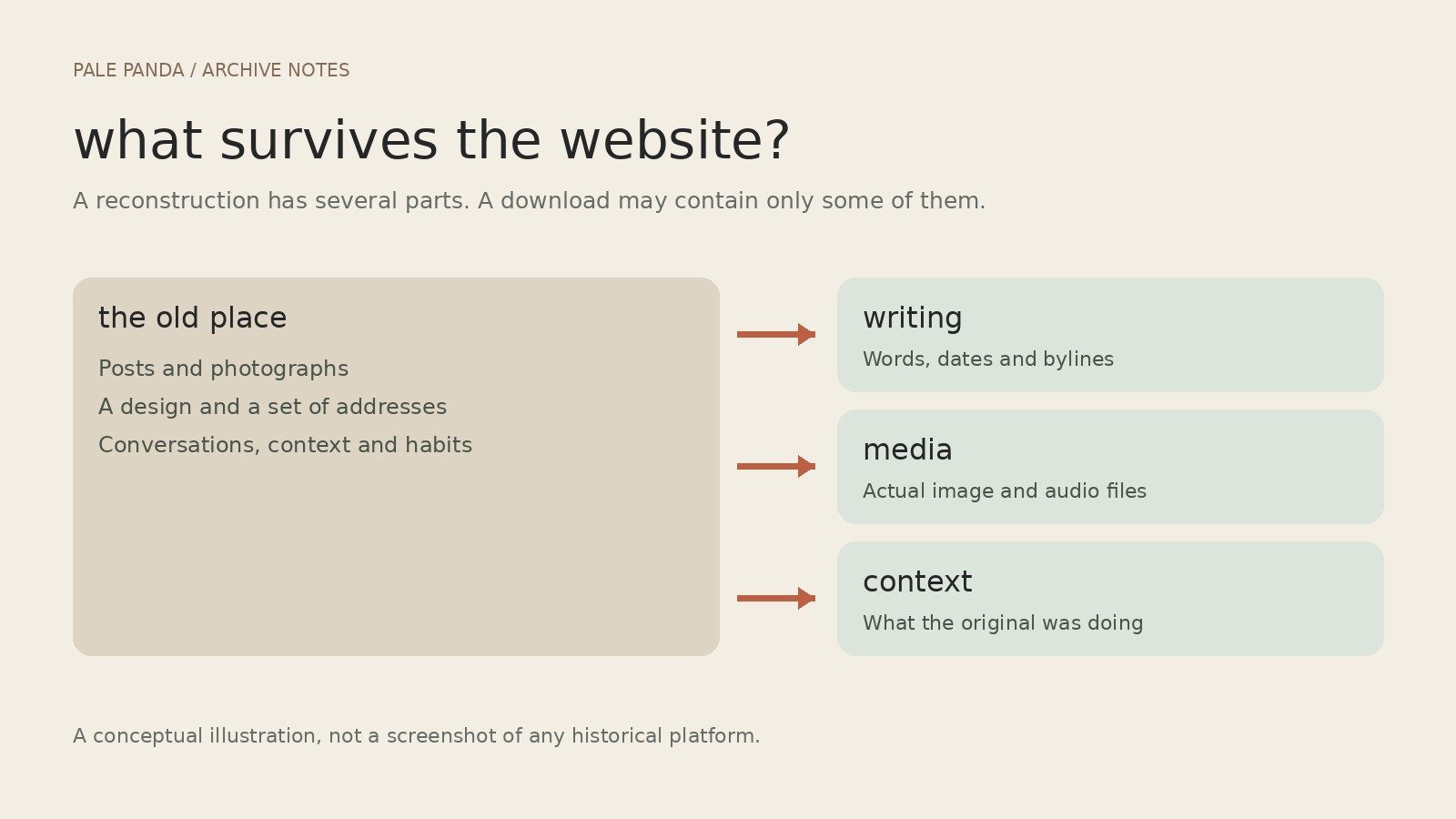
    the file is not the website

    Even an export button needs a follow-up question: what, exactly, came out?

    WordPress.com’s export documentation, checked in October 2026, gives a useful concrete example. Its content export contains posts, pages, comments and references to media. It does not contain the actual image files, the theme or design customizations. Images must be copied separately or fetched during the import while the source remains accessible. A successful download can therefore be one part of a recovery, rather than proof that everything is safe. The distinction is spelled out in WordPress.com’s export guide.

    It is easy to understand how this gets missed. A file called an export feels reassuringly complete. Open it and the sentences are there. The photograph may be there only as an address. If the address stops working, the file has preserved a very precise description of where the photograph used to be.

    The same problem applies to a post built around somebody else’s embedded video. Saving the surrounding paragraph does not put the video in a box with it. Links and embeds are useful connections, but they are also dependencies.

    The 2009 original and the 2026 adaptation are kept separate, preserving Andrew Schwegler’s byline and historical point of view.

    save the boring parts

    A sensible archive keeps more than the prose: original media where you have the rights, publication dates, bylines, source addresses and enough notes to distinguish a missing file from something deliberately removed. Then someone has to open the recovered pages and check them. Particularly the pages with images. Particularly the page you assumed would be fine.

    There is a limit to restoration. A download cannot reconstruct every conversation around a post, or make an old recommendation current. It should not quietly turn somebody’s 2009 opinion into their latest position, either. Dates are part of the writing.

    That is a useful standard for bringing Pale Panda into this blog. Keep the authorship. Keep the historical context. Let a new essay be visibly new rather than sanding the year off the old one. Repair what can be repaired without pretending the original room is still there.

    The underdogs roundup was looking for the next good place to put things. Its more durable question is what you can take with you when that place changes its mind.

    sources & credits

    Original writing: Andrew Schwegler, The Social Media Underdogs (Pale Panda, October 13, 2009; recovered post 2301) and Virb Gives Up On Trying to be Facebook (2010; recovered post 2309). Technical reference: WordPress.com, “Export your website’s content”, checked October 24, 2026. This is a new adaptation, not a verbatim restoration. Illustrations: original editorial diagrams prepared for tacobout; these are explanatory graphics, not historical website screenshots.

  • christmas countdown #49: a christmas carol (2009) and a future nobody wants to visit

    christmas countdown #49: a christmas carol (2009) and a future nobody wants to visit

    the ghosts bring an overdue account of what scrooge has done with his time, and the bill is difficult to ignore. Read more

    a christmas ghost story has an unfair advantage. everybody already understands what it means to be haunted by an earlier version of the holiday. the room remembers people who no longer sit in it. even the decorations can keep an inconvenient record.

    Ebenezer Scrooge in a black top hat and coat on a snowy Victorian street in Disney’s A Christmas Carol.

    robert zemeckis’s 2009 adaptation puts jim carrey at the centre of dickens’s familiar visitation. scrooge is taken through the past, present and possible future, with the animation giving the journey a restless, sometimes alarming physical scale.

    the spectacle can be a lot. there are moments when the machinery threatens to turn a moral reckoning into an attraction that wants to show you how fast it can move. still, this version makes room for the story’s unpleasantness. scrooge needs more than a cosy reminder to be generous.

    what keeps the premise troubling is the gap between intention and consequence. someone can think of himself as merely practical while other people experience him as a closed door. the ghosts make those separate accounts occupy the same room. nobody gets to hide behind being busy.

    why christmas matters

    the holiday puts private comfort beside public need. a warm house becomes harder to admire when the story keeps asking who has been left outside it. christmas also gives change a deadline, which is useful when a man has spent years postponing decency.

    the right evening

    a darker animation night for viewers comfortable with frightening ghosts, rather than a soothing background film for the youngest children. number 49 goes to a version whose unease survives its excess. the future is still unwritten, but it is becoming less patient.

    From my media collectionA Christmas Carol (2009)Director: Robert Zemeckis • Genre: Animation, Family, Fantasy, Drama • Year: 2009Save this countdown pick or add your take on Trove.View on Trove

    image credits: body image from Disney Movies; featured artwork from Disney+. Disney’s A Christmas Carol © Disney.

  • 1
    christmas countdown #50: jingle all the way (1996) and the panic in the toy aisle

    christmas countdown #50: jingle all the way (1996) and the panic in the toy aisle

    a missing toy, an absent dad, and the peculiar belief that christmas can be repaired before the shops close. Read more

    the frightening thing about jingle all the way is how little explaining its central disaster requires. a father has promised a toy. he has not bought the toy. somehow, the future of the entire family now appears to depend on stock availability.

    Arnold Schwarzenegger in a Santa suit raises his hands beside the Jingle All the Way title on a green background.

    the 1996 film sends arnold schwarzenegger through a christmas eve shopping scramble that keeps getting louder and less defensible. sinbad supplies a rival shopper, and the adults turn a children’s present into an excuse to behave like people who should never be allowed near children’s presents.

    it is a broad, exhausting comedy. that is part of the case for putting it here, rather than pretending the countdown needs to open with a masterpiece. its ridiculous scale catches something familiar about the season: a small failure acquires an audience, then a deadline, then the weight of every earlier failure.

    the uncomfortable detail is the attempted shortcut. showing up consistently would take months. buying the correct object could, in theory, be finished this afternoon. the movie lets that calculation become physical chaos, with a very large man discovering that being very large does not improve inventory.

    why christmas matters

    christmas turns the toy into a test of whether somebody has been listening. the commercial machinery supplies the test, the scarcity and the closing time. beneath the slapstick is the worry that love has become something you can fail to locate on a shelf.

    the right evening

    a noisy, low-stakes watch after shopping, preferably when nobody still needs you to buy anything. it earns number 50 for making festive panic recognisable, even when the shouting threatens to flatten the joke.

    From my media collectionJingle All the Way (1996)Director: Brian Levant • Genre: Family, Adventure, Comedy • Year: 1996Save this countdown pick or add your take on Trove.View on Trove

    image credits: body artwork from 20th Century Studios; featured artwork from Disney+. Jingle All the Way © 20th Century Studios.

    Fediverse Reactions
  • 2
    all of us strangers and the terror of a quiet flat

    all of us strangers and the terror of a quiet flat

    A nearly empty tower block, parents who still answer the door, and the unsettling distance between getting out and feeling free. Read more

    An empty flat looks very different depending on whether someone is expected back. The same clean surfaces, the same closed door. One version is peaceful. The other has started to feel permanent.

    Andrew Haigh’s All of Us Strangers gives that silence an entire tower block. Adam, played by Andrew Scott, lives in a nearly empty London building. Harry, played by Paul Mescal, is a neighbour who interrupts his solitude. Elsewhere, Adam’s dead parents are apparently still at home, unchanged by the thirty years he has had to live without them. That is the premise laid out by Searchlight, and it is already enough to make a perfectly ordinary evening feel suspect.

    The modern building is the detail that keeps catching. A haunted house usually comes with a warning in the architecture: the bad staircase, the sealed room, the wallpaper nobody should have chosen. This one could be an upgrade. Somewhere you might move when life is finally supposed to be getting better.

    There is something particularly bleak about giving loneliness an expensive-looking address. The room has been delivered. The life that was meant to happen inside it remains outstanding.

    the past still answers the door

    Claire Foy and Andrew Scott face each other across a kitchen table in All of Us Strangers.

    The parents are a more intimate disturbance. Adam can return to them, but returning does not make the intervening years disappear. Ben Walters’s Sight and Sound review is useful on the uncomfortable coexistence of parental tenderness and inherited homophobia. Affection does not automatically supply understanding. A parent can love a child and still help teach that child to hide.

    That is a cruel thing for a ghost story to leave intact. Bringing people back would be so much easier if they returned with the right vocabulary, a complete apology and the benefit of everything learned in their absence. Haigh allows the reunion to be more awkward than that.

    The fantasy of going home tends to leave out the conversation you would have once you got there.

    Jamie Bell stands by a fireplace while Andrew Scott sits on a sofa in All of Us Strangers.

    the happy ending has a long commute

    Queer adulthood is often described as an eventual destination: get out, come out, find your people. There are good reasons those promises matter. But a destination can become another way to judge the person who has reached the right city, acquired the right freedoms, and is still eating alone.

    The most troubling question here is how much of a life can be spent waiting to feel as though it has begun. A new address can make that waiting less visible. So can a relationship. Neither comes with a receipt for the years already spent.

    Scott and Mescal supply the romance, but the premise refuses to let desire clear the building of everything that was there before it. There is another person within reach. There is also a whole past in the room.

    This is the darker companion to the Weekend conversation from Sunday: what happens when the time available to two men is crowded by time that cannot be recovered?

    The unnerving thing about the flat is how little it needs to change. Someone could come over. The light could stay on. From outside, it would be almost impossible to tell the difference.

    Watch the official All of Us Strangers trailer from Searchlight Pictures on YouTube.

    Film written and directed by Andrew Haigh. This essay discusses the published premise and leaves the ending alone. Image credits: featured still of Andrew Scott and Paul Mescal, photo by Parisa Taghizadeh, courtesy of Searchlight Pictures, © 2023 Searchlight Pictures; kitchen-table still of Claire Foy and Andrew Scott, courtesy of Searchlight Pictures, © 2023 Searchlight Pictures; sitting-room still of Jamie Bell and Andrew Scott, courtesy of Searchlight Pictures, © 2024 Searchlight Pictures. Official publicity images from the Searchlight press gallery, used for editorial coverage. All rights reserved.

    Fediverse Reactions
  • the fediverse is a place you choose, not a promise

    the fediverse is a place you choose, not a promise

    A fresh guide built from Andrew Schwegler’s “What Is the Fediverse?” on Pale Panda, April 20, 2021. This is a new adaptation,… Read more

    A fresh guide built from Andrew Schwegler’s “What Is the Fediverse?” on Pale Panda, April 20, 2021. This is a new adaptation, not the original article. Technical details checked October 24, 2026.

    The useful question about a social network is fairly small: can you talk to the people you want to talk to without hating the place where you do it?

    The fediverse offers a different way to arrange that place. You join a service run by one operator, but your conversations can reach compatible services run by other people. The email comparison from Pale Panda’s original guide still helps: choosing an address should not require everyone you know to choose the same provider.

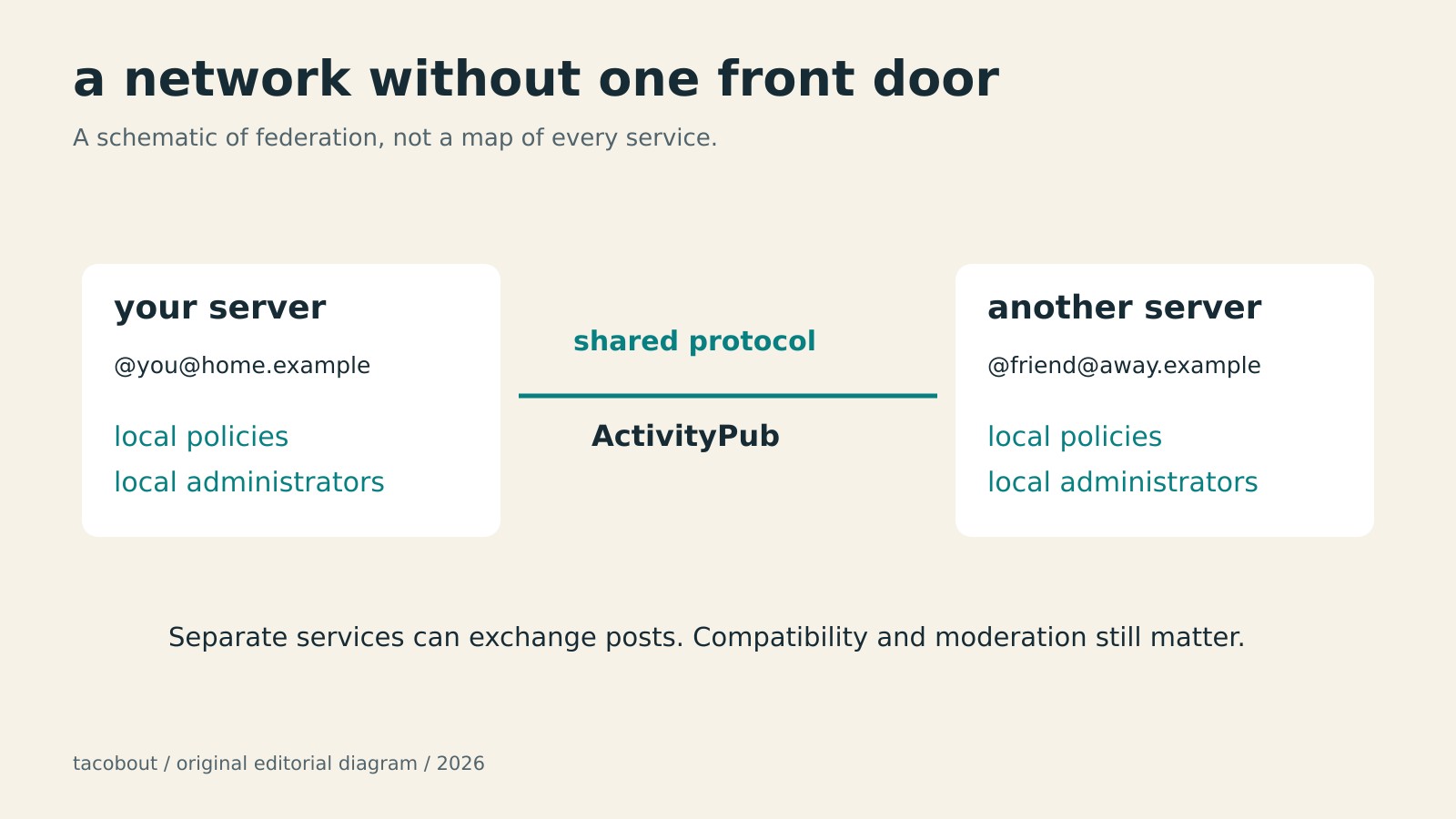
    ActivityPub is one protocol that makes those exchanges possible. It describes how services deliver social activity to each other. It does not make every application identical, or promise that every server will accept everything another server sends. Think shared language, with local house rules.

    pick the people running the place

    For a first Mastodon account, start with the server directory, then read a candidate’s own policies. The server hosts your account. Its administrators matter more than whether the domain looks cute in your bio.

    Check what the rules prohibit, how to contact moderators, and whether the funding and shutdown policies make sense. Look at public conversations. A rule against harassment is useful; evidence of people maintaining a usable community is better. You are choosing somebody’s ongoing operation, not just a sign-up form.

    Registration can be open, approval-based, or invitation-only. Follow that server’s process. There is no need to join the same server as every friend. There is also no universal promise that two particular servers will communicate: moderation decisions and technical compatibility can limit the connection.

    Three checks before joining a Mastodon server: rules, moderation contacts, and funding or shutdown plans.

    find a person before you find everybody

    Share your complete address, such as @name@example.social, rather than just @name. The domain is part of the address. If you have someone’s profile URL, paste it into your own server’s search box. That is often easier than trying to persuade a page on a different server that you are already logged in somewhere else.

    Hashtags, follows, and conversations are useful starting points. Follow a few people whose posts you actually want to read. Reply when you have something to add. A feed does not become good merely because you have successfully created an account.

    The old guide’s claim that Mastodon cannot search post text needs retiring. Full-text search is available when the server has the necessary search backend. Its searchable material includes public posts from accounts that opt in, alongside certain posts you wrote or interacted with. It is not a search engine for every post on every server. An empty result is not proof that nobody said it.

    private does not mean encrypted

    Mastodon’s private mentions are not end-to-end encrypted messages. Administrators of the sending and receiving servers may be able to access their text. Keep sensitive conversations in an appropriate encrypted messenger. A visibility menu is not a security guarantee.

    The same caution applies to sweeping claims about the whole fediverse. Different operators have different terms, policies, and business models. Federation does not itself guarantee an ad-free service, permanent availability, or perfect moderation. Read the actual agreement rather than the nicest paragraph in an explainer.

    Mastodon can transfer supported lists and followers; an exported archive does not import old posts and media as posting history.

    know what can leave with you

    Mastodon gives you useful exit options, with limits. Its documented migration process can redirect an old profile and move followers where their software supports it. You can export and import supported lists. You can also request an archive of your posts and media.

    Those are different operations. The post archive does not become your posting history on the new server: Mastodon’s documented migration does not import those posts and media. Save anything you need before moving. Nor should deleting an account be treated as proof that every copy, screenshot, or independently retained record has vanished.

    That leaves a reasonably appealing proposition, without the sales pitch. Choose a place with tolerable rules and people worth reading. Learn its limitations. Keep an exit plan. A social network is allowed to be useful without volunteering to become your entire internet.

    credits

    Source essay: Andrew Schwegler, What Is the Fediverse? How to Find the Right Instance, Join, and Search., Pale Panda, April 20, 2021. Original editorial diagrams created for tacobout; schematic illustrations, not archival screenshots. Linked technical documentation was checked October 24, 2026.

  • 3
    the election needle has never needed a sports physical

    the election needle has never needed a sports physical

    Iowa is within a point. Washington is voting on who needs a doctor’s note to play ball. Here’s where to vote, what… Read more

    there is a version of election night where i spend four hours learning the precise shape of a county in Iowa and find out tomorrow morning that Washington voted on whether a middle-schooler needs a doctor to verify her sex to play soccer. the county will still be shaped like that tomorrow. i’d like to give the kid a tab of her own.

    before you leave the house

    Check your assigned location and hours with your election office. In Alabama, polls are open 7 a.m.–7 p.m. local time. Bring an accepted photo ID. If you’re in line when polls close, stay in line.

    Find my polling place (U.S.)Find my Alabama precinct

    County sample ballots  ·  Alabama ID list  ·  Montgomery election office

    Jump to   Polls  ·  Forecasts  ·  LGBTQ+ watch  ·  Trans rights  ·  Stickers

    Pip waves from the front of the voting line in a school gym. Facet’s folding sample ballot trails beside Hitch’s two orange sneakers. Schwegler waits with his hands in his pockets, and Telly wears a blue jacket and jeans.

    one point in Iowa is a very small point

    Nationally, Democrats led the generic congressional ballot by 8.1 points in Call the Map’s Election Day polling average, which includes polls through November 2. That question asks which party people favor for Congress. Nobody gets to check a bubble marked “generic Democrat, please distribute evenly across 435 districts.” National polling average.

    Look at the final New York Times/Siena surveys, released November 1. In Michigan, Abdul El-Sayed led Mike Rogers 53% to 42%. In Iowa, Josh Turek led Ashley Hinson 48% to 47%. Siena puts the sampling margin for an individual Iowa estimate at ±4.7 points. If your takeaway from those two headlines is simply “Democrats lead,” you have misplaced a fairly important ten points. Siena toplines and sampling details.

    Horizontal bars show Democratic leads in Silver Bulletin’s November 3, 2026 Senate polling averages: Michigan 4.9 percentage points, Kansas 4.0, Maine 3.9, Texas 3.3, Ohio special election 3.0, and Iowa 1.1. These are polling averages, not win probabilities or results.

    Average several pollsters and Michigan looks closer. Silver Bulletin’s final average puts it at D+4.9, with Iowa still just D+1.1. A few points of polling error in the same direction across several states can change who gets to run the Senate. That’s the tab i’ll be refreshing. November 3 polling averages.

    what 53 seats means depends on who’s counting

    Sabato’s Crystal Ball made a call in every race on November 2. Add up the seats its editors rated at least leaning Democratic and you get 239 House seats, 53 Senate seats, and 28 governorships. A seat their editors barely favor counts once, just like a seat they’re sure about. Final ratings and maps.

    Three separate stacked bars show Sabato’s Crystal Ball final ratings on November 2, 2026. House: 239 seats at least lean Democratic and 196 Republican out of 435. Senate: 53 Democratic and 47 Republican out of 100. Governors: 28 Democratic and 22 Republican out of 50. Majority markers are 218, 51, and 26. These are ratings, not probabilities or election results.

    Crosstab’s November 3 model also put 53–47 at the center of its Senate forecast, but gave Democrats a 75% chance of controlling the chamber, compared with 91% in the House. A Republican Senate still shows up about once in four simulations. If that’s the combination we get, the model already had a chair set out for it. The graphics above are pre-election snapshots. Crosstab forecast.

    LGBTQ+ watch · who gets a seat, who gets a marriage license

    New Hampshire, U.S. Senate. Rep. Chris Pappas faces former Sen. John E. Sununu for Jeanne Shaheen’s open seat. Pappas could become the first openly gay man elected to the U.S. Senate. The seat is already held by a Democrat, which means a result that would be historic for gay men could look entirely uneventful on a party-control map. Same color. Quite a different evening. AP’s New Hampshire race guide.

    Three House races worth a tab. In Indiana’s 5th, JD Ford, the first openly gay member of the state legislature, is challenging Victoria Spartz. In New York’s 17th, Army veteran Cait Conley is challenging Mike Lawler. In Arizona’s 6th, former Marine drill instructor JoAnna Mendoza is challenging Juan Ciscomani. All three are out LGBTQ+ candidates running for Republican-held seats. LGBTQ+ Victory Fund’s candidate rundown.

    Virginia, Question 2. Same-sex couples can already marry in Virginia. A yes would remove the state constitution’s unenforceable ban and replace it with an affirmative right for two adults to marry regardless of sex, gender, or race. A no leaves the dormant ban in the text. That’s a hell of a sentence to leave lying around about somebody’s husband. Official explanation and amendment text.

    trans rights watch · read what the yes would do

    Delaware, U.S. House. Sarah McBride, the first openly trans member of Congress, is seeking a second term against Republican Joe Arminio. Read the local race guide and you’ll find McBride talking about the cost of living. She has constituents who need groceries, a fact you could miss entirely from the national coverage of which bathroom she uses. WHYY’s Delaware voter guide.

    Washington · IL26-638. A yes would bar trans girls from certain girls’ K–12 interschool competitions and require any student seeking to participate in those events to get a health care provider’s statement verifying sex. That means a girl whose eligibility nobody ever questioned would also need the paperwork. Somewhere between a pair of cleats and the first practice, the state would like another signature. Washington legislative summary.

    Colorado · Propositions 134 and 135. Two separate votes. A yes on 134 would set statewide sex-based eligibility rules for school and college sports, including intramurals. A yes on 135 would prohibit specified transition-related surgeries for minors and bar public funding and insurance coverage for those surgeries. Its scope is surgery. Colorado’s official Blue Book.

    Arizona · Proposition 318. A yes would expand sex-based team restrictions to more private schools and restrict access to school private spaces, including restrooms, by sex recorded at birth. Nebraska · Initiative 442. A yes would write sex-based restrictions for girls’ and women’s school sports into the state constitution. Arizona voter pamphlet · Nebraska ballot guide.

    Missouri · Amendment 3. One oval does double duty. A yes would repeal the reproductive-rights amendment voters approved in 2024 and constitutionally prohibit gender-transition procedures for minors. A no keeps the 2024 amendment in place. You don’t get to split your answer between the two questions the legislature bundled together. Missouri’s official ballot language.

    When the first network calls control of a chamber tonight, i’ll want to know. I’ll also want to know whether a girl in Washington needs to make a second appointment before she can make the team. There’s room on the screen for both. More down-ballot races from Hitch.

    the sticker table

    Take one on the way out. Each character opens as a transparent PNG.


    Credits. Polling graphic from Silver Bulletin’s final averages, ratings graphic from Sabato’s Crystal Ball. Both charts, and all mascot illustrations by taco ’bout it.

    Fediverse Reactions
  • 1
    godzilla clocks in; druski passes the collection plate

    godzilla clocks in; druski passes the collection plate

    Godzilla’s PS5 remaster arrives November 3, Derelikt sets a November 13 date, and Druski’s Netflix comedy gets a December premiere. Read more

    Tuesday, November 3, 2026 · morning briefing

    Godzilla has a character-select screen, a space station has a staffing problem, and Druski’s pastor has acquired a streaming deal. Three new announcements worth a look.

    godzilla clocks in for demolition

    Godzilla: Destroy All Monsters Melee Remastered is due on PS5 today, November 3, according to PlayStation’s November 2 fighter guide. The roster has 12 kaiju, and the guide is a useful way to choose a starting monster: Heisei Godzilla offers balanced stats, Rodan favors speed at the expense of defense, and King Ghidorah keeps opponents at a distance. A familiar face is a perfectly respectable first pick, especially when that face can level a building.

    the space station has failed its vibe check

    Derelikt arrives on PS5 November 13. Creator Philipp Jensen’s new announcement describes a sci-fi horror game built around a missing excavation crew, an asteroid outpost and survivors whose accounts do not agree. Its hand-painted textures and deliberately unstable-looking geometry aim for late-PlayStation atmosphere, while exploration, resource management and puzzles share the workload with gunplay. The announcement includes a trailer and screenshots; expect horror imagery. Apparently the haunted workplace has survived several console generations.

    druski passes the collection plate to netflix

    Netflix has announced a multiyear partnership with Druski, starting with Collect & Praise on December 1. The semi-scripted comedy expands his megachurch pastor character into a series. Netflix will also license selected existing work, including Coulda Been Love and Coulda Been Records Auditions. This is a new home and a firm premiere date for the character, rather than an invitation to hunt through unrelated sketches for the next installment.

    Sources: PlayStation Blog’s November 2 announcements and Netflix Tudum’s November 2 partnership announcement, linked above. Release dates are the publishers’ announced dates. No episode outcomes or wrestling results are included.

    Fediverse Reactions
  • 3

    the werewolf bar mitzvah cinematic universe remains underfunded

    30 Rock built a cemetery for an eight-second joke. The feature-length pitch can practically write itself. Read more

    A feature-length Werewolf Bar Mitzvah movie is an extremely reasonable thing to want. 30 Rock supplied the title, the monster and the party; a studio could at least supply a budget.

    (more…)
    Fediverse Reactions
  • the sword got a second job; diplomacy got another season

    the sword got a second job; diplomacy got another season

    La Bola Negra expands, The Diplomat returns, Queen’s Domain launches, and Windows Search picks up the phone. Read more

    Friday, October 30, 2026 · afternoon briefing

    A queer epic adds more cinemas, diplomacy gets another season, and a sword has been asked to handle transportation. Four developments before the weekend.

    la bola negra gets a bigger screen

    Sebastián and Rafael in a scene from La Bola Negra.

    La Bola Negra expands its theatrical run today, with Atlanta’s AMC Phipps Plaza among the new U.S. locations. Javier Calvo and Javier Ambrossi’s film connects three generations of gay men across Spanish history; Netflix’s city-by-city list distinguishes this weekend’s openings from November additions. Streaming follows December 2, so the Netflix logo is not yet an instruction to reach for the remote.

    the diplomat renews its lease on trouble

    Netflix has renewed The Diplomat for a fifth season. Its October 29 announcement confirms more of Debora Cahn’s political drama but gives no premiere date. The renewal can be enjoyed without an explanation of the finale; the linked announcement does contain spoilers.

    A woman smiles at a dinner table set with wine glasses and flowers in The Diplomat.

    the sword has a second job

    Queen’s Domain arrives on Xbox Series X|S today. The retro-fantasy action RPG uses its holy sword for traversal as well as combat, with an interconnected island built around exploration and hidden routes. The publisher’s launch guide explains how to get around, which seems worth learning before assigning every problem to the sharp end.

    windows search would also like to make the call

    Microsoft’s latest Windows 11 Experimental builds add inline settings controls, richer file previews and Phone Link actions inside Search. Android phone support is available in this preview; iPhone support is planned for early next year. These are Insider test builds, not a general release: the Start menu on every PC has not suddenly acquired the same ambitions.

    Image credits: La Bola Negra featured still and body image © Netflix, via its theatrical announcement; The Diplomat image © Netflix, via the renewal announcement. Video: Netflix’s official La Bola Negra trailer.