

From the Pale Panda archive: a new essay built from Andrew Schwegler’s “The Social Media Underdogs,” published October 13, 2009, with background from “Virb Gives Up On Trying to be Facebook,” 2010. The original observations belong to those dates; the preservation discussion below is new.
In 2009, Pale Panda surveyed Yahoo! Meme, Posterous, Vox, Virb and Hi5. The question was familiar: surely there had to be something beyond the handful of sites everybody already used.
Read the roundup now and the interesting part is how many different jobs those sites were supposed to do. Posterous was described as a way to publish once and distribute the result elsewhere. Vox offered a more selective audience. Virb was the promising home for artists whose friends, inconveniently, had other plans. Yahoo! Meme’s limits on customization mattered enough to complain about. A profile was somewhere you put things, arranged things and sometimes expected those things to stay.
That last expectation deserves more attention than it generally gets during signup.
the pivot is somebody else’s moving day
The follow-up on Virb makes a useful companion piece. In 2010, the old blog described a move away from social networking toward a website-building service. The new themes looked good. A portfolio tool sounded useful. The problem was that a useful new product did not necessarily preserve what people had come for.
The post also raised a much less glamorous concern: getting the old content out. That was Andrew’s contemporary assessment, not a retrospective audit of every export option Virb ever offered. It still points to the right question. If a service changes its purpose, what happens to the work that fitted the previous one?
“We’re excited about our next chapter” can mean a considerable amount of unpaid administrative work for the people in the last chapter.
A homepage can survive while its original purpose disappears. A brand can carry on while the conversations, layouts and reasons to visit no longer fit. Counting which companies survived misses that quieter kind of loss.
Posterous illustrates a different distinction. In the 2009 roundup, its appeal was getting a post onto several services at once. That is distribution. Preservation asks whether the copies remain usable independently, with their photographs and context intact. Publishing everywhere sounds wonderfully permanent until you have to establish what every version actually contains.

the file is not the website
Even an export button needs a follow-up question: what, exactly, came out?
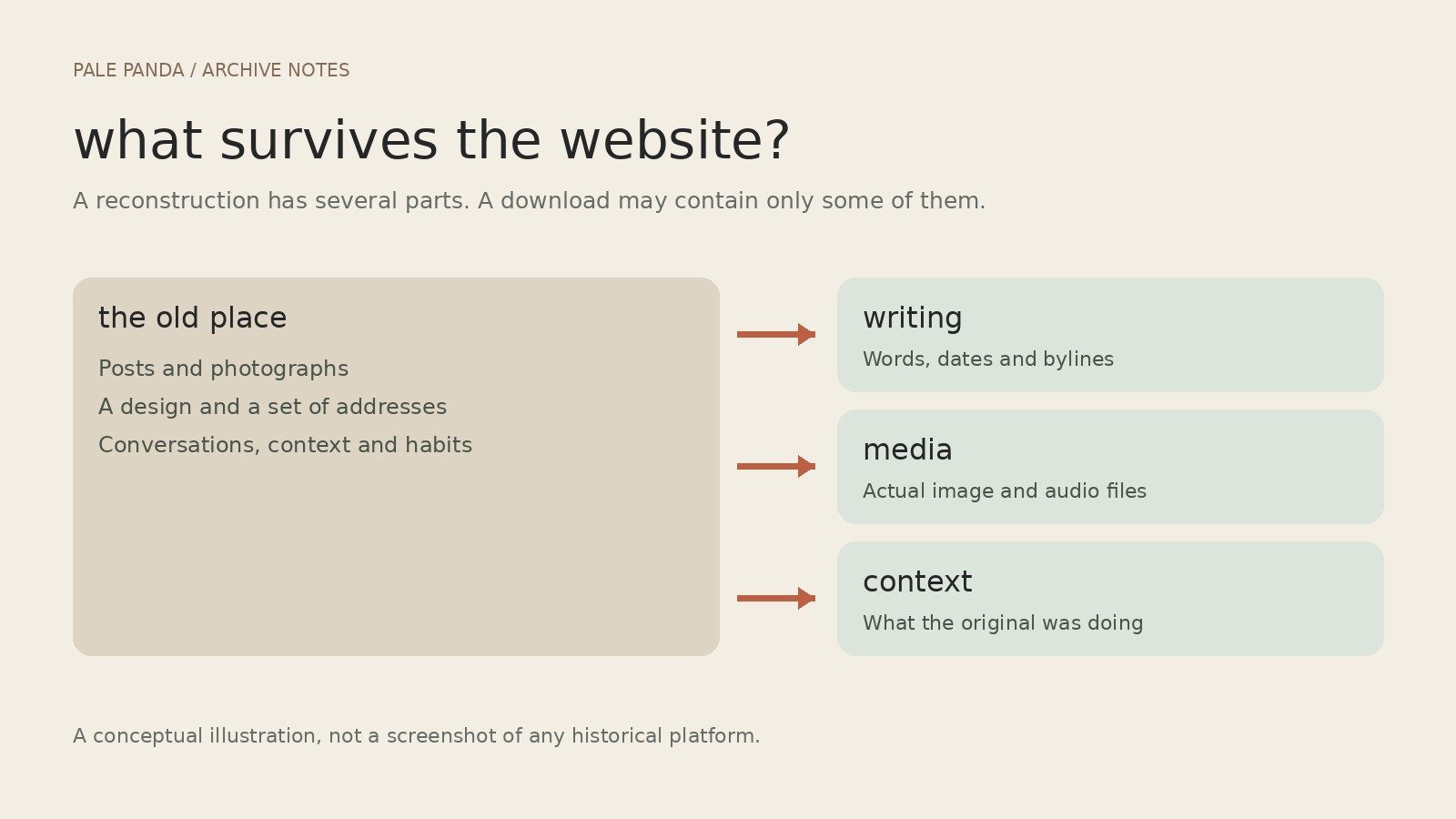
WordPress.com’s export documentation, checked in October 2026, gives a useful concrete example. Its content export contains posts, pages, comments and references to media. It does not contain the actual image files, the theme or design customizations. Images must be copied separately or fetched during the import while the source remains accessible. A successful download can therefore be one part of a recovery, rather than proof that everything is safe. The distinction is spelled out in WordPress.com’s export guide.
It is easy to understand how this gets missed. A file called an export feels reassuringly complete. Open it and the sentences are there. The photograph may be there only as an address. If the address stops working, the file has preserved a very precise description of where the photograph used to be.
The same problem applies to a post built around somebody else’s embedded video. Saving the surrounding paragraph does not put the video in a box with it. Links and embeds are useful connections, but they are also dependencies.

save the boring parts
A sensible archive keeps more than the prose: original media where you have the rights, publication dates, bylines, source addresses and enough notes to distinguish a missing file from something deliberately removed. Then someone has to open the recovered pages and check them. Particularly the pages with images. Particularly the page you assumed would be fine.
There is a limit to restoration. A download cannot reconstruct every conversation around a post, or make an old recommendation current. It should not quietly turn somebody’s 2009 opinion into their latest position, either. Dates are part of the writing.
That is a useful standard for bringing Pale Panda into this blog. Keep the authorship. Keep the historical context. Let a new essay be visibly new rather than sanding the year off the old one. Repair what can be repaired without pretending the original room is still there.
The underdogs roundup was looking for the next good place to put things. Its more durable question is what you can take with you when that place changes its mind.
sources & credits
Original writing: Andrew Schwegler, The Social Media Underdogs (Pale Panda, October 13, 2009; recovered post 2301) and Virb Gives Up On Trying to be Facebook (2010; recovered post 2309). Technical reference: WordPress.com, “Export your website’s content”, checked October 24, 2026. This is a new adaptation, not a verbatim restoration. Illustrations: original editorial diagrams prepared for tacobout; these are explanatory graphics, not historical website screenshots.


leave a reply