

A magazine cover has two jobs: tell you what is inside and make you pick it up. Physique Pictorial had another complication. What it showed and what it could comfortably say were not always the same thing.
Bob Mizer launched the magazine in 1951. His foundation’s account places it within the history of male physique imagery, using the respectable language of physical culture while making images for gay men. The Smithsonian holds the publication within its LGBTQ archival collections. It belongs in a design history as well as a history of desire: the pictures reached readers through an object someone had to edit, print, distribute and keep.

That object matters. An isolated photograph asks for one act of looking. A magazine arranges a sequence. Cover, image, caption, next image: the reader moves through a deliberately made field of attention. Scale and placement can make a body seem monumental, intimate, one of many, or the singular attraction on a page. None of those effects is produced by the model alone.
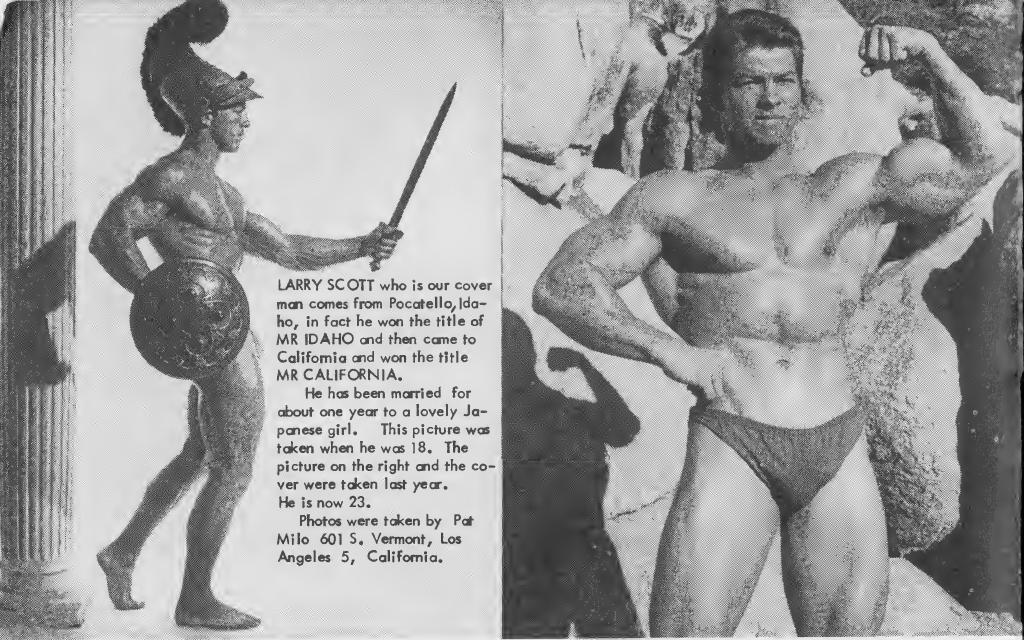
The July 1962 issue makes that arrangement concrete. On the cover, Larry Scott shares the page with a tilted masthead and very little other information. Inside, a full-page photograph of Richard Harrison has short biographical passages fitted around his body and the car behind him. The design gives the pictured man a name, a little narrative and a sequence of places in which to look.

The title does useful work before the first page turns. “Physique” supplies an explanatory framework: a body can be assessed, admired, studied. “Pictorial” promises pictures. The wording does not eliminate desire. It creates a public-facing container for it, with just enough institutional seriousness to suggest that the reader might be conducting research.
A magazine also makes looking repeatable. It can be bought, carried home, revisited and stored. This is different from an image that disappears into a feed after a second. Pages give the material an order and a boundary. You know when you have reached the end, even if you immediately turn back to the beginning for entirely scholarly reasons.
It would be easy to flatten that history into a congratulatory story about how primitive people managed before the internet. The more interesting question is what the printed form made possible. A publication could connect readers who never occupied the same room. It could create a recognizable aesthetic across successive issues. It could give pictures a context larger than a single encounter with a single body.
That does not make every image innocent or every historical choice beyond criticism. A visual ideal can be pleasurable and restrictive at once. Looking carefully includes asking who appears, who does not, what gets repeated and which kinds of masculinity become the default. Appreciation becomes more interesting when it can notice the frame rather than pretending the frame is invisible.
The Bob Mizer Museum and Photographic Archives relaunched Physique Pictorial in 2017. Its account of the project describes new photographers working in relation to the earlier visual tradition. The continuity is not simply that men remain photographable. It is that editing and presenting those images still shapes the kind of attention they receive.
A handsome body may sell the first glance. The design decides what happens after it.
sources
Bob Mizer Foundation: TIMELESS / history and relaunch. Background on the magazine’s history and 2017 relaunch.
Smithsonian National Museum of American History: Physique Pictorial archive item.
Image credits: Physique Pictorial, vol. 12 no. 1 (July 1962), cover and pp. 2–3. Larry Scott photographs by Pat Milo; Richard Harrison photograph credited to AMG in the issue. Scans via Internet Archive and Wikimedia Commons, which identifies this issue as public domain in the United States (published without a copyright notice). Featured image is a detail of page 2.


leave a reply