Telly on the microphone
ON THE AIR

Hot takes, wrestling rabbit holes, free-streaming deep dives & life on the open web. Welcome to taco ‘bout it—Schwegler’s corner for TV commentary, chaotic internet culture, and fediverse experiments.

  • 1
    the depression toad is not your pharmacist

    the depression toad is not your pharmacist

    a psychedelic nasal spray has promising depression-trial results. the best part is that the toad gets to stay out of it. Tune in & read →

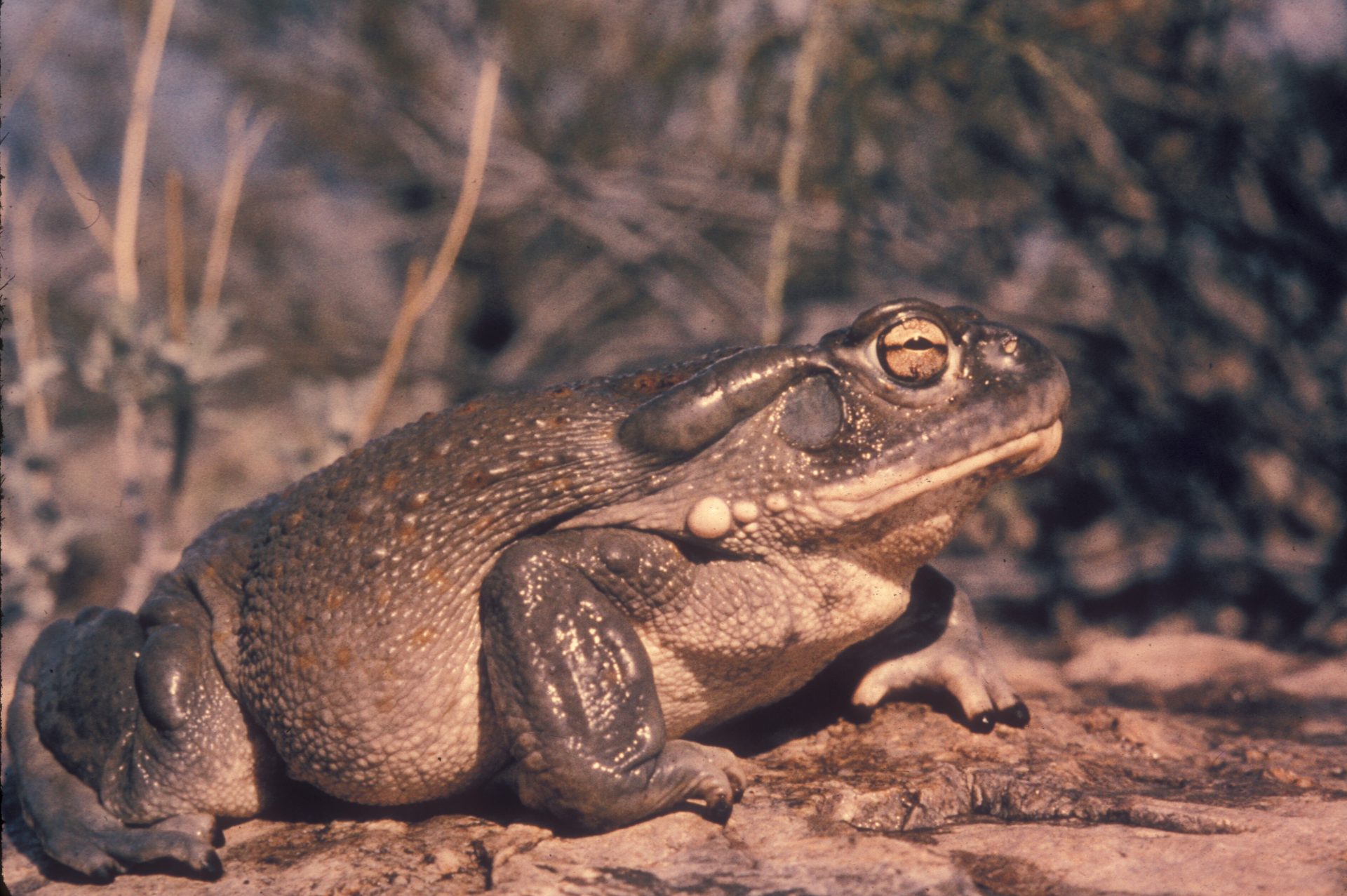
    somewhere in the Sonoran Desert, a toad has been informed that it may be the future of treating depression. the toad, which has no medical degree and was frankly busy sitting in the dirt, would like to be excluded from this narrative.

    a Popular Science story on a new psychedelic nasal spray is the sort of headline that makes me briefly believe the universe is running a very elaborate improv show. a toad-inspired antidepressant. administered through your nose. possibly effective after one dose. at some point the writers’ room needs to explain what genre we’re in.

    but buried underneath the amphibian comedy is actual good news, and a reason to be suspicious of the way we package it.

    first, no toads were employed in this trial

    the compound is called mebufotenin, or 5-MeO-DMT. it occurs naturally in the defensive secretions of the Sonoran Desert toad, but the drug tested here was made synthetically in a lab. nobody needed to go outside and squeeze an unwilling amphibian. this is both scientifically practical and, from the toad’s perspective, probably a major workplace improvement.

    in a randomized phase 2b trial published in JAMA on October 26, 193 adults with treatment-resistant depression received one of three nasal-spray doses under clinical supervision, with psychological support. everyone had already tried at least two antidepressant treatments without adequate relief. this was not an experiment involving people who felt a bit sad because the weather was bad.

    four weeks later, depression scores had fallen by an average of 11.1 points in the 12-milligram group, compared with 5.5 points in the tiny-dose comparison group, on a 60-point clinical scale. the adjusted difference was 5.3 points. the smaller 8-milligram group actually saw a 12.5-point average drop. benefits over the comparator were still detectable at the end of eight weeks.

    that is genuinely promising. it is not the same thing as proving one nose-squirt cures depression forever. the comparison group also received a very low dose of the drug, not a completely inert placebo, and the researchers have not established what happens after eight weeks.

    Close-up of a woman using a generic nasal spray; this is an illustrative image, not the experimental drug.

    finally, a psychedelic that respects your calendar

    one reason psychedelic therapy is difficult to scale is that a treatment session can commandeer your day. somebody has to supervise the experience, somebody has to make sure you’re safe afterward, and somebody has to pay for all of that time. the fantasy that every struggling person can take an entire workday to have a medically supervised revelation is very beautiful. it is also extremely American in the sense that nobody has explained who is covering their shift.

    with this drug, most participants receiving the two active doses were judged ready for discharge within two hours. important footnote: the trial protocol still kept people at the clinic for at least four hours. ready to leave is not the same thing as actually being sent home. even so, a shorter psychedelic experience could eventually make treatment easier to provide than longer sessions with other psychedelics.

    and here’s the thing: depression treatment does not have to be spiritually picturesque to count. i do not require a rebirth, a vision quest, or an encounter with my inner child wearing a tiny hat. i want treatments that work, evidence that survives scrutiny, and clinics people can actually get to.

    the toad would prefer the synthetic version

    the Sonoran Desert toad uses its secretions to defend itself. people seeking the psychedelic have collected or harassed the animals, adding pressure to wild populations. UC Berkeley’s Center for the Science of Psychedelics describes the animal-welfare and conservation concerns around collecting those secretions.

    a 2026 ecological and historical analysis goes further: it questions marketing that portrays contemporary toad-secretion ceremonies as an uninterrupted ancient tradition, and argues that laboratory-made 5-MeO-DMT can eliminate the need to disturb living toads. you can respect Indigenous communities and traditions without accepting every modern wellness entrepreneur’s origin story at face value.

    The chemical structure of 5-MeO-DMT, shown as a black molecular diagram.

    i like that the molecule can be drawn on a piece of paper and manufactured without involving its original, deeply unenthusiastic spokesperson. science is allowed to take inspiration from nature without turning nature into a retail supply chain.

    please do the part where we prove it works

    this was a relatively small, company-funded trial, with the sponsor involved in study design and analysis. people and clinicians could often guess who had received a psychedelic dose, which complicates blinding. some participants stopped existing antidepressants to enter the study. and the adverse effects weren’t imaginary: headache, nausea, nasal discomfort, transient blood-pressure increases, anxiety, and, in one participant receiving the highest dose, severe panic attacks were reported. these are reasons for careful trials and oversight, not for getting creative with the wildlife.

    larger phase 3 trials need to test safety, durability, and whether these results hold up in a broader population. this nasal spray is experimental, not an approved at-home depression treatment. and if it does eventually work, access and affordability will matter at least as much as the very cool animal anecdote in the press release.

    because i would love for this to become another real option for people who haven’t gotten relief from existing treatments. i would love even more for it to become an option they can afford. the breakthroughs that matter are the ones that make it out of a journal, through an actual care system, and into people’s lives.

    meanwhile, please leave the toad alone. he has already contributed enough.


    sources: the clinical trial in JAMA; Popular Science’s reporting; UC Berkeley’s 5-MeO-DMT background; and the 2026 conservation analysis.

    image credits: featured Sonoran Desert toad photograph by Saguaro National Park Service (U.S. public domain); illustrative nasal-spray photograph by NIAID (CC BY 2.0; it does not show the experimental drug); 5-MeO-DMT structure by Nynyny (public domain).


    Fediverse reactions
  • 1
    the space station got roommates and a hot-water dispenser

    the space station got roommates and a hot-water dispenser

    November 2: the space station welcomes its first resident crew, the Morris worm overwhelms early internet computers, and an octopus puts three… Tune in & read →

    a few things worth knowing · monday, november 2, 2026

    Two November 2 anniversaries: moving into an orbiting laboratory, and discovering that a network can have a very bad evening. Then an octopus contributes some unusually thorough plumbing.

    today in history: the space station got roommates

    On November 2, 2000, NASA astronaut Bill Shepherd and Russian cosmonauts Yuri Gidzenko and Sergei Krikalev arrived at the International Space Station as its first resident crew. Twenty-six years ago today, Expedition 1 began turning a construction project in orbit into a working home.

    The early to-do list included activating the hot-water dispenser and the toilet. Oxygen generation and carbon-dioxide removal followed over the next few days. Even a historic arrival needs someone to sort out the utilities. NASA’s account of the crew’s arrival.

    The featured photograph shows the station on December 2, 2000, a month into that first expedition. It was taken from shuttle Endeavour during its approach, before the station grew into the sprawling structure familiar from later photographs. NASA’s image record.

    today in history: the network had a very bad evening

    On November 2, 1988, the program now known as the Morris worm began spreading from a computer at MIT. It overwhelmed vulnerable computers on the early internet. The FBI estimates that about 6,000 of the roughly 60,000 connected machines were affected within 24 hours.

    The worm did not need to destroy files to cause trouble. Systems slowed, mail was delayed, and some institutions disconnected from the network. All of this happened before the World Wide Web. The internet had already developed a troubleshooting backlog. The FBI’s history of the Morris worm.

    one evergreen detour: the octopus has assigned each heart a job

    Close view of a pale purple octopus on the seafloor near Shallop Canyon, with curled arms and rows of suckers visible.

    This one has no November 2 anniversary attached. An octopus has three hearts: two push blood through the gills, while the third circulates oxygenated blood around the body.

    Its oxygen-carrying protein, hemocyanin, contains copper rather than the iron in our hemoglobin, giving the blood its blue color. Three hearts and eight arms is quite a lot of equipment for an animal that can still look mildly inconvenienced by a camera. Smithsonian Ocean’s explanation of cephalopod circulation.

    Image credits: International Space Station, photographed December 2, 2000, NASA; used editorially under NASA’s media guidelines. Octopus near Shallop Canyon, NOAA, via U.S. Fish & Wildlife Service, public domain. Images shown at reduced display size without creative alteration. No claim to original U.S. Government works.

    Fediverse reactions
  • 1
    godzilla clocks in; druski passes the collection plate

    godzilla clocks in; druski passes the collection plate

    Godzilla’s PS5 remaster arrives November 3, Derelikt sets a November 13 date, and Druski’s Netflix comedy gets a December premiere. Tune in & read →

    Tuesday, November 3, 2026 · morning briefing

    Godzilla has a character-select screen, a space station has a staffing problem, and Druski’s pastor has acquired a streaming deal. Three new announcements worth a look.

    godzilla clocks in for demolition

    Godzilla: Destroy All Monsters Melee Remastered is due on PS5 today, November 3, according to PlayStation’s November 2 fighter guide. The roster has 12 kaiju, and the guide is a useful way to choose a starting monster: Heisei Godzilla offers balanced stats, Rodan favors speed at the expense of defense, and King Ghidorah keeps opponents at a distance. A familiar face is a perfectly respectable first pick, especially when that face can level a building.

    the space station has failed its vibe check

    Derelikt arrives on PS5 November 13. Creator Philipp Jensen’s new announcement describes a sci-fi horror game built around a missing excavation crew, an asteroid outpost and survivors whose accounts do not agree. Its hand-painted textures and deliberately unstable-looking geometry aim for late-PlayStation atmosphere, while exploration, resource management and puzzles share the workload with gunplay. The announcement includes a trailer and screenshots; expect horror imagery. Apparently the haunted workplace has survived several console generations.

    druski passes the collection plate to netflix

    Netflix has announced a multiyear partnership with Druski, starting with Collect & Praise on December 1. The semi-scripted comedy expands his megachurch pastor character into a series. Netflix will also license selected existing work, including Coulda Been Love and Coulda Been Records Auditions. This is a new home and a firm premiere date for the character, rather than an invitation to hunt through unrelated sketches for the next installment.

    Sources: PlayStation Blog’s November 2 announcements and Netflix Tudum’s November 2 partnership announcement, linked above. Release dates are the publishers’ announced dates. No episode outcomes or wrestling results are included.

    Fediverse reactions
  • 1
    a social network of five is still a social network

    a social network of five is still a social network

    A new essay revisiting Andrew Schwegler’s “A Social Network of 5,” published on Pale Panda on May 25, 2012. Five people is… Tune in & read →

    A new essay revisiting Andrew Schwegler’s “A Social Network of 5,” published on Pale Panda on May 25, 2012.

    Five people is a terrible number if you are selling a social network. It is a perfectly respectable number if you want to have a conversation.

    That was the useful part of Pale Panda’s 2012 defense of Google+. The service did not need to contain everybody. It needed to contain a few interesting people, some worthwhile links, and a way to stop the rest of the room from interrupting. The original piece called this a better signal-to-noise ratio. A less technical description would be: a website that occasionally knew when to shut up.

    The old post’s follow recommendations belong to their moment. The underlying question travels rather well. How many people does a social network actually need before it becomes useful to the person using it?

    the room and the stadium

    A public network and a small conversation solve different problems. A public network can help a person find work, circulate an investigation, locate an audience, or discover something outside their existing circle. Reach matters for those things. Pretending it never matters is its own kind of smugness.

    But reach becomes a strange standard for judging every interaction. A joke between friends does not improve because strangers can grade it. A recommendation does not become more useful because ten thousand people have already repeated it. Sometimes the interesting part is knowing which person recommended the thing, and knowing what their terrible taste in other things tells you.

    The 2012 essay described a mix: public posts and news sources alongside smaller circles organized by relationship or subject. Its appeal was not total retreat. It was being able to change the size of the room without leaving the building.

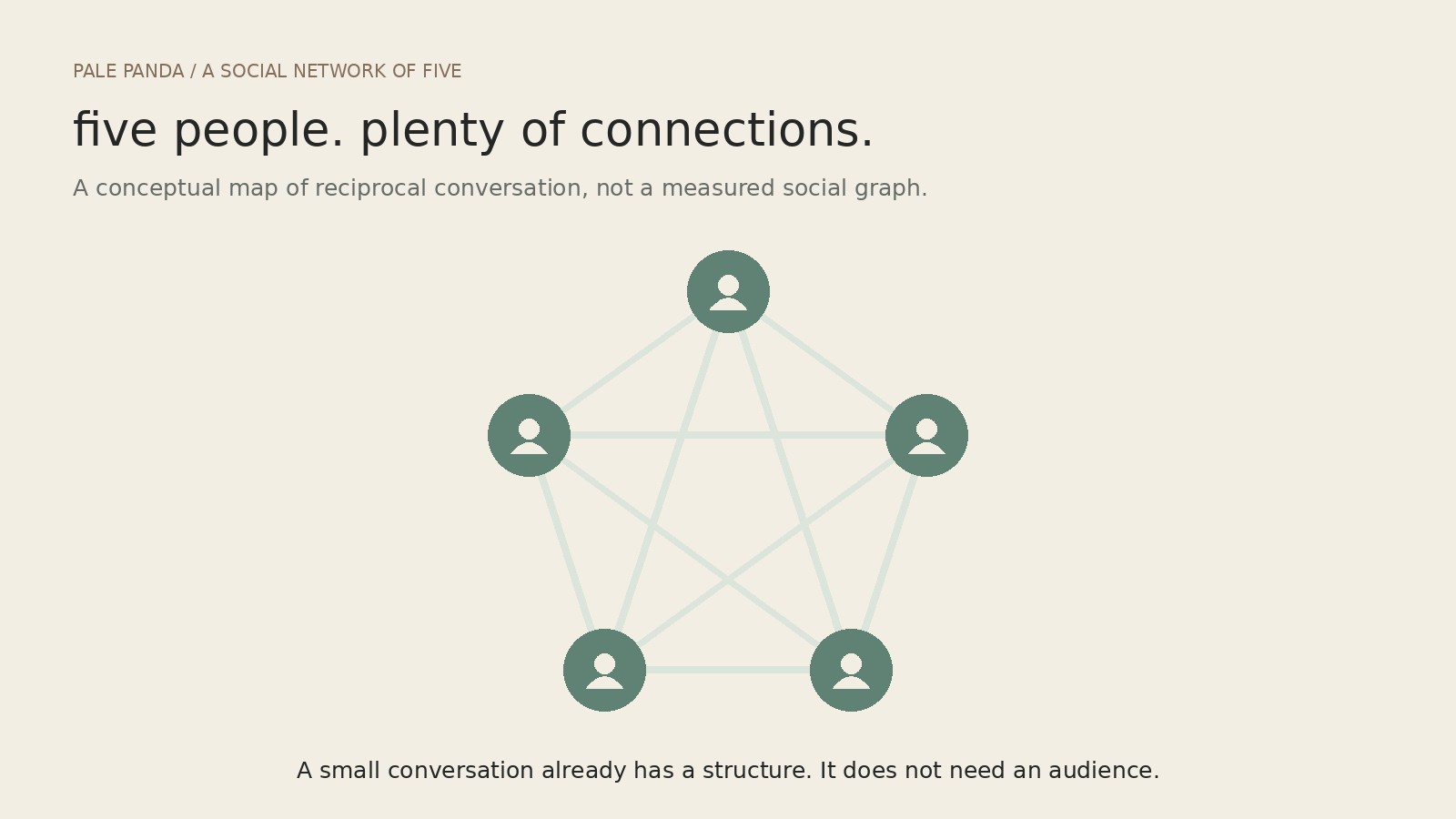
    A small room with reciprocal connections beside a stadium with a central broadcaster and a larger audience.

    small can still be annoying

    There is no automatic virtue in a tiny group. Five people can be exhausting. A private conversation can become a little court with its own rules, grudges, and compulsory opinions. Familiarity makes context easier; it does not make everybody thoughtful.

    So the useful distinction is not simply big versus small. It is whether the space leaves room for ordinary participation. Can someone post a link without turning it into a performance? Can a conversation end? Can a person disappear for a few days without returning to an administrative task disguised as friendship?

    Those are modest expectations. They also make a better checklist than asking which service is winning.

    the business has other questions

    Of course, a pleasant corner of a website does not guarantee a viable website. Google’s own 2018 shutdown announcement cited limited consumer adoption and the challenges of maintaining the product. In December it moved the planned consumer shutdown to April 2019. A useful small circle and a successful mass-market product were different measurements.

    This is the tension the old post accidentally preserved. The person using the service wanted a manageable feed. The company needed a reason to keep operating it. Neither requirement disappears because the other one is inconvenient.

    That is a reason to keep contact information and copies of anything important outside a single platform. It is also a reason to stop treating a service’s size as a complete review of its social value.

    Google+ wordmark and interlocking colored circles from the original 2012 article.

    five is allowed to be enough

    A good small network does not have to become the next anything. It can be a group that sends each other songs. A few people who know a lot about an obscure subject. Friends whose updates are worth reading even when nothing particularly marketable has happened to them.

    The original essay was enthusiastic about a specific product. The durable idea is less glamorous: a social space should be judged partly by the conversations it makes possible, and partly by the noise it lets people avoid.

    Five people talking to each other is already a social network. It does not need a growth strategy to count.

    archive and sources

    Original: Andrew Schwegler, “A Social Network of 5”, May 25, 2012, recovered from the author’s WordPress export. This adaptation retains the original premise rather than presenting its old platform recommendations as current advice. Historical context checked October 24, 2026.

    image credits

    Original editorial diagrams prepared for tacobout: a five-person conversation network and the room and the stadium. These are conceptual illustrations, not historical screenshots or measured data. Google+ wordmark and circles: Google branding, restored from the image accompanying the original 2012 article, reproduced here to identify the historical service. No affiliation or endorsement is implied.

    Fediverse reactions
  • 3
    hockney, weekend and a party worth remembering

    hockney, weekend and a party worth remembering

    David Hockney: a splash without a swimmer Start with David Hockney’s A Bigger Splash. His foundation’s 1967 chronology places the painting alongside… Tune in & read →

    David Hockney: a splash without a swimmer

    Start with David Hockney’s A Bigger Splash. His foundation’s 1967 chronology places the painting alongside his continuing experiments with water, light and reflection. The absent swimmer is a useful prompt: desire can be suggested by a trace rather than a body placed in the middle of the frame. A pool, a disturbance, somebody just out of sight. Not every invitation needs to introduce itself.

    David Hockney’s A Bigger Splash: a white splash breaks a blue swimming pool beside a diving board and a modern house.

    Explore Hockney’s 1967 work.

    Weekend

    A one-night stand is often an ending, a joke or a complication. Andrew Haigh’s Weekend uses it as the beginning of a conversation.

    The 2011 film follows Russell and Glen, played by Tom Cullen and Chris New, through a brief encounter that extends across a weekend. Its scale is small enough to make the question of what comes next feel very large.

    That is the reason to put it on an after-dark list. Not because a hookup needs romance to become respectable, but because physical intimacy and emotional disclosure do not necessarily arrive in the same order. A stranger can know one part of you before he knows anything else.

    The useful thing to notice is what the premise refuses to rush past: the time after attraction has done its opening work. What can two people ask each other? Which version of themselves do they offer? How much can be said before the available time runs out?

    Criterion’s edition includes a conversation with Haigh specifically about the sex scenes, giving the curious viewer somewhere to take that discussion beyond the film. No grand claim about the definitive gay experience is necessary. Two men and a short stretch of time are plenty.

    Criterion’s Weekend cover shows two men resting together in bed beneath the film’s title.

    Explore Weekend at Criterion. Adult themes; this is an evergreen film pick, not a claim of free streaming access.

    From my media collectionWeekend (2011)Director: Andrew Haigh • Genre: Drama, Romance • Year: 2011Andrew Haigh’s film on Trove.View on Trove

    Pet Shop Boys: Being Boring

    Finish with Being Boring. The band’s own site points to the corrected HD version of its official video, replacing an American edit that had been uploaded by mistake. That is a good reason to follow the artist’s link rather than whichever reupload turns up first. Pair it with Weekend as an invitation to think about time spent with other people, not a demand to produce a life lesson before the music ends.

    Watch through the official Pet Shop Boys page.

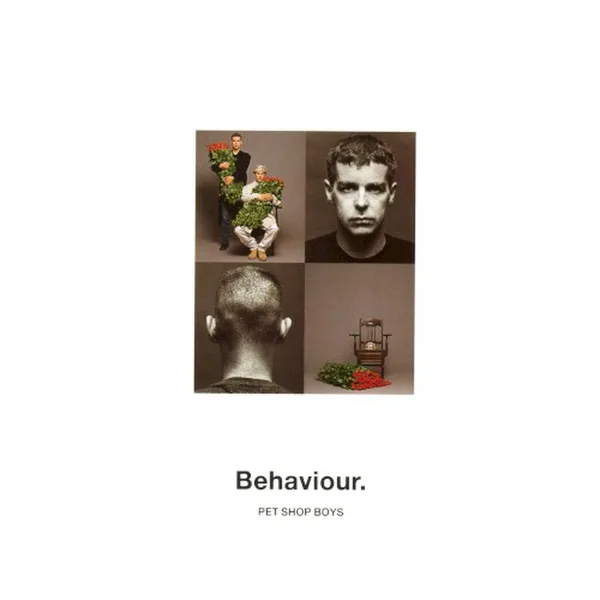
    From my media collectionPet Shop Boys — Behaviour (1990)Artist: Pet Shop Boys • Year: 1990The original album featuring Being Boring.View on Trove

    Image credits: David Hockney, A Bigger Splash, 1967, Tate, via The David Hockney Foundation; © David Hockney. Weekend still and edition cover by Jason Hardy via The Criterion Collection. Limited contextual images of the works discussed; no endorsement implied.

    Fediverse reactions
  • real hero shit: the party hired a nepo baby

    real hero shit: the party hired a nepo baby

    Kendra Wells sends a pampered prince on a missing-persons quest. The party needs a fighter; human resources needs a word. Tune in & read →

    Affiliate note: As an Amazon Associate I earn from qualifying purchases.

    The party needs a fighter. Unfortunately, the applicant is a prince. Apparently even fantasy adventuring has a nepotism problem.

    Kendra Wells’s Real Hero Shit puts Michel, Ani and Hocus on a missing-persons job in a mountain town, then adds Prince Eugene: purple, pampered, and not exactly built for a discreet investigation. The local guards are being obstructed. Eugene would mostly like something interesting to do. These are not equivalent stakes.

    A preview comic page shows Prince Eugene greeting townspeople and introducing himself to Michel and the adventuring party.

    That mismatch is the useful hook here. This is queer fantasy comedy with an actual problem underneath the party friction: a prince discovering that the world’s protective padding was installed specifically for him. There are swords and flirting, but the royal field trip also comes with a question about who gets protected when people disappear.

    This is Book 1, a 120-page graphic novel from Iron Circus, not a giant lore assignment. A manageable place to start if your preferred adventuring party is less solemn fellowship, more personnel issue.

    Real Hero Shit, Book 1

    Kendra Wells · Iron Circus Comics · 120-page softcover · ISBN 9781945820830.

    A compact first adventure for readers who prefer their party with a personnel problem.

    Book details and premise: Iron Circus Comics.

    Illustration © Kendra Wells. Creator’s website.

    Preview page: © Kendra Wells / Iron Circus Comics, via Iron Circus Comics’ official Book 1 preview. Resized for display; no crop.

  • 5
    the original pride flag made room for sex

    the original pride flag made room for sex

    The original eight-stripe Pride flag included pink for sex. Its material history is more interesting than a corporate rainbow. Tune in & read →

    gay by design · no. 1

    The original rainbow Pride flag had eight stripes. Pink stood for sex. That seems worth remembering whenever the rainbow gets treated as a particularly cheerful corporate filing system.

    Eight horizontal rainbow stripes, including pink at the top and turquoise above blue.

    The GLBT Historical Society’s exhibition on Gilbert Baker preserves the practical history behind the symbol. The flags made for San Francisco’s 1978 Gay Freedom Day celebrations were handmade, collective undertakings. The archive credits collaborators as well as Baker, including Lynn Segerblom’s distinctive hybrid of rainbow and American-flag designs. This was not a logo that arrived fully formed in a conference room.

    The eight-stripe design assigned meanings across the spectrum: sex, life, healing, sunlight, nature, art and magic, serenity, and spirit. Pink and turquoise subsequently disappeared amid production and display considerations. The familiar six-stripe version is therefore also a story about making and using an object, not simply refining a mood board.

    The familiar six-stripe rainbow flag: red, orange, yellow, green, blue and violet.

    That is what makes the flag a satisfying piece of design. It has to survive outside the drawing. Fabric must be sourced, dyed, cut, sewn, carried and seen at a distance. It must remain legible when the wind folds half of it away. The physical demands are not an unfortunate interruption of the concept. They are where the concept becomes public.

    The horizontal bands give it unusual flexibility. There is no face to reproduce badly, no small lettering to disappear across a street, no elaborate emblem demanding a specialist printer. A child’s drawing and an enormous sewn banner can remain recognizably related without being identical objects. The design can move between scales and materials without losing its central gesture.

    Its usefulness also comes from what it does not insist on specifying. A flag can announce presence before it explains a position. That is different from a policy document, and it is not a defect. In a crowd, on a balcony or in a shop window, the first message is often simply that someone is here and willing to be seen.

    The original pink stripe keeps the history from becoming too antiseptic. Queer identity is not only a suitable sentiment for an annual brand calendar. Desire belongs in the picture. Remembering that does not require pretending one stripe could capture everybody’s relationship to sex. It means refusing to tidy the actual design history into something more comfortable for a sponsor.

    Baker’s own account connects the flag to community, liberation and the possibilities of a shared symbol. The object has since acquired many uses its makers could not control. That is the strange success of public design: people take it somewhere else.

    Looking back at the eight-color version is not a demand to choose one flag forever. It is a reminder that these objects have makers, materials and arguments inside them. The rainbow did not begin as a decorative background. People had to sew it, raise it and stand underneath it.

    Pink was not there by accident.

    sources

    GLBT Historical Society: Gilbert Baker online exhibition.

    Gilbert Baker Foundation: Rainbow Flag origin story.

    National Archives: Gilbert Baker and the Rainbow Flag.

    Image credits: Photograph: Ludovic Bertron, Rainbow flag and blue skies, CC BY 2.0. Eight-stripe flag: Gilbert Baker design, vector by Fibonacci, public domain. Six-stripe flag: Guanaco and subsequent Wikimedia Commons editors, unrestricted reuse. Designs shown as distinct historical versions, not archival photographs.

    Fediverse reactions
  • 1
    drawing spirited away, one impossible room at a time

    drawing spirited away, one impossible room at a time

    The Art of Spirited Away offers production drawings, designs, and a different question: how did anyone decide this should look like that? Tune in & read →

    As an Amazon Associate I earn from qualifying purchases.

    An art book is a useful way to spend more time with a movie without asking it to become a franchise. No sequel announcement required. Just let somebody explain how the rooms got there.

    The Art of Spirited Away is the production-art option: VIZ’s 240-page hardcover gathers paintings, designs, sketches, storyboards, commentary and a complete English-language script. It is a book about the film’s visual construction, rather than another adaptation to follow through the same plot.

    That distinction is the reason to consider it. A finished animated scene makes hundreds of design decisions look inevitable. A room has a particular shape, a character occupies it a particular way, and somehow the whole thing feels like a place that existed before the camera arrived. Looking at the preparatory work changes the question from “what happens next?” to “how did anyone decide this should look like that?”

    Chihiro and her parents stand on a deserted street lined with colorful, ornate buildings in Spirited Away.

    The finished film gives those rooms and streets a life of their own. The book goes back to the drawings that built them.

    Hayao Miyazaki at the 2008 Venice Film Festival.

    VIZ has a preview and edition details. Try that first. Choose this for an interest in drawing, environments or filmmaking; skip it if what you want is a new story. The book includes the script, so it is better saved until after the film if you want to avoid plot details.

    The linked edition is the English-language Studio Ghibli Library hardcover, ISBN 9781569317778. Check that number rather than treating every cover with Chihiro on it as the same book. Apparently even a trip to a spirit bathhouse benefits from checking the paperwork.

    The Art of Spirited Away

    English-language Studio Ghibli Library hardcover · VIZ · 240 pages · ISBN 9781569317778.

    For the drawings, environments and decisions behind the finished film.

    For the finished film, here is GKIDS’ official trailer. Spirited Away on Trove keeps the film alongside the rest of the collection.

    Image credits: featured photograph, Ghibli Museum exterior, lumoplank, CC0; Hayao Miyazaki at the 2008 Venice Film Festival, Thomas Schulz, CC BY-SA 2.0. Images resized for display; no other changes. The museum is contextual photography, not a location depicted in the book or film; the portrait is editorial, not an endorsement.

    Additional image: Spirited Away film still, © 2001 Hayao Miyazaki/Studio Ghibli, NDDTM, via Studio Ghibli’s official still gallery. This is a finished-film image, not a page from the book. Resized for display; no crop.

    Fediverse reactions
  • 2
    lestat dresses like subtlety owes him money

    lestat dresses like subtlety owes him money

    Lestat does not dress to blend in. The red velvet and wolf fur are doing precisely the opposite job. In AMC’s season-two… Tune in & read →

    Lestat does not dress to blend in. The red velvet and wolf fur are doing precisely the opposite job.

    In AMC’s season-two interview, Sam Reid connects those extravagant clothes to Lestat’s refusal to hide. The same instinct drives his theatricality: being looked at is not an unfortunate side effect of immortality. It is part of the attraction.

    That makes the wardrobe more interesting than a collection of expensive vampire outfits. It turns confidence into a visible surface. Before Lestat explains himself, his clothes have already announced that his presence deserves an audience. A quieter man might bring flowers. This one brings production values.

    Costume designer Carol Cutshall gives the elegance a more precise lineage. In her AMC interview about season one, she describes Lestat’s modern suits as retaining a restrictive, almost corseted fit. She also identifies J. C. Leyendecker’s menswear illustrations as a reference for Louis and Lestat’s early coordinated looks.

    Lestat wears a dark pinstripe suit over a striped shirt and patterned tie.

    That is a more revealing design idea than simply putting beautiful actors in beautiful clothes. A close fit can make the body seem controlled even when the personality is not. Coordinated outfits can present a couple as a composed unit before the relationship has earned that apparent stability. The wardrobe offers an attractive picture of order; the drama can then pull it apart.

    The publicity stills offer a useful close look at the tailoring: Lestat’s dark pinstripes and layered shirt-and-tie combination keep the torso formally contained; Louis’s lighter pinstripe suit and crisp rounded collar produce a related, but not identical, outline. Even seated in a waistcoat, Lestat looks arranged rather than relaxed. The clothes keep performing composure while the characters do anything but.

    Jacob Anderson as Louis wears a gray pinstripe suit, white rounded collar and patterned tie.

    The useful distinction is between charisma and kindness. Costume can make a fictional monster magnetic without making his behavior defensible. In fact, the gap is the point: the more persuasive the presentation, the easier it is to see how desire and judgment can travel in opposite directions.

    For a costume-minded look at Interview with the Vampire, follow the fabric before the fangs. Red velvet promises warmth. The man wearing it is another matter.

    Read Sam Reid’s AMC interview (season-two spoilers).

    Image credits: Interview with the Vampire publicity stills via AMC and its Carol Cutshall costume interview. Limited visual excerpts for costume criticism; original image credits preserved.

    Fediverse reactions