

Spoilers for episodes 5 and 6 at the link. Sam Barsanti reviews “Firewall” and “Deadlock” at The A.V. Club.
(more…)
A.V. Club’s episode 5–6 review asks whether VisionQuest’s conversations are moving the story forward. Spoilers at the source. Read more
Spoilers for episodes 5 and 6 at the link. Sam Barsanti reviews “Firewall” and “Deadlock” at The A.V. Club.
(more…)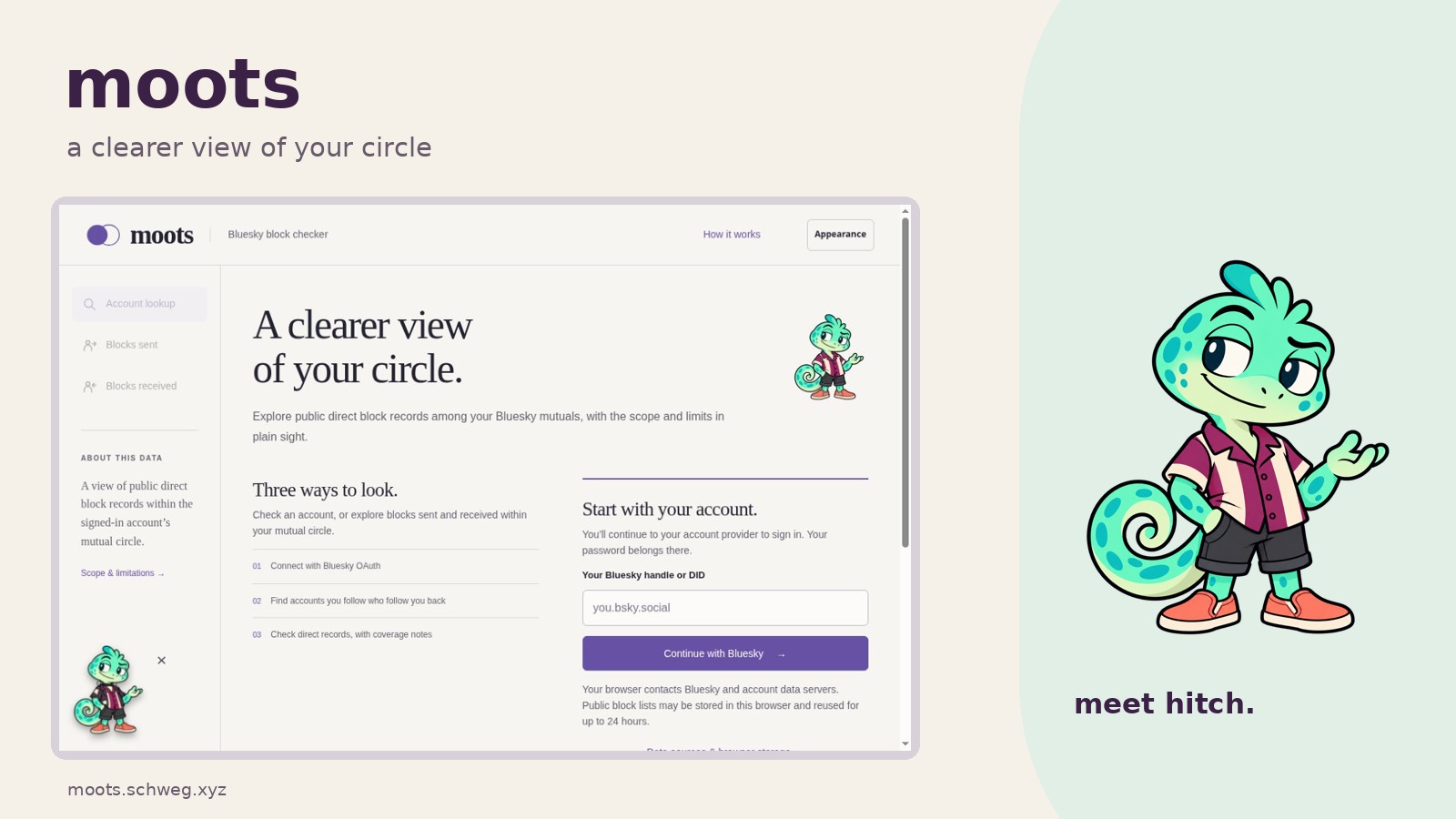
moots has a little mint gecko now. meet hitch, then take a practical look at account lookup, blocks sent and received, and… Read more
moots has a little gecko now. his name is hitch. he’s mint green, wears a plum-and-cream shirt, and has apparently decided that coral slip-ons are appropriate footwear for looking through public records.
he’s the new face of moots, my Bluesky block checker. this seems like a good excuse to explain what the tool actually does. the gecko will be supervising.
moots starts with the account you sign in with. your circle is the people you follow who follow you back. every view uses that circle, including when you look up somebody else.
the tool reads public direct block records and lets you look at them three ways: which of your mutuals have a record blocking a particular account, which mutuals have sent blocks to others in your circle, and which have received them from others in that circle. those last two views stay inside your circle. nobody has been appointed commissioner of all of Bluesky.
open moots.schweg.xyz, enter your full Bluesky handle, and choose Continue with Bluesky. a DID, the account’s persistent identifier, works too. most people can stick with their handle.

you’ll continue to your account provider to sign in through OAuth. read the authorization screen before approving it. your password goes to your provider; moots doesn’t ask you to make an app password. the current OAuth setup uses the transitional atproto transition:generic scope; review the permissions your provider shows before continuing.

Account lookup: enter the handle or DID of the account you want to check, then choose Check account. a matching row means someone in your mutual circle has a public direct block record naming that account. the direction is your mutual → the account you entered. entering somebody else’s handle doesn’t switch the scan to their mutuals.
Blocks sent: choose Scan blocks sent to see which accounts in your circle have direct block records naming other accounts in that same circle. open a row to see the accounts on the receiving end.
Blocks received: choose Scan blocks received to look in the other direction. a row’s count is how many other members of your circle have direct block records naming that account. open its details to see who those records came from.
the sent and received views sort by observed count. you can filter the results or change the sort. a bigger number still only describes the records found within this particular circle.

the results show how many mutuals were fully checked, how many were incomplete, and how many block lists came from the browser’s cache. a server can time out or hit a rate limit. an incomplete scan can miss matches, and counts may be lower than the full picture.
use Retry incomplete to try the unfinished accounts again, or Refresh circle & records to request a fresh circle and fresh records. cached lists can be reused for up to 24 hours; the results flag them and show the oldest cached list’s fetch time.
“nothing found” means nothing matched in the records available for that snapshot. list-based blocks and mutes are outside the scan. records can also change after you check.
the analysis happens in your browser, which contacts Bluesky, identity services, and the servers holding account data. those services may log requests. moots can’t promise an anonymous lookup.
successful block lists are stored in the browser and remain until overwritten or cleared, even after their 24-hour reuse window ends. the mutual-circle cache is reused for up to 15 minutes. signing out clears that circle cache, but leaves the stored block lists.
to remove cached scan data, open Data sources & browser storage or Scope & limitations and choose Clear cached scan data. clearing it leaves your OAuth session unchanged, so use Sign out separately when you’re finished.

a block record doesn’t tell you why it exists. it doesn’t establish a block in the reverse direction, explain a relationship, or give you a reason to hassle somebody. people get to set boundaries without providing a footnote.
moots is an independent tool, unaffiliated with Bluesky. if you want to look under the hood, the source is on GitHub. otherwise, start here. hitch is already dressed.
The VisionQuest cast discusses humanity, grief and connection. Spoilers through episode 4 in the linked interview. Read more
Spoilers through episode 4 in the linked interview. Read Katie Campione’s October 23 cast interview at Deadline.
(more…)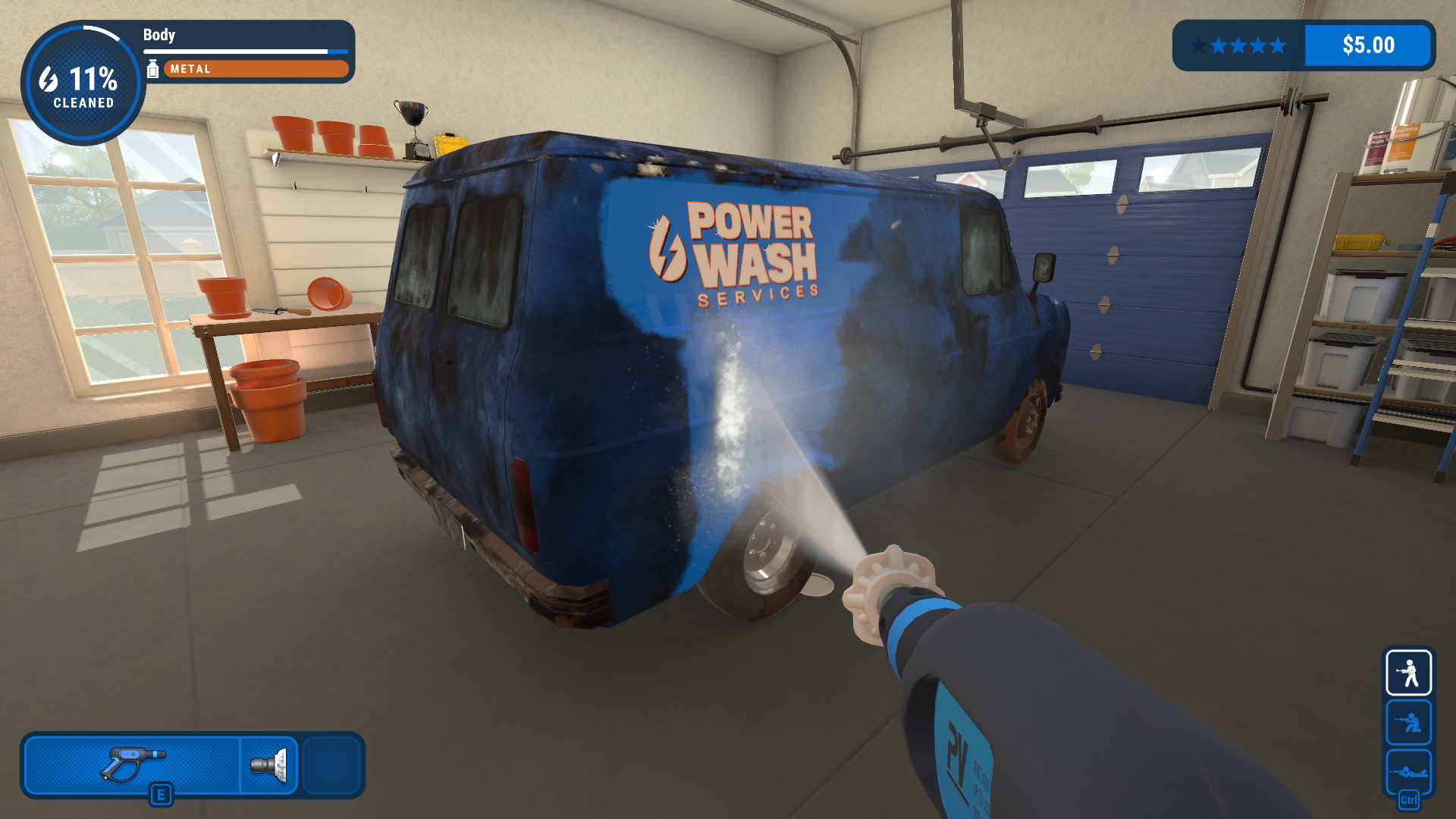
the dirt comes off, the game acknowledges your contribution, and nobody walks in holding a bowl of cereal. chore games have an… Read more

the least realistic thing in a game about cleaning is that the job can be finished. the dirt comes off, the game acknowledges your contribution, and nobody walks into the room holding a bowl of cereal. an extraordinary piece of speculative fiction.
the joke about chore games is usually that somebody has paid money to do imaginary work. fair. the yard-work simulator situation remains very funny. but the more interesting part is the contract. these games can tell you what needs doing, show you that it is getting done, and agree on a point at which you may leave. actual housework has historically been evasive about all three.
 From my media collectionPowerWash SimulatorDeveloper: FuturLab • Publisher: FuturLab • Platform: windows • Year: 2022View on Trove
look at the featured PowerWash Simulator screenshot. the blue van is partly filthy, partly blue, and the display says eleven percent cleaned. there is even a separate bar for the body of the vehicle. the evidence of effort is sitting right next to the effort. you do not have to remember what it looked like before, explain how much you did, or defend the decision to start with that particular patch.
the game’s store description explicitly offers cleaning without time pressure or a final score, alongside separate challenge modes for anyone who wants those constraints. that distinction matters. the basic appeal can survive without a supervisor. the van has a problem; you have a hose; this relationship has excellent communication.
a real clean surface is mostly an absence. nothing happened here today, visually speaking, because somebody made sure nothing remained. a game can turn that invisible maintenance into a visible event. every newly blue strip of van is a tiny before-and-after photograph that you are operating.
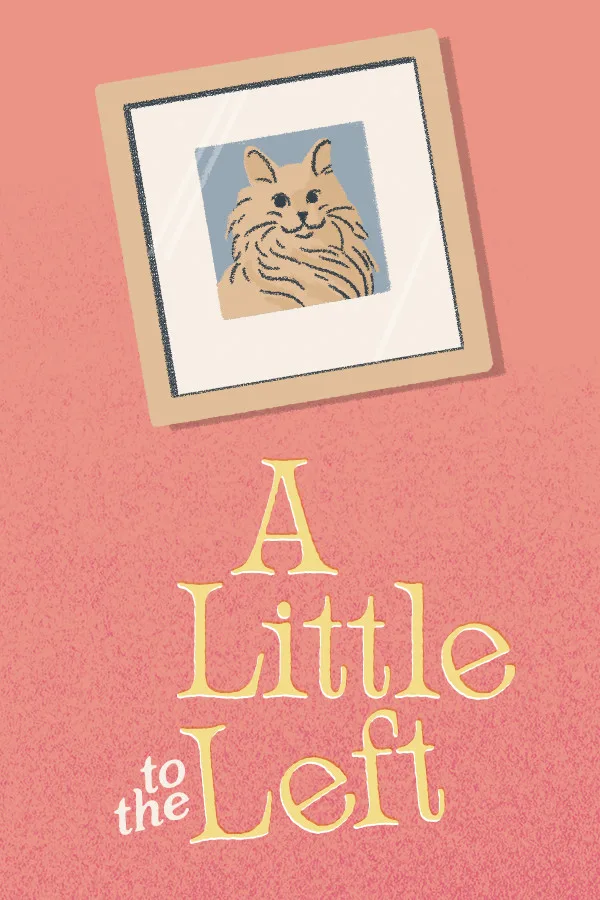 From my media collectionA Little to the LeftDeveloper: Max Inferno • Publisher: Secret Mode • Platform: windows, mac • Year: 2022View on Trove

A Little to the Left makes the agreement smaller. here is a drawer. here are its objects. there is a satisfying arrangement to discover, sometimes more than one. the screenshot’s compartments practically advertise their intentions. scissors and batteries have been invited into a world where the available space is somebody else’s design problem.
an actual junk drawer contains an unlabelled key and a cable that might still be important. putting them away requires decisions about an entire household’s past and possible future. the puzzle gets to edit that down to shape, size, order. a little rectangle of solvable confusion. its cat can interfere, but at least the cat is credited as part of the game.
there is a useful limit to this theory: the game also offers a daily puzzle. even fictional tidying can become an appointment. the appeal depends on which part you choose to engage with. a finite drawer is a lovely proposition. an obligation to maintain a streak is a separate negotiation.
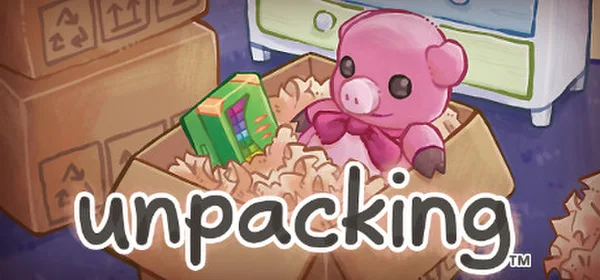 From my media collectionUnpackingDeveloper: Witch Beam • Publisher: Balor Games • Platform: windows, mac, linux • Year: 2021View on Trove

Unpacking stretches the idea across eight moves. possessions come out of boxes and find places in rooms, with no timers or scores. the objects also carry a life through those moves. a shirt, a toy, a book: ordinary belongings get enough attention to become the story.
it even offers an “allow items anywhere” option that removes the placement puzzle. the player can decide how much judgment belongs in this particular household. imagine the possibilities if a cupboard had a setting.
none of this requires turning leisure into self-improvement. the game library still isn’t homework. you can abandon the fictional cleaning too. but for a while, these games offer work with unusually legible boundaries: an object, a manageable mess, a response. the room fits on the screen. the box can become empty. somebody has finally written a definition of done that does not include checking the laundry.
Featured screenshot: FuturLab / PowerWash Simulator, via Steam.
Lindsay Chervinsky checks AI history videos for WIRED. A period costume is not a bibliography. Read more

Sammy Hajhamid’s Switch 2 writeup gives the reset button its own tiny employee. The human effort still matters. Read more
Sammy Hajhamid’s Switch 2 jailbreak writeup has a very good supporting character: a Bluetooth light-switch gadget whose job is to press the power button after the console crashes.

The software can send controller inputs and receive video. Restarting the physical machine still requires a small appliance to reach over and do the obvious thing. Someone has to work the door.
(more…)
Nerdist follows VisionQuest’s Butcherbird story into the comics. Marvel’s robot family tree could use a second whiteboard. Spoilers through episode 4 at… Read more

VisionQuest has reached the part of the family history that requires arrows. Eric Diaz’s Nerdist explainer traces the Butcherbird story back through Marvel’s comics, where creating a robot rarely produces a manageable relationship.
Spoilers through episode 4 in the linked article. Read the comics-history explainer at Nerdist.
(more…)The ballot keeps going after the famous names. Bolts has a useful guide to the rest of it. Read more
Ziwe gives a Queens classroom an assignment in interviewing, free speech, and asking the next question. Read more
Content note: The linked interview contains frank adult discussion. Rachel Handler takes Wicker’s fantasy-romance premise to a gynecologist. Sometimes the correct follow-up… Read more

Content note: The linked interview contains frank adult discussion.
Rachel Handler takes Wicker’s fantasy-romance premise to a gynecologist. Sometimes the correct follow-up to a movie trailer is a consultation.
(more…)