

thirst, with footnotes · no. 4
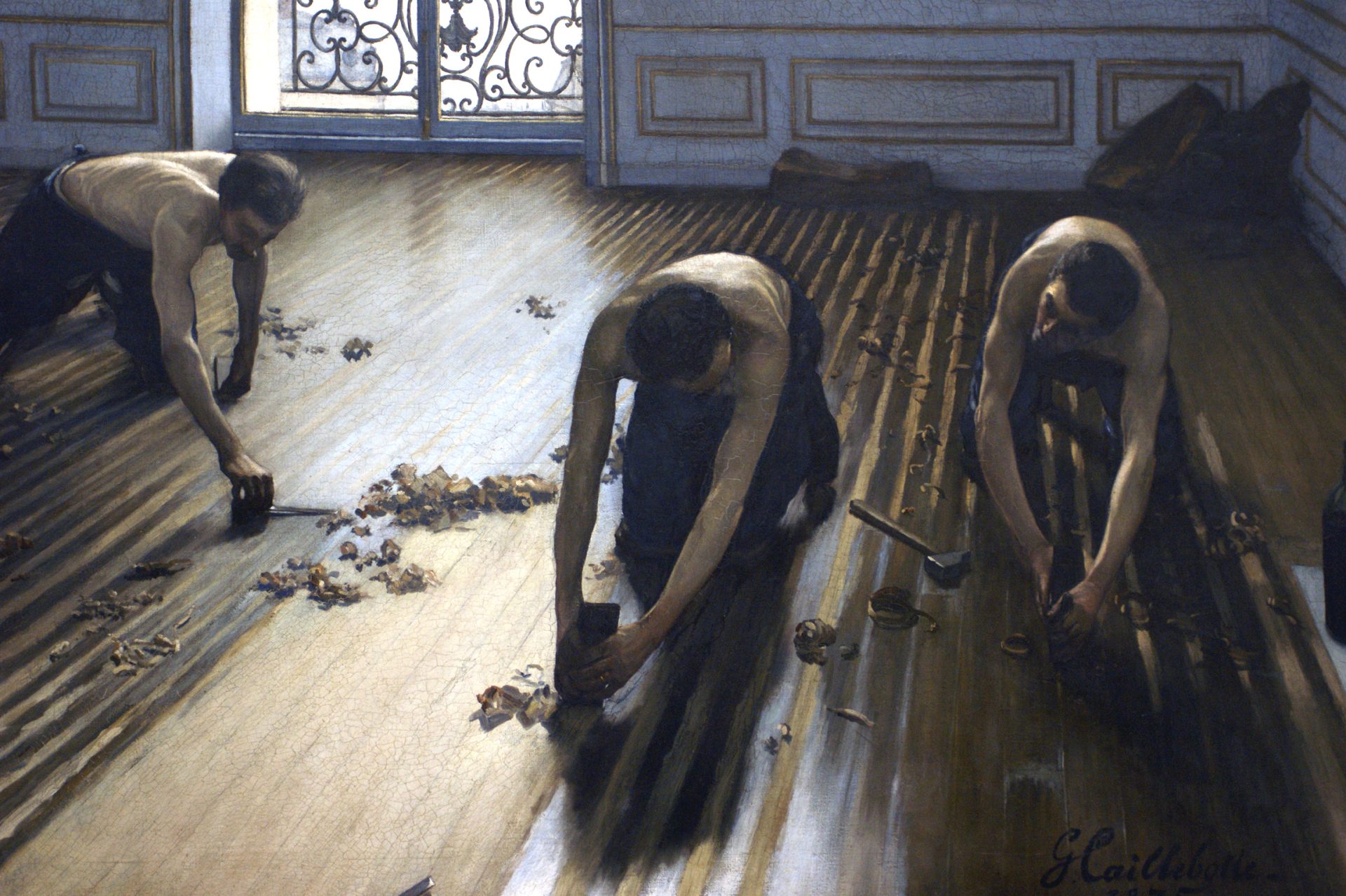
Three shirtless men are working on a floor, and the floor is somehow still the most aggressive thing in the composition.
Gustave Caillebotte’s The Floor Scrapers, painted in 1875 and now in the Musée d’Orsay, sends its boards racing toward the viewer. Their long lines pull the room open. The men bend into that geometry, backs catching the light while their attention stays on the job. Nobody looks out to ask whether the arrangement is working. It is working.
The museum situates the picture among early representations of the urban working class. That matters. These are not mythological bodies accompanied by a convenient explanation from antiquity. They are workers in an interior, with tools, repetitive movements and a surface that has to be finished. The subject does not need a god’s name to justify the space it occupies.
It is entirely possible to notice the men’s bodies without deciding that work is only a pretext for displaying them. The two kinds of attention can coexist. Their posture tells us something about physical effort; it also makes shoulders, backs and arms into compelling shapes. A useful queer way of looking does not have to erase labor in order to acknowledge attraction.
The perspective prevents the scene from settling into a polite row of specimens. We are above the workers, looking into an occupied room. The boards make distance measurable. One man is nearer, another farther away, and the repetition of bent bodies establishes a rhythm without making them identical. This is not three versions of the same pose pasted onto a background.

That distinction is worth slowing down for. A picture can offer bodies for contemplation without reducing every body to a standardized ideal. Here, the task gives each figure an action and a relation to the others. The attraction sits inside an arrangement of work, space and light rather than floating free of it.
Nor is a queer response evidence about Caillebotte’s own sexuality. Looking is not a retrospective identity test. The painting can sustain a contemporary gay viewer’s attention without being turned into a confession the artist never supplied. Art does not need to fill out a dating profile before it becomes available to desire.
What the work does offer, quite visibly, is a refusal to leave male bodies unexamined. The men are not simply the invisible operators of tools. Their physical presence shapes the whole room. The window, the floor and the lines of their backs all belong to the same visual argument.
There is a reason to include the preparatory study alongside the finished picture: it makes composition look like a choice again, rather than a fortunate thing that happened while some men were renovating. The scene was built as an image.
Compare the later Man at His Bath (1884), now at the Museum of Fine Arts, Boston. A solitary adult figure, seen from behind while drying himself, makes an ordinary bodily routine the subject of a substantial painting. The setting and action differ, but both works ask the viewer to look closely at a male body without a mythological storyline doing the introducing.

The parquet gets an extraordinary amount of attention. The people doing it should, too.
sources
Musée d’Orsay: Raboteurs de parquets.
Musée d’Orsay: Caillebotte exhibition account.
Public-domain reproduction of the painting.
Public-domain preparatory study.
Museum of Fine Arts, Boston: Man at His Bath acquisition record.
Image credits: Gustave Caillebotte: The Floor Scrapers (1875), Musée d’Orsay; preparatory study; and Man at His Bath (1884), Museum of Fine Arts Boston. Public-domain reproductions via Wikimedia Commons. Original compositions retained.


leave a reply