

A fresh guide built from Andrew Schwegler’s “What Is the Fediverse?” on Pale Panda, April 20, 2021. This is a new adaptation, not the original article. Technical details checked October 24, 2026.
The useful question about a social network is fairly small: can you talk to the people you want to talk to without hating the place where you do it?
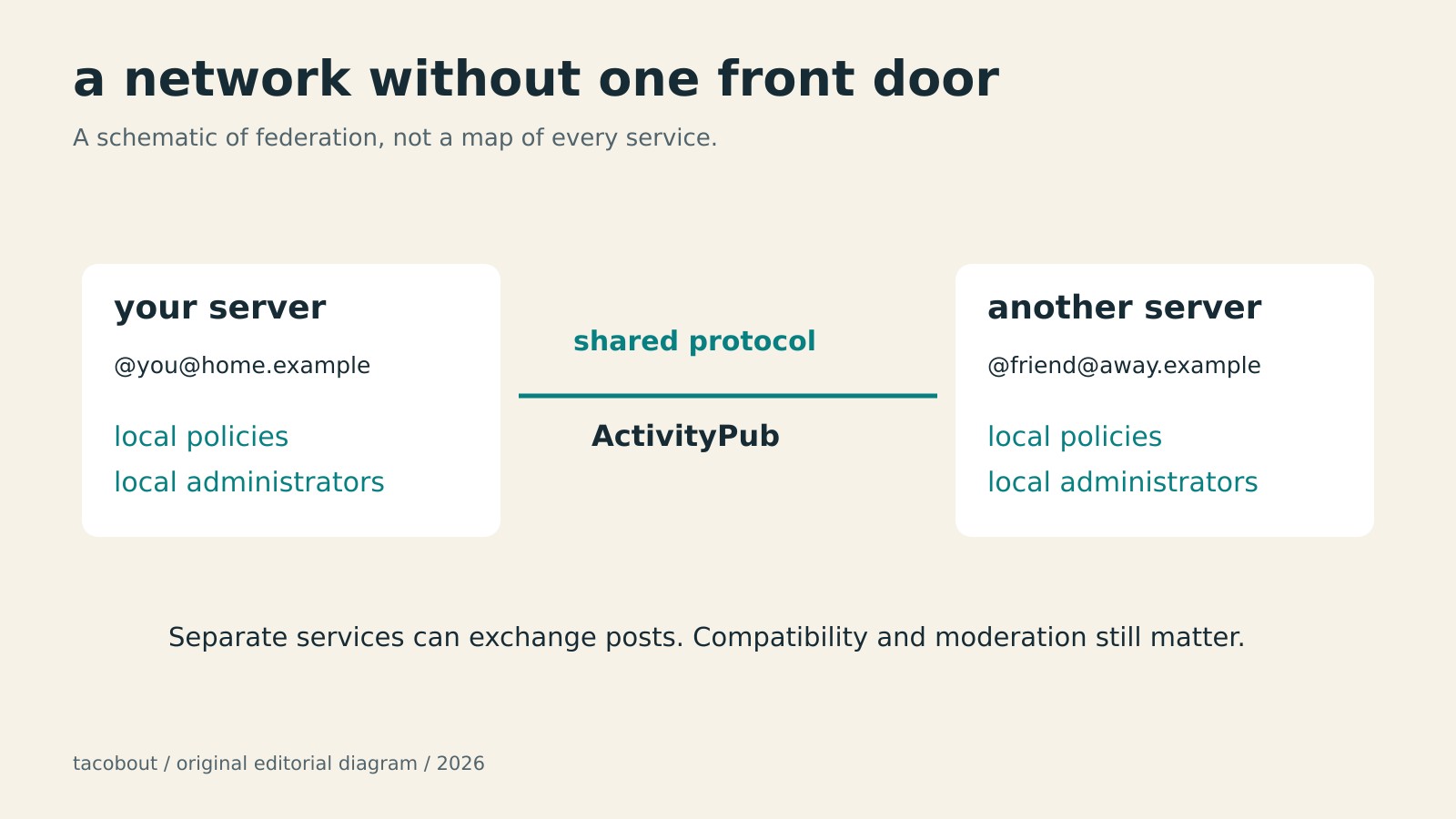
The fediverse offers a different way to arrange that place. You join a service run by one operator, but your conversations can reach compatible services run by other people. The email comparison from Pale Panda’s original guide still helps: choosing an address should not require everyone you know to choose the same provider.
ActivityPub is one protocol that makes those exchanges possible. It describes how services deliver social activity to each other. It does not make every application identical, or promise that every server will accept everything another server sends. Think shared language, with local house rules.
pick the people running the place
For a first Mastodon account, start with the server directory, then read a candidate’s own policies. The server hosts your account. Its administrators matter more than whether the domain looks cute in your bio.
Check what the rules prohibit, how to contact moderators, and whether the funding and shutdown policies make sense. Look at public conversations. A rule against harassment is useful; evidence of people maintaining a usable community is better. You are choosing somebody’s ongoing operation, not just a sign-up form.
Registration can be open, approval-based, or invitation-only. Follow that server’s process. There is no need to join the same server as every friend. There is also no universal promise that two particular servers will communicate: moderation decisions and technical compatibility can limit the connection.

find a person before you find everybody
Share your complete address, such as @name@example.social, rather than just @name. The domain is part of the address. If you have someone’s profile URL, paste it into your own server’s search box. That is often easier than trying to persuade a page on a different server that you are already logged in somewhere else.
Hashtags, follows, and conversations are useful starting points. Follow a few people whose posts you actually want to read. Reply when you have something to add. A feed does not become good merely because you have successfully created an account.
The old guide’s claim that Mastodon cannot search post text needs retiring. Full-text search is available when the server has the necessary search backend. Its searchable material includes public posts from accounts that opt in, alongside certain posts you wrote or interacted with. It is not a search engine for every post on every server. An empty result is not proof that nobody said it.
private does not mean encrypted
Mastodon’s private mentions are not end-to-end encrypted messages. Administrators of the sending and receiving servers may be able to access their text. Keep sensitive conversations in an appropriate encrypted messenger. A visibility menu is not a security guarantee.
The same caution applies to sweeping claims about the whole fediverse. Different operators have different terms, policies, and business models. Federation does not itself guarantee an ad-free service, permanent availability, or perfect moderation. Read the actual agreement rather than the nicest paragraph in an explainer.

know what can leave with you
Mastodon gives you useful exit options, with limits. Its documented migration process can redirect an old profile and move followers where their software supports it. You can export and import supported lists. You can also request an archive of your posts and media.
Those are different operations. The post archive does not become your posting history on the new server: Mastodon’s documented migration does not import those posts and media. Save anything you need before moving. Nor should deleting an account be treated as proof that every copy, screenshot, or independently retained record has vanished.
That leaves a reasonably appealing proposition, without the sales pitch. Choose a place with tolerable rules and people worth reading. Learn its limitations. Keep an exit plan. A social network is allowed to be useful without volunteering to become your entire internet.
credits
Source essay: Andrew Schwegler, What Is the Fediverse? How to Find the Right Instance, Join, and Search., Pale Panda, April 20, 2021. Original editorial diagrams created for tacobout; schematic illustrations, not archival screenshots. Linked technical documentation was checked October 24, 2026.


leave a reply