November 4: Kinect reaches its sixteenth anniversary, EPOXI visits a very active comet, and Nintendo’s playing-card years stretch much further back than… Read more
a few things worth knowing · wednesday, november 4, 2026
November 4, 2010 was busy: Xbox asked people to become the controller, and a spacecraft visited a comet with excellent stage presence. Two anniversaries, followed by an evergreen detour into Nintendo’s considerably less electronic beginnings.
today in history: kinect turns sixteen
Kinect for Xbox 360 launched in the United States on November 4, 2010. Microsoft’s pitch was controller-free play: the sensor tracked body movements and gestures, with voice commands joining the performance. The living room had acquired a motion-capture department.
Microsoft Research’s first-anniversary account credits work on audio, skeletal tracking, and facial recognition. That is the interesting engineering underneath the waving: the system had to turn a person’s movements into something software could use. Sixteen years later, “be the controller” still sounds like a job description that should come with breaks. Microsoft’s anniversary account · the original launch announcement.
today in history: the comet supplied its own special effects
On the same date in 2010, NASA’s EPOXI mission flew past comet Hartley 2. This was the reused Deep Impact spacecraft, which had already visited Tempel 1 in 2005. A second comet was a fairly ambitious encore.
Hartley 2’s nucleus is roughly two kilometers long, with rough ends and a smoother, narrower middle. The mission found carbon dioxide driving icy grains out into the surrounding cloud. A small object could put on a surprisingly elaborate production. NASA/JPL’s mission account · the full-nucleus photograph.
The close-up above was enhanced by the mission team to make the jets easier to see. They emerge from both the sunlit and dark sides, and along the boundary between them. The comet did not need an effects budget. NASA’s image explanation.
evergreen detour: nintendo’s first hardware was a deck of cards
This one has no November 4 anniversary attached. Nintendo’s company history begins in 1889, when Fusajiro Yamauchi started making and selling hanafuda playing cards in Kyoto. The business was already decades old when it began selling Disney-character cards in 1959.
Its first home video-game machines, TV Game 15 and TV Game 6, arrived in 1977; the Family Computer followed in 1983. That is 94 years between the first cards and the Famicom. A long development cycle, even allowing for the change in medium. Nintendo’s company timeline.
Image credits: Hartley 2, PIA13575 (featured), and the enhanced jet detail, PIA13574, NASA/JPL-Caltech/UMD. Both photographed November 4, 2010; displayed at reduced size with the mission’s scale markers retained. Used editorially under JPL’s image-use policy. No endorsement implied.
GTA VI’s PS5 preload, Xbox’s phone-controller preview, a Christmas Eve thriller and WWE’s two-day Disney takeover. Read more
Wednesday, November 4, 2026 · afternoon briefing
GTA VI has submitted its storage request. Xbox has found another use for your phone. Christmas has a confession to make, and John Cena is taking December bookings. Four developments worth a tab.
gta would like a drawer of its own
PlayStation’s November 3 preparation guide puts Grand Theft Auto VI pre-downloads at local midnight on November 10 for players who preorder, ahead of the November 19 launch. The practical instruction is to clear at least 212GB on PS5. That is a storage requirement with opinions about the rest of your library. These preload and space details are specifically for PS5; downloading early does not let you play early.
the missing controller might be your phone
Xbox’s November 4 announcement starts two cloud-gaming previews: Android and iOS phones can act as controllers through their browsers on supported Smart TVs, while U.S. players can test the Nano Controller’s direct Wi-Fi connection to cloud servers. Xbox says the latter may reduce input latency. Both are tests with device and game limits. Phone controls are enabled through Preview Features under Settings → Account in the supported TV experience. The controller may still be under the cushion; the phone has merely accepted the temporary position.
christmas eve begins at the police station
Netflix has set Proxies for a global December 11 premiere, releasing its teaser and first images today. Oriol Paulo’s thriller stars Eduard Fernández, Mario Casas and Blanca Suárez, and opens with a man confessing to killings on Christmas Eve morning. Why he has chosen that moment is the problem. Paulo co-wrote it with Guillem Clua. A seasonal alternative for anyone who finds the village bakery insufficiently threatening. The promotional images and teaser contain disturbing imagery.
john cena books two days at disney
WWE and Disney’s November 3 announcement puts the John Cena Classic on December 14 and an Avengers: Doomsday-themed Worlds Collide on December 15 at ESPN Wide World of Sports near Orlando. The Cena event streams on Netflix as a special Raw; Worlds Collide brings together WWE, NXT and AAA wrestlers. Two-day combo tickets go on sale November 13 at 10 a.m. Eastern / 9 a.m. Central, with general presales a day earlier. The crossover also includes co-branded title belts. Corporate synergy has found something it can fasten around its waist.
50 films, 50 nights, and a deeply unreasonable amount of festive opinion. Our Christmas movie countdown runs November 5–December 24. Read more
christmas is 51 days away, which seems rude considering halloween was approximately twenty minutes ago. so we’re doing the sensible thing: making an entire film season out of it.
starting november 5, we’re counting down 50 christmas movies, one a day, until our number one arrives on christmas eve. classics, queer romance, animation, family disasters, and a little festive bloodshed. the holidays contain multitudes.
this is an editorial ranking, not a scientific measurement of how much christmas a film contains. the season has to matter to the story or the atmosphere, but the people involved do not have to be having a nice time. feature films and feature-length television movies count; standalone television specials get to sit this one out.
each day brings a spoiler-light case for the film, what makes it belong here, and the kind of evening it suits. no homework, no requirement to agree with the order, and absolutely no promise that everybody will behave at dinner.
A 2012 Pale Panda review, restored with its original date and wonderfully irritable affection. Read more
From the Pale Panda archive. By Andrew Schwegler, originally published April 18, 2012. The review below is preserved as criticism from that date.
Overview
Is this my new favorite because of 30 Rock’s ever-increasing cartoonish-ness? Probably not. I love cartoons. Maybe Parks and Rec just isn’t as funny? Again, no, this is maybe the funniest season of Parks and Rec yet. Is it because I’ve somehow began to loathe how uninteresting How I Met Your Mother has become? Maybe a little—ok, a lot.
It has to do with the cast of characters. This show has all the appeal of an interesting version of How I Met your Mother. It’s like Friends meets people who don’t just magically maintain lavish incomes with little-to-no signs of employment. These characters, though completely crazy sit-com archetypes, manage to bring something more to the table.
We Hate Everything
The characters on Happy Ending seem to hate everything except each other—and even that is sometimes tenuous. This is something that my group of friends can definitely relate to.
There’s actually a show that utilizes our generation’s love of cynicism and I’m happy for that. There is a common, universal fact that anyone will eventually learn as they age: everyone and everything is annoying.
Finally, there’s a show out there that we, the terrible generation, can enjoy with our Wednesday night glass (or so) of wine.
Sonic Racing starts Year Two with Duel Mode and console cars, Netflix tests AI Discover, and The Law of Beasts gets a… Read more
Tuesday, November 3, 2026 · afternoon briefing
Sega has put wheels on a Dreamcast. Netflix would like to help pick your mood. A new Polish drama is asking harder questions than either of them.
the dreamcast has passed its driving test
Sonic Racing: CrossWorlds starts Year Two today, November 3. Sega’s new developer interview explains the practical change: Duel Mode trades the usual 12-racer crowd for one opponent, while a new Super Slot boosts a one-slot Gadget. There is finally room to blame a specific hedgehog.
The Sega Consoles Pack turns the Dreamcast, Genesis and Saturn into vehicles, including a Dreamcast car with a controller-shaped front and a tiny VMU. These console cars are bonus content for Season Pass Two and the Year Two Digital Deluxe Edition, not a promise that every new vehicle comes with the free update. Sega’s full roadmap also dates the free unlockable Bayonetta racer to today. Current owners should check the pass rather than rebuy the base game in a bundle.
Official Sega Bayonetta reveal trailer, first released September 16. Today’s news is the Year Two launch.
Netflix announced AI Discover today, a test tab for a small group of US members using English on supported TVs. It starts with themes such as quick watches or family movie night, then offers narrower choices. A recommendation control can keep a suggestion or tell this feature not to recommend it again.
The useful caveat is the rollout: this is a limited test expanding over coming weeks, not a missing button everybody should already have. Netflix says eligible viewers should look for a red gem marked “New” in the TV app’s navigation. Whether another menu actually gets dinner watched before it goes cold remains a question for the test.
a friendship meets a case that will not stay closed
One distinction matters before the true-crime label does all the work: Netflix says the series draws on real events surrounding Poland’s “Beasts Act,” but its two central women and their friendship are fictional. This is a scripted drama, not a documentary account of those characters. The premise concerns child murder; choose the teaser accordingly.
Sources: Sega / PlayStation Blog and Netflix’s official newsroom, checked November 3, 2026. Announcement and rollout details may change. No plot outcomes included. Featured and Dreamcast car artwork: Sega, via the linked PlayStation Blog announcement. Videos: Sega Asia (EN) and Netflix Polska.
The McRib lawsuit is proceeding, not decided. The joke is the shape; the question is what advertising makes people expect. Read more
the McRib is in federal court, which feels like the natural destination for a sandwich that comes and goes like a Victorian ghost. after decades of mysterious disappearances, limited-time returns, and a patty with the silhouette of a cartoon xylophone, it is finally being asked to explain itself.
A federal judge in Chicago has allowed parts of a proposed class action against McDonald’s to move forward. The plaintiffs say the sandwich’s name, ridged shape, and marketing misled buyers into thinking it contains actual pork rib meat. McDonald’s disputes the allegations. That’s the story. Nobody has ruled the McRib guilty of impersonating a rib, and we have not reached the stage where the sandwich can take the witness stand.
A 115-million-year-old fossil has chemical traces of heme, but the blood-cell claim is still debated. The rock is fascinating enough without Jurassic… Read more
a dinosaur has been dead for 115 million years and has somehow managed to get a more interesting blood test than most living people. unfair, honestly. the rest of us have to make appointments.
Researchers studying the leg bones of Aratasaurus museunacionali, a small meat-eating dinosaur from what is now Brazil, report microscopic structures resembling red blood cells and chemical evidence associated with heme, the molecule connected to hemoglobin. The fossils were recovered from a gypsum mine, not from a secret laboratory staffed by a man who refuses to listen when Jeff Goldblum speaks.
a psychedelic nasal spray has promising depression-trial results. the best part is that the toad gets to stay out of it. Read more
somewhere in the Sonoran Desert, a toad has been informed that it may be the future of treating depression. the toad, which has no medical degree and was frankly busy sitting in the dirt, would like to be excluded from this narrative.
a Popular Science story on a new psychedelic nasal spray is the sort of headline that makes me briefly believe the universe is running a very elaborate improv show. a toad-inspired antidepressant. administered through your nose. possibly effective after one dose. at some point the writers’ room needs to explain what genre we’re in.
but buried underneath the amphibian comedy is actual good news, and a reason to be suspicious of the way we package it.
first, no toads were employed in this trial
the compound is called mebufotenin, or 5-MeO-DMT. it occurs naturally in the defensive secretions of the Sonoran Desert toad, but the drug tested here was made synthetically in a lab. nobody needed to go outside and squeeze an unwilling amphibian. this is both scientifically practical and, from the toad’s perspective, probably a major workplace improvement.
in a randomized phase 2b trial published in JAMA on October 26, 193 adults with treatment-resistant depression received one of three nasal-spray doses under clinical supervision, with psychological support. everyone had already tried at least two antidepressant treatments without adequate relief. this was not an experiment involving people who felt a bit sad because the weather was bad.
four weeks later, depression scores had fallen by an average of 11.1 points in the 12-milligram group, compared with 5.5 points in the tiny-dose comparison group, on a 60-point clinical scale. the adjusted difference was 5.3 points. the smaller 8-milligram group actually saw a 12.5-point average drop. benefits over the comparator were still detectable at the end of eight weeks.
that is genuinely promising. it is not the same thing as proving one nose-squirt cures depression forever. the comparison group also received a very low dose of the drug, not a completely inert placebo, and the researchers have not established what happens after eight weeks.
finally, a psychedelic that respects your calendar
one reason psychedelic therapy is difficult to scale is that a treatment session can commandeer your day. somebody has to supervise the experience, somebody has to make sure you’re safe afterward, and somebody has to pay for all of that time. the fantasy that every struggling person can take an entire workday to have a medically supervised revelation is very beautiful. it is also extremely American in the sense that nobody has explained who is covering their shift.
with this drug, most participants receiving the two active doses were judged ready for discharge within two hours. important footnote: the trial protocol still kept people at the clinic for at least four hours. ready to leave is not the same thing as actually being sent home. even so, a shorter psychedelic experience could eventually make treatment easier to provide than longer sessions with other psychedelics.
and here’s the thing: depression treatment does not have to be spiritually picturesque to count. i do not require a rebirth, a vision quest, or an encounter with my inner child wearing a tiny hat. i want treatments that work, evidence that survives scrutiny, and clinics people can actually get to.
the toad would prefer the synthetic version
the Sonoran Desert toad uses its secretions to defend itself. people seeking the psychedelic have collected or harassed the animals, adding pressure to wild populations. UC Berkeley’s Center for the Science of Psychedelics describes the animal-welfare and conservation concerns around collecting those secretions.
a 2026 ecological and historical analysis goes further: it questions marketing that portrays contemporary toad-secretion ceremonies as an uninterrupted ancient tradition, and argues that laboratory-made 5-MeO-DMT can eliminate the need to disturb living toads. you can respect Indigenous communities and traditions without accepting every modern wellness entrepreneur’s origin story at face value.
i like that the molecule can be drawn on a piece of paper and manufactured without involving its original, deeply unenthusiastic spokesperson. science is allowed to take inspiration from nature without turning nature into a retail supply chain.
please do the part where we prove it works
this was a relatively small, company-funded trial, with the sponsor involved in study design and analysis. people and clinicians could often guess who had received a psychedelic dose, which complicates blinding. some participants stopped existing antidepressants to enter the study. and the adverse effects weren’t imaginary: headache, nausea, nasal discomfort, transient blood-pressure increases, anxiety, and, in one participant receiving the highest dose, severe panic attacks were reported. these are reasons for careful trials and oversight, not for getting creative with the wildlife.
larger phase 3 trials need to test safety, durability, and whether these results hold up in a broader population. this nasal spray is experimental, not an approved at-home depression treatment. and if it does eventually work, access and affordability will matter at least as much as the very cool animal anecdote in the press release.
because i would love for this to become another real option for people who haven’t gotten relief from existing treatments. i would love even more for it to become an option they can afford. the breakthroughs that matter are the ones that make it out of a journal, through an actual care system, and into people’s lives.
meanwhile, please leave the toad alone. he has already contributed enough.
image credits: featured Sonoran Desert toad photograph by Saguaro National Park Service (U.S. public domain); illustrative nasal-spray photograph by NIAID (CC BY 2.0; it does not show the experimental drug); 5-MeO-DMT structure by Nynyny (public domain).
A new essay revisiting Andrew Schwegler’s “A Social Network of 5,” published on Pale Panda on May 25, 2012. Five people is… Read more
A new essay revisiting Andrew Schwegler’s “A Social Network of 5,” published on Pale Panda on May 25, 2012.
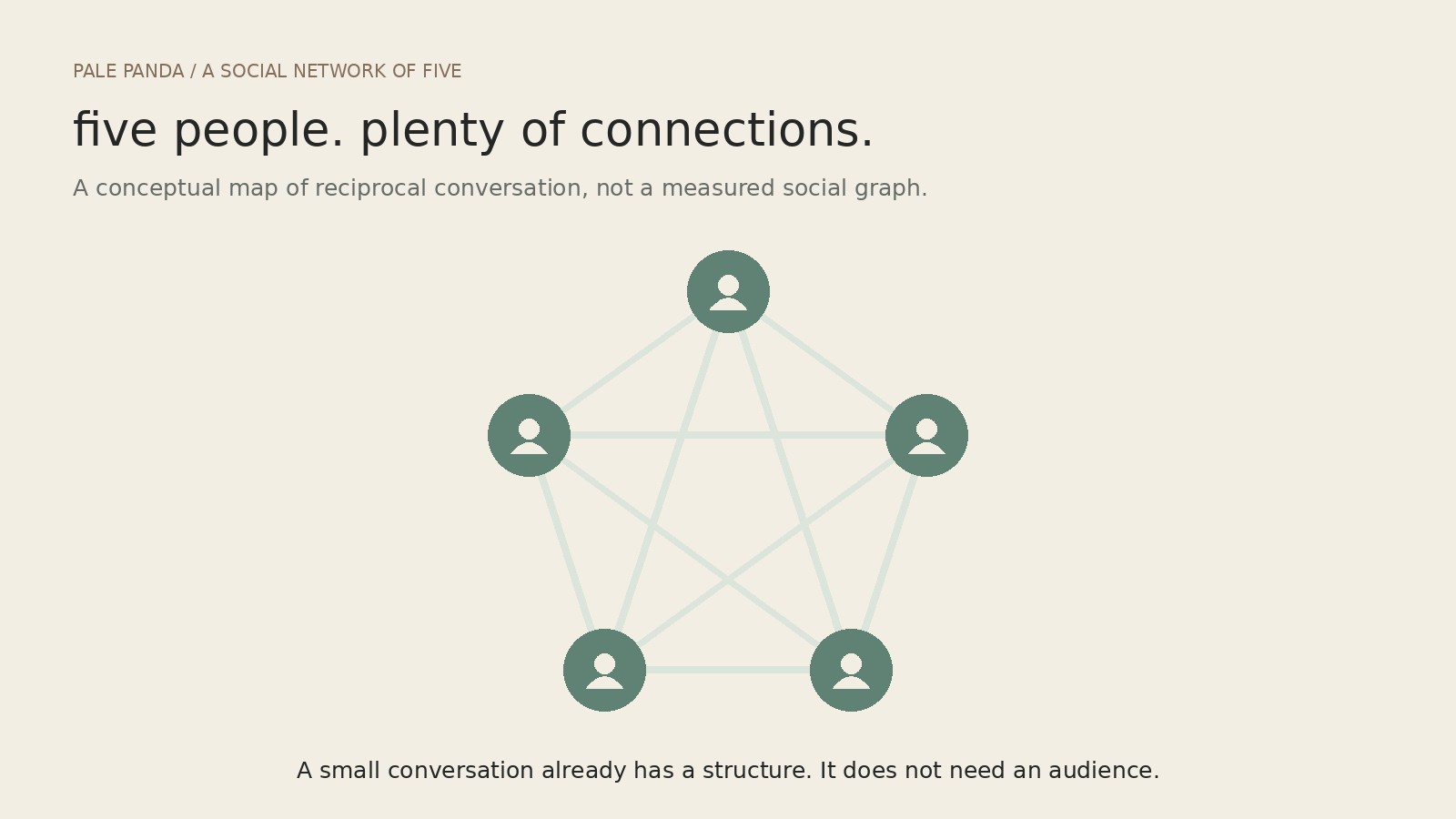
Five people is a terrible number if you are selling a social network. It is a perfectly respectable number if you want to have a conversation.
That was the useful part of Pale Panda’s 2012 defense of Google+. The service did not need to contain everybody. It needed to contain a few interesting people, some worthwhile links, and a way to stop the rest of the room from interrupting. The original piece called this a better signal-to-noise ratio. A less technical description would be: a website that occasionally knew when to shut up.
The old post’s follow recommendations belong to their moment. The underlying question travels rather well. How many people does a social network actually need before it becomes useful to the person using it?
the room and the stadium
A public network and a small conversation solve different problems. A public network can help a person find work, circulate an investigation, locate an audience, or discover something outside their existing circle. Reach matters for those things. Pretending it never matters is its own kind of smugness.
But reach becomes a strange standard for judging every interaction. A joke between friends does not improve because strangers can grade it. A recommendation does not become more useful because ten thousand people have already repeated it. Sometimes the interesting part is knowing which person recommended the thing, and knowing what their terrible taste in other things tells you.
The 2012 essay described a mix: public posts and news sources alongside smaller circles organized by relationship or subject. Its appeal was not total retreat. It was being able to change the size of the room without leaving the building.
small can still be annoying
There is no automatic virtue in a tiny group. Five people can be exhausting. A private conversation can become a little court with its own rules, grudges, and compulsory opinions. Familiarity makes context easier; it does not make everybody thoughtful.
So the useful distinction is not simply big versus small. It is whether the space leaves room for ordinary participation. Can someone post a link without turning it into a performance? Can a conversation end? Can a person disappear for a few days without returning to an administrative task disguised as friendship?
Those are modest expectations. They also make a better checklist than asking which service is winning.
the business has other questions
Of course, a pleasant corner of a website does not guarantee a viable website. Google’s own 2018 shutdown announcement cited limited consumer adoption and the challenges of maintaining the product. In December it moved the planned consumer shutdown to April 2019. A useful small circle and a successful mass-market product were different measurements.
This is the tension the old post accidentally preserved. The person using the service wanted a manageable feed. The company needed a reason to keep operating it. Neither requirement disappears because the other one is inconvenient.
That is a reason to keep contact information and copies of anything important outside a single platform. It is also a reason to stop treating a service’s size as a complete review of its social value.
five is allowed to be enough
A good small network does not have to become the next anything. It can be a group that sends each other songs. A few people who know a lot about an obscure subject. Friends whose updates are worth reading even when nothing particularly marketable has happened to them.
The original essay was enthusiastic about a specific product. The durable idea is less glamorous: a social space should be judged partly by the conversations it makes possible, and partly by the noise it lets people avoid.
Five people talking to each other is already a social network. It does not need a growth strategy to count.
archive and sources
Original: Andrew Schwegler, “A Social Network of 5”, May 25, 2012, recovered from the author’s WordPress export. This adaptation retains the original premise rather than presenting its old platform recommendations as current advice. Historical context checked October 24, 2026.
image credits
Original editorial diagrams prepared for tacobout: a five-person conversation network and the room and the stadium. These are conceptual illustrations, not historical screenshots or measured data. Google+ wordmark and circles: Google branding, restored from the image accompanying the original 2012 article, reproduced here to identify the historical service. No affiliation or endorsement is implied.
David Hockney: a splash without a swimmer Start with David Hockney’s A Bigger Splash. His foundation’s 1967 chronology places the painting alongside… Read more
David Hockney: a splash without a swimmer
Start with David Hockney’s A Bigger Splash. His foundation’s 1967 chronology places the painting alongside his continuing experiments with water, light and reflection. The absent swimmer is a useful prompt: desire can be suggested by a trace rather than a body placed in the middle of the frame. A pool, a disturbance, somebody just out of sight. Not every invitation needs to introduce itself.
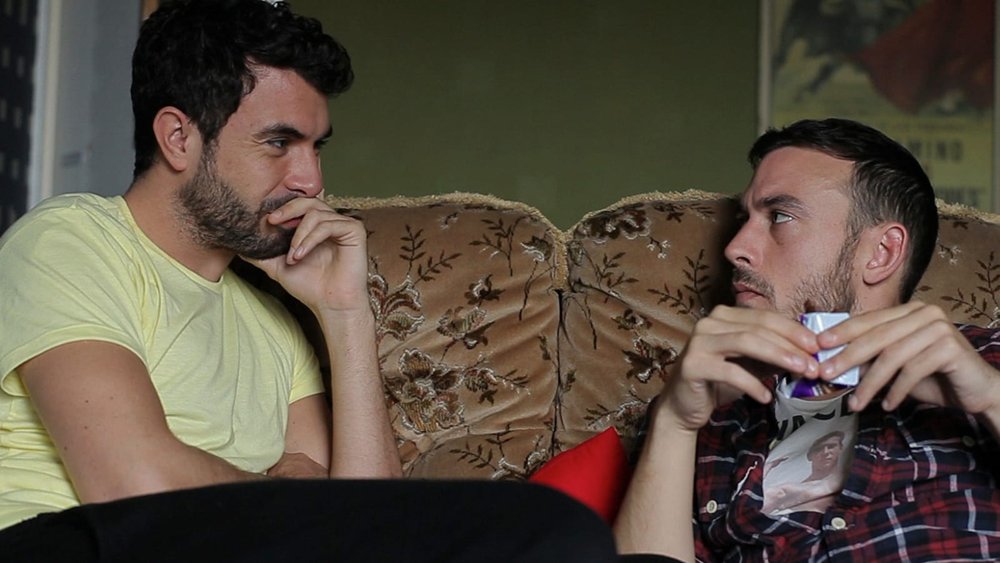
A one-night stand is often an ending, a joke or a complication. Andrew Haigh’s Weekend uses it as the beginning of a conversation.
The 2011 film follows Russell and Glen, played by Tom Cullen and Chris New, through a brief encounter that extends across a weekend. Its scale is small enough to make the question of what comes next feel very large.
That is the reason to put it on an after-dark list. Not because a hookup needs romance to become respectable, but because physical intimacy and emotional disclosure do not necessarily arrive in the same order. A stranger can know one part of you before he knows anything else.
The useful thing to notice is what the premise refuses to rush past: the time after attraction has done its opening work. What can two people ask each other? Which version of themselves do they offer? How much can be said before the available time runs out?
Criterion’s edition includes a conversation with Haigh specifically about the sex scenes, giving the curious viewer somewhere to take that discussion beyond the film. No grand claim about the definitive gay experience is necessary. Two men and a short stretch of time are plenty.
Explore Weekend at Criterion. Adult themes; this is an evergreen film pick, not a claim of free streaming access.
Finish with Being Boring. The band’s own site points to the corrected HD version of its official video, replacing an American edit that had been uploaded by mistake. That is a good reason to follow the artist’s link rather than whichever reupload turns up first. Pair it with Weekend as an invitation to think about time spent with other people, not a demand to produce a life lesson before the music ends.