
CHANNEL ARCHIVE

trans rights

Dispatches, commentary, and media logs from the open web.

  • 3
    the election needle has never needed a sports physical

    the election needle has never needed a sports physical

    Iowa is within a point. Washington is voting on who needs a doctor’s note to play ball. Here’s where to vote, what… Read more

    there is a version of election night where i spend four hours learning the precise shape of a county in Iowa and find out tomorrow morning that Washington voted on whether a middle-schooler needs a doctor to verify her sex to play soccer. the county will still be shaped like that tomorrow. i’d like to give the kid a tab of her own.

    before you leave the house

    Check your assigned location and hours with your election office. In Alabama, polls are open 7 a.m.–7 p.m. local time. Bring an accepted photo ID. If you’re in line when polls close, stay in line.

    Find my polling place (U.S.)Find my Alabama precinct

    County sample ballots  ·  Alabama ID list  ·  Montgomery election office

    Jump to   Polls  ·  Forecasts  ·  LGBTQ+ watch  ·  Trans rights  ·  Stickers

    Pip waves from the front of the voting line in a school gym. Facet’s folding sample ballot trails beside Hitch’s two orange sneakers. Schwegler waits with his hands in his pockets, and Telly wears a blue jacket and jeans.

    one point in Iowa is a very small point

    Nationally, Democrats led the generic congressional ballot by 8.1 points in Call the Map’s Election Day polling average, which includes polls through November 2. That question asks which party people favor for Congress. Nobody gets to check a bubble marked “generic Democrat, please distribute evenly across 435 districts.” National polling average.

    Look at the final New York Times/Siena surveys, released November 1. In Michigan, Abdul El-Sayed led Mike Rogers 53% to 42%. In Iowa, Josh Turek led Ashley Hinson 48% to 47%. Siena puts the sampling margin for an individual Iowa estimate at ±4.7 points. If your takeaway from those two headlines is simply “Democrats lead,” you have misplaced a fairly important ten points. Siena toplines and sampling details.

    Horizontal bars show Democratic leads in Silver Bulletin’s November 3, 2026 Senate polling averages: Michigan 4.9 percentage points, Kansas 4.0, Maine 3.9, Texas 3.3, Ohio special election 3.0, and Iowa 1.1. These are polling averages, not win probabilities or results.

    Average several pollsters and Michigan looks closer. Silver Bulletin’s final average puts it at D+4.9, with Iowa still just D+1.1. A few points of polling error in the same direction across several states can change who gets to run the Senate. That’s the tab i’ll be refreshing. November 3 polling averages.

    what 53 seats means depends on who’s counting

    Sabato’s Crystal Ball made a call in every race on November 2. Add up the seats its editors rated at least leaning Democratic and you get 239 House seats, 53 Senate seats, and 28 governorships. A seat their editors barely favor counts once, just like a seat they’re sure about. Final ratings and maps.

    Three separate stacked bars show Sabato’s Crystal Ball final ratings on November 2, 2026. House: 239 seats at least lean Democratic and 196 Republican out of 435. Senate: 53 Democratic and 47 Republican out of 100. Governors: 28 Democratic and 22 Republican out of 50. Majority markers are 218, 51, and 26. These are ratings, not probabilities or election results.

    Crosstab’s November 3 model also put 53–47 at the center of its Senate forecast, but gave Democrats a 75% chance of controlling the chamber, compared with 91% in the House. A Republican Senate still shows up about once in four simulations. If that’s the combination we get, the model already had a chair set out for it. The graphics above are pre-election snapshots. Crosstab forecast.

    LGBTQ+ watch · who gets a seat, who gets a marriage license

    New Hampshire, U.S. Senate. Rep. Chris Pappas faces former Sen. John E. Sununu for Jeanne Shaheen’s open seat. Pappas could become the first openly gay man elected to the U.S. Senate. The seat is already held by a Democrat, which means a result that would be historic for gay men could look entirely uneventful on a party-control map. Same color. Quite a different evening. AP’s New Hampshire race guide.

    Three House races worth a tab. In Indiana’s 5th, JD Ford, the first openly gay member of the state legislature, is challenging Victoria Spartz. In New York’s 17th, Army veteran Cait Conley is challenging Mike Lawler. In Arizona’s 6th, former Marine drill instructor JoAnna Mendoza is challenging Juan Ciscomani. All three are out LGBTQ+ candidates running for Republican-held seats. LGBTQ+ Victory Fund’s candidate rundown.

    Virginia, Question 2. Same-sex couples can already marry in Virginia. A yes would remove the state constitution’s unenforceable ban and replace it with an affirmative right for two adults to marry regardless of sex, gender, or race. A no leaves the dormant ban in the text. That’s a hell of a sentence to leave lying around about somebody’s husband. Official explanation and amendment text.

    trans rights watch · read what the yes would do

    Delaware, U.S. House. Sarah McBride, the first openly trans member of Congress, is seeking a second term against Republican Joe Arminio. Read the local race guide and you’ll find McBride talking about the cost of living. She has constituents who need groceries, a fact you could miss entirely from the national coverage of which bathroom she uses. WHYY’s Delaware voter guide.

    Washington · IL26-638. A yes would bar trans girls from certain girls’ K–12 interschool competitions and require any student seeking to participate in those events to get a health care provider’s statement verifying sex. That means a girl whose eligibility nobody ever questioned would also need the paperwork. Somewhere between a pair of cleats and the first practice, the state would like another signature. Washington legislative summary.

    Colorado · Propositions 134 and 135. Two separate votes. A yes on 134 would set statewide sex-based eligibility rules for school and college sports, including intramurals. A yes on 135 would prohibit specified transition-related surgeries for minors and bar public funding and insurance coverage for those surgeries. Its scope is surgery. Colorado’s official Blue Book.

    Arizona · Proposition 318. A yes would expand sex-based team restrictions to more private schools and restrict access to school private spaces, including restrooms, by sex recorded at birth. Nebraska · Initiative 442. A yes would write sex-based restrictions for girls’ and women’s school sports into the state constitution. Arizona voter pamphlet · Nebraska ballot guide.

    Missouri · Amendment 3. One oval does double duty. A yes would repeal the reproductive-rights amendment voters approved in 2024 and constitutionally prohibit gender-transition procedures for minors. A no keeps the 2024 amendment in place. You don’t get to split your answer between the two questions the legislature bundled together. Missouri’s official ballot language.

    When the first network calls control of a chamber tonight, i’ll want to know. I’ll also want to know whether a girl in Washington needs to make a second appointment before she can make the team. There’s room on the screen for both. More down-ballot races from Hitch.

    the sticker table

    Take one on the way out. Each character opens as a transparent PNG.


    Credits. Polling graphic from Silver Bulletin’s final averages, ratings graphic from Sabato’s Crystal Ball. Both charts, and all mascot illustrations by taco ’bout it.

    Fediverse Reactions
  • 3
    you can just stop buying the wizard stuff

    you can just stop buying the wizard stuff

    loving what a story meant to you does not require an eternal pipeline of purchases, reboots, merchandise, and increasingly strained excuses. Read more

    I never got into Harry Potter. This was not an act of moral courage. I read some of the first book as a kid, did not like it, and stopped. The Sorting Hat failed to assign me a house because I had already wandered off to look at the X-Men again.

    That means I do not have the same nostalgia to untangle that a lot of people do. I understand why the books matter to them. They found the series at exactly the age when a fictional world can become load-bearing, and it followed them through childhood, adolescence, midnight release parties, movies, friendships, and the period when every personality quiz on the internet needed to know whether you were a Hufflepuff.

    i never got into Harry Potter because I didn’t like the first book and never finished it as a kid. BUT, even if I did like it back then it’s not that hard to just not consume media that directly pays for the creator’s bigoted activism to continue to do massive harm

    — schweg, (@schwegler.lol) 2026-09-03T10:49:43.910Z

    But “this mattered to me” and “I must continue buying every new thing made from it” are two different sentences. They have been stapled together by an entertainment industry that would very much prefer nobody notice the seam.

    The seven British-edition Harry Potter books arranged together
    Photo by Mo HH92, via Wikimedia Commons, licensed CC BY-SA 3.0.

    the old books are not asking for more money

    Nobody is coming into your house to confiscate the battered paperbacks you already own. Nobody can retroactively remove the friends you made through fandom, the comfort you found in the story, or the fan fiction that was probably doing more interesting things with the premise anyway. Memory is not a subscription service. It does not stop working when you decline to purchase the reboot.

    The current franchise, however, is a business. New books, games, licensed merchandise, theme-park trips, and television adaptations are transactions. J.K. Rowling remains publicly connected to the Wizarding World, and her own website describes her as a campaigner on sex and gender issues. It also promotes her privately funded legal organization, which finances cases intended to establish and enforce “sex-based rights.” That is not an inference assembled from a haunted corkboard. The fund says what it does on its own website.

    So the familiar defense that buying one game or watching one new series is too indirect to matter feels increasingly unserious. Of course one purchase does not single-handedly finance a court case. That is how mass consumer products work. No individual soda purchase builds an entire bottling plant either, but Coca-Cola has somehow managed to acquire several.

    A transgender Pride flag flying outdoors against the sky
    Photo by the UK Foreign and Commonwealth Office, via Wikimedia Commons, licensed CC BY 2.0.

    there are ways to keep the memory without feeding the machine

    Keep the books you have. Borrow them from the library. Buy a used copy if you absolutely need one. Read old fanfic. Rewatch the DVD that has been sitting in a storage tote since the Obama administration. Those choices are materially different from preordering the newest deluxe edition and then explaining that your money is merely symbolic.

    More importantly, let the fondness be historical. We already do this with thousands of things. A childhood restaurant closes, a television show ends, a band breaks up, or a website disappears because somebody forgot to renew the domain. We are capable of loving what something was without demanding an eternal pipeline of branded content. In fact, adulthood is mostly discovering that everything you loved has either ended or been purchased by private equity.

    I do not think people have to perform a public ritual of shame because they once loved Harry Potter. I do think the insistence that a beloved childhood property must remain an active consumer identity forever is a little bleak. The story already happened. You got what you needed from it. The memories are yours, and the corporation cannot repossess them.

    You can just stop buying the wizard stuff.

    Fediverse Reactions
  • 2
    we have rebuilt the trip planner as a civil-rights document

    we have rebuilt the trip planner as a civil-rights document

    Erin Reed’s 2023 and July 2026 trans legal-risk maps show more than a bad legislative season. They show ordinary travel becoming a… Read more

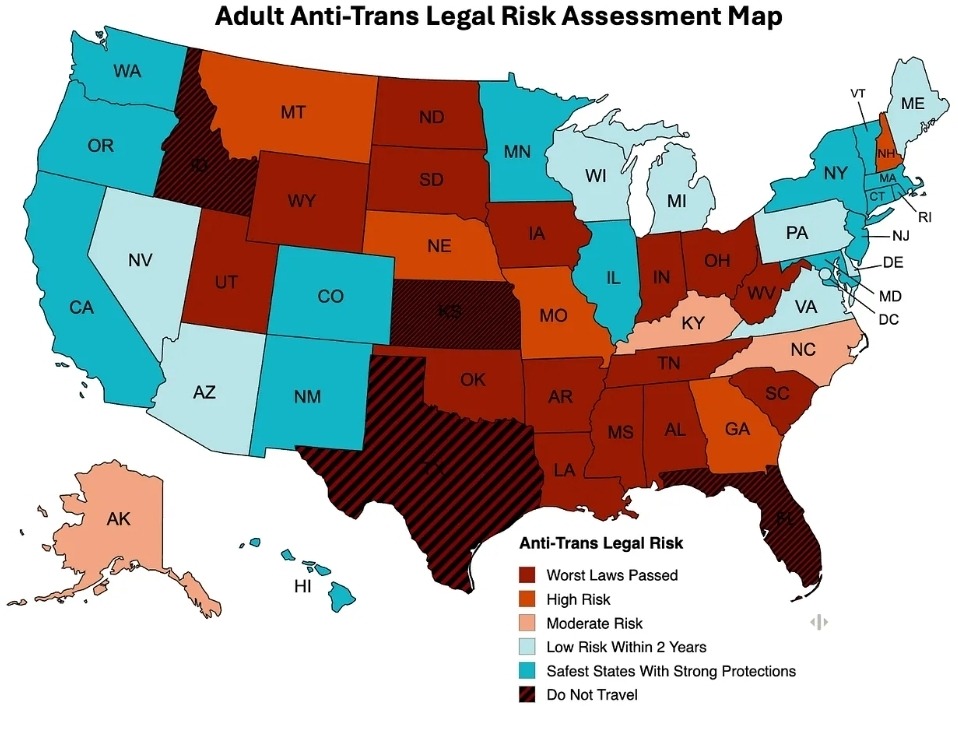
    i reblogged a comparison between Erin Reed’s 2023 anti-trans risk map and her July 2026 update because sometimes a picture does exactly what a hundred individual headlines cannot: it shows the direction of travel.

    the map is not an official travel advisory, and it should not be treated like one. Reed describes it as a qualitative legal-risk assessment built from five years of tracking bills, hearings, court fights, executive actions, and reports from organizers in each state. that distinction matters. so does the fact that people need this kind of map at all.

    the colors did not merely move

    United States map showing Erin Reed's 2023 adult anti-trans risk assessment, with Florida marked Do Not Travel and many states in lower-risk categories.
    Erin Reed’s Adult Anti-Trans Risk Assessment Map, 2023. Source: Erin in the Morning; used for commentary and historical comparison.

    in the 2023 version, Florida stood alone in the map’s striped “Do Not Travel” category. the July 2026 adult map puts Florida, Idaho, Kansas, and Texas there. South Carolina moves into “Worst Laws Passed.” Reed’s accompanying report, published July 13, says Idaho’s new bathroom law can expose a trans person to a felony and a prison sentence of up to five years, while South Carolina expanded its bathroom restrictions to colleges and universities.

    this is what makes the comparison more useful than treating each new restriction as a discrete piece of bad news. laws do not arrive alone. they stack. a bathroom ban sits beside restrictions on identity documents, health care, schools, public employment, and legal recognition. eventually “can i use this restroom?” becomes “can i safely cross this state?” which is a deranged question for a person to have to answer before filling the gas tank.

    and then there is the map for kids

    United States map showing Erin Reed's July 2026 youth anti-trans legal risk assessment; every state is rated moderate risk or worse, and Florida, Idaho, Kansas, and Texas are marked Do Not Travel.
    Erin Reed’s Youth Anti-Trans Legal Risk Assessment Map, July 2026. Source: Erin in the Morning; used for commentary and comparison.

    the youth map is the one that stops me. there is no low-risk category left anywhere in the country. Reed writes that federal policy, pressure on schools and hospitals, and the broader spread of state restrictions have pushed every state to at least moderate risk for trans youth.

    another useful check is the Movement Advancement Project, which tracks more than 50 LGBTQ-related laws and policies in real time. its current gender-identity policy scores put 22 states, plus three territories, in the negative category. it is a different methodology answering a different question, but the broad shape is familiar: protections are concentrated, penalties are spreading, and geography increasingly decides how much of your ordinary life the government considers negotiable.

    maps like these are practical tools, but they are also records of policy failure. the country is being recolored in ways that turn moving, traveling, going to school, getting a prescription, or using a public building into legal-risk calculations. we have somehow rebuilt the trip planner as a civil-rights document. very efficient. extremely normal.

    the legal landscape changes quickly. check the dated methodology and state details in Erin Reed’s July 13, 2026 report, and consult qualified local counsel or advocacy organizations for legal advice.