CHANNEL ARCHIVE

gay

Dispatches, commentary, and media logs from the open web.

  • 3
    hockney, weekend and a party worth remembering

    hockney, weekend and a party worth remembering

    David Hockney: a splash without a swimmer Start with David Hockney’s A Bigger Splash. His foundation’s 1967 chronology places the painting alongside… Read more

    David Hockney: a splash without a swimmer

    Start with David Hockney’s A Bigger Splash. His foundation’s 1967 chronology places the painting alongside his continuing experiments with water, light and reflection. The absent swimmer is a useful prompt: desire can be suggested by a trace rather than a body placed in the middle of the frame. A pool, a disturbance, somebody just out of sight. Not every invitation needs to introduce itself.

    David Hockney’s A Bigger Splash: a white splash breaks a blue swimming pool beside a diving board and a modern house.

    Explore Hockney’s 1967 work.

    Weekend

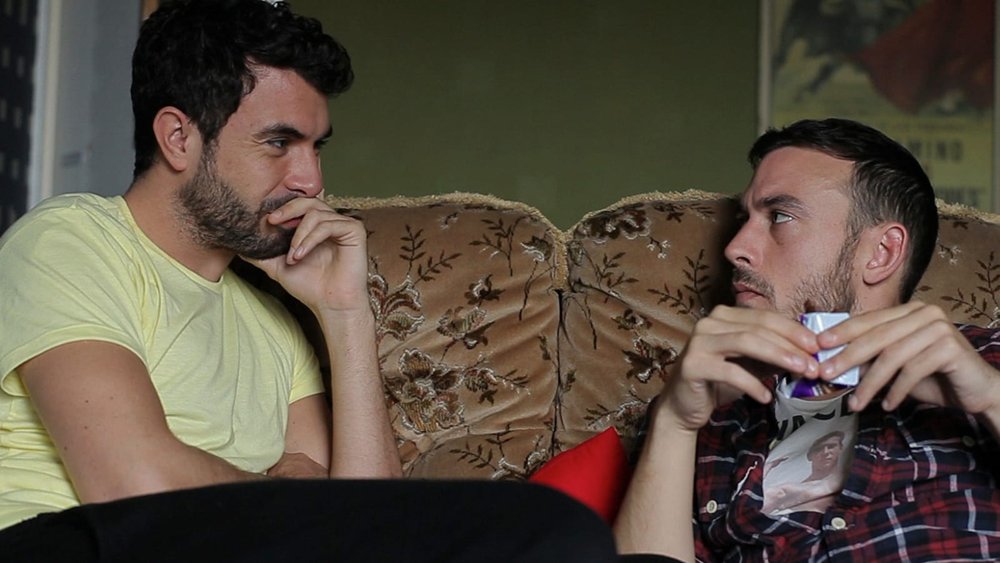
    A one-night stand is often an ending, a joke or a complication. Andrew Haigh’s Weekend uses it as the beginning of a conversation.

    The 2011 film follows Russell and Glen, played by Tom Cullen and Chris New, through a brief encounter that extends across a weekend. Its scale is small enough to make the question of what comes next feel very large.

    That is the reason to put it on an after-dark list. Not because a hookup needs romance to become respectable, but because physical intimacy and emotional disclosure do not necessarily arrive in the same order. A stranger can know one part of you before he knows anything else.

    The useful thing to notice is what the premise refuses to rush past: the time after attraction has done its opening work. What can two people ask each other? Which version of themselves do they offer? How much can be said before the available time runs out?

    Criterion’s edition includes a conversation with Haigh specifically about the sex scenes, giving the curious viewer somewhere to take that discussion beyond the film. No grand claim about the definitive gay experience is necessary. Two men and a short stretch of time are plenty.

    Criterion’s Weekend cover shows two men resting together in bed beneath the film’s title.

    Explore Weekend at Criterion. Adult themes; this is an evergreen film pick, not a claim of free streaming access.

    From my media collectionWeekend (2011)Director: Andrew Haigh β€’ Genre: Drama, Romance β€’ Year: 2011Andrew Haigh’s film on Trove.View on Trove

    Pet Shop Boys: Being Boring

    Finish with Being Boring. The band’s own site points to the corrected HD version of its official video, replacing an American edit that had been uploaded by mistake. That is a good reason to follow the artist’s link rather than whichever reupload turns up first. Pair it with Weekend as an invitation to think about time spent with other people, not a demand to produce a life lesson before the music ends.

    Watch through the official Pet Shop Boys page.
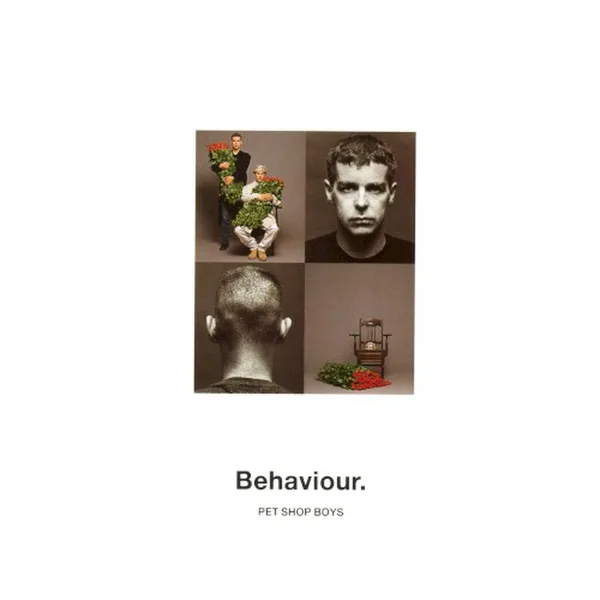
    From my media collectionPet Shop Boys β€” Behaviour (1990)Artist: Pet Shop Boys β€’ Year: 1990The original album featuring Being Boring.View on Trove

    Image credits: David Hockney, A Bigger Splash, 1967, Tate, via The David Hockney Foundation; Β© David Hockney. Weekend still and edition cover by Jason Hardy via The Criterion Collection. Limited contextual images of the works discussed; no endorsement implied.

    Fediverse Reactions
  • 5
    the original pride flag made room for sex

    the original pride flag made room for sex

    The original eight-stripe Pride flag included pink for sex. Its material history is more interesting than a corporate rainbow. Read more

    gay by design Β· no. 1

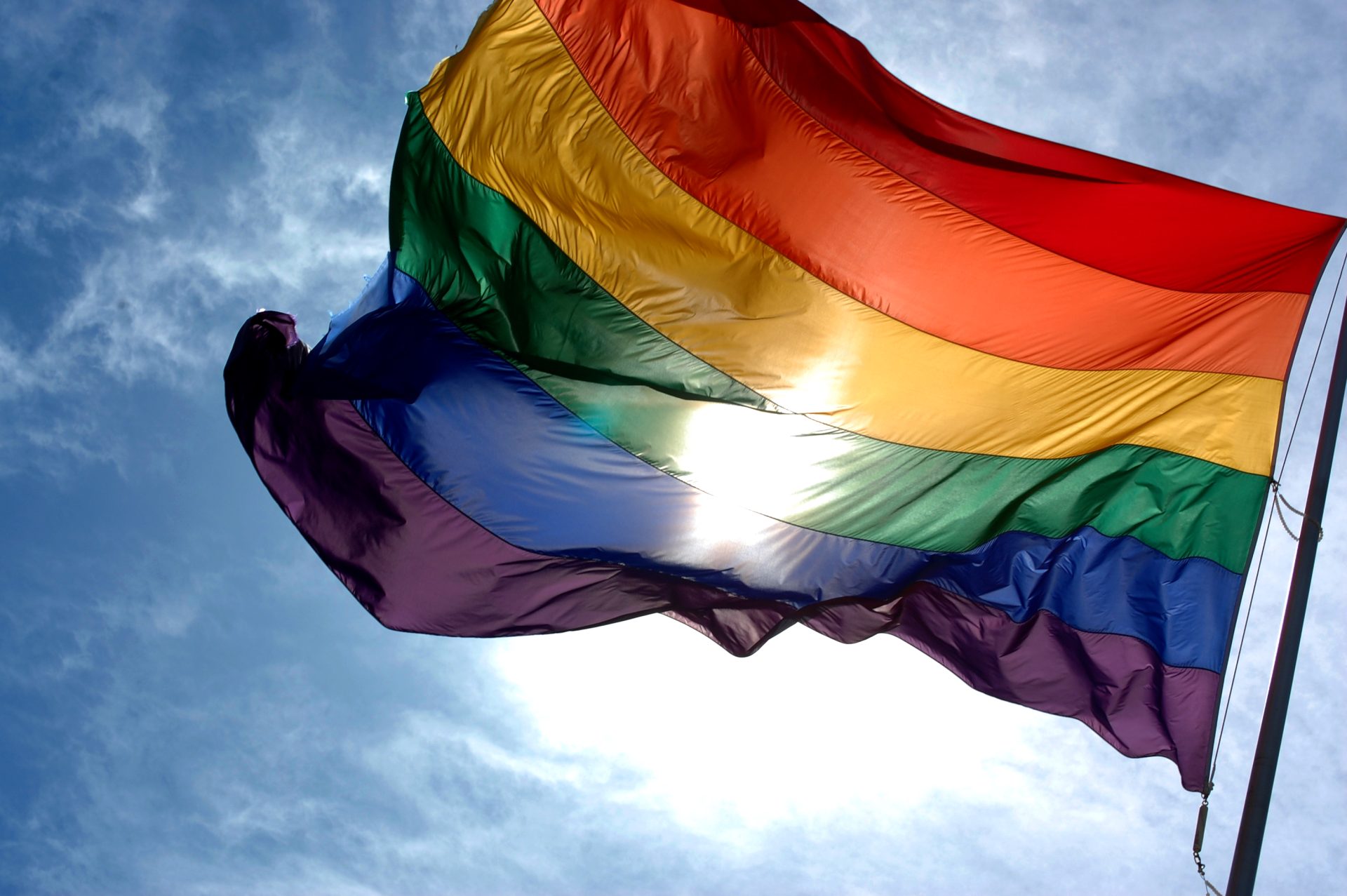
    The original rainbow Pride flag had eight stripes. Pink stood for sex. That seems worth remembering whenever the rainbow gets treated as a particularly cheerful corporate filing system.

    Eight horizontal rainbow stripes, including pink at the top and turquoise above blue.

    The GLBT Historical Society’s exhibition on Gilbert Baker preserves the practical history behind the symbol. The flags made for San Francisco’s 1978 Gay Freedom Day celebrations were handmade, collective undertakings. The archive credits collaborators as well as Baker, including Lynn Segerblom’s distinctive hybrid of rainbow and American-flag designs. This was not a logo that arrived fully formed in a conference room.

    The eight-stripe design assigned meanings across the spectrum: sex, life, healing, sunlight, nature, art and magic, serenity, and spirit. Pink and turquoise subsequently disappeared amid production and display considerations. The familiar six-stripe version is therefore also a story about making and using an object, not simply refining a mood board.

    The familiar six-stripe rainbow flag: red, orange, yellow, green, blue and violet.

    That is what makes the flag a satisfying piece of design. It has to survive outside the drawing. Fabric must be sourced, dyed, cut, sewn, carried and seen at a distance. It must remain legible when the wind folds half of it away. The physical demands are not an unfortunate interruption of the concept. They are where the concept becomes public.

    The horizontal bands give it unusual flexibility. There is no face to reproduce badly, no small lettering to disappear across a street, no elaborate emblem demanding a specialist printer. A child’s drawing and an enormous sewn banner can remain recognizably related without being identical objects. The design can move between scales and materials without losing its central gesture.

    Its usefulness also comes from what it does not insist on specifying. A flag can announce presence before it explains a position. That is different from a policy document, and it is not a defect. In a crowd, on a balcony or in a shop window, the first message is often simply that someone is here and willing to be seen.

    The original pink stripe keeps the history from becoming too antiseptic. Queer identity is not only a suitable sentiment for an annual brand calendar. Desire belongs in the picture. Remembering that does not require pretending one stripe could capture everybody’s relationship to sex. It means refusing to tidy the actual design history into something more comfortable for a sponsor.

    Baker’s own account connects the flag to community, liberation and the possibilities of a shared symbol. The object has since acquired many uses its makers could not control. That is the strange success of public design: people take it somewhere else.

    Looking back at the eight-color version is not a demand to choose one flag forever. It is a reminder that these objects have makers, materials and arguments inside them. The rainbow did not begin as a decorative background. People had to sew it, raise it and stand underneath it.

    Pink was not there by accident.

    sources

    GLBT Historical Society: Gilbert Baker online exhibition.

    Gilbert Baker Foundation: Rainbow Flag origin story.

    National Archives: Gilbert Baker and the Rainbow Flag.

    Image credits: Photograph: Ludovic Bertron, Rainbow flag and blue skies, CC BY 2.0. Eight-stripe flag: Gilbert Baker design, vector by Fibonacci, public domain. Six-stripe flag: Guanaco and subsequent Wikimedia Commons editors, unrestricted reuse. Designs shown as distinct historical versions, not archival photographs.

    Fediverse Reactions
  • 2
    lestat dresses like subtlety owes him money

    lestat dresses like subtlety owes him money

    Lestat does not dress to blend in. The red velvet and wolf fur are doing precisely the opposite job. In AMC’s season-two… Read more

    Lestat does not dress to blend in. The red velvet and wolf fur are doing precisely the opposite job.

    In AMC’s season-two interview, Sam Reid connects those extravagant clothes to Lestat’s refusal to hide. The same instinct drives his theatricality: being looked at is not an unfortunate side effect of immortality. It is part of the attraction.

    That makes the wardrobe more interesting than a collection of expensive vampire outfits. It turns confidence into a visible surface. Before Lestat explains himself, his clothes have already announced that his presence deserves an audience. A quieter man might bring flowers. This one brings production values.

    Costume designer Carol Cutshall gives the elegance a more precise lineage. In her AMC interview about season one, she describes Lestat’s modern suits as retaining a restrictive, almost corseted fit. She also identifies J. C. Leyendecker’s menswear illustrations as a reference for Louis and Lestat’s early coordinated looks.

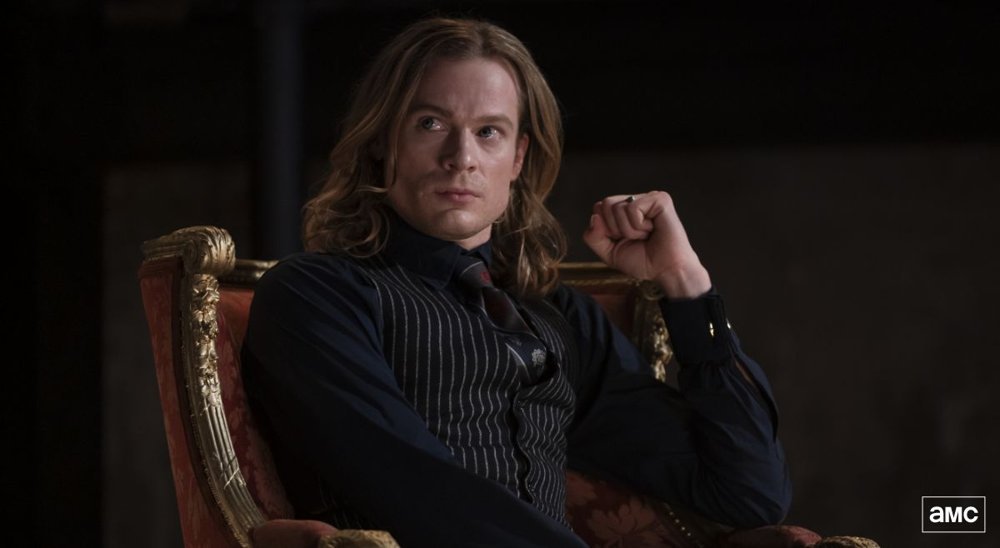
    Lestat wears a dark pinstripe suit over a striped shirt and patterned tie.

    That is a more revealing design idea than simply putting beautiful actors in beautiful clothes. A close fit can make the body seem controlled even when the personality is not. Coordinated outfits can present a couple as a composed unit before the relationship has earned that apparent stability. The wardrobe offers an attractive picture of order; the drama can then pull it apart.

    The publicity stills offer a useful close look at the tailoring: Lestat’s dark pinstripes and layered shirt-and-tie combination keep the torso formally contained; Louis’s lighter pinstripe suit and crisp rounded collar produce a related, but not identical, outline. Even seated in a waistcoat, Lestat looks arranged rather than relaxed. The clothes keep performing composure while the characters do anything but.

    Jacob Anderson as Louis wears a gray pinstripe suit, white rounded collar and patterned tie.

    The useful distinction is between charisma and kindness. Costume can make a fictional monster magnetic without making his behavior defensible. In fact, the gap is the point: the more persuasive the presentation, the easier it is to see how desire and judgment can travel in opposite directions.

    For a costume-minded look at Interview with the Vampire, follow the fabric before the fangs. Red velvet promises warmth. The man wearing it is another matter.

    Read Sam Reid’s AMC interview (season-two spoilers).

    Image credits: Interview with the Vampire publicity stills via AMC and its Carol Cutshall costume interview. Limited visual excerpts for costume criticism; original image credits preserved.

    Fediverse Reactions
  • 11

    Brazilian volleyball star Douglas Souza has married his long-term boyfriend, Gabriel Campos

    Outside hitter Douglas was part of the national team squad that claimed Olympic gold at their home Games in Rio in 2016.… Read more

    Douglas Souza (right) kisses his husband Gabriel Campos, in an image posted in June to celebrate the outside hitter's return to the Brazil national volleyball team. | @augabri and @douglassouza on Instagram

    Outside hitter Douglas was part of the national team squad that claimed Olympic gold at their home Games in Rio in 2016.

    He went on to win World Championships silver with Brazil in 2018, and in the same year, he started posting pictures of himself with his boyfriend on social media, coming out as gay in the process. The couple had begun dating in 2017.

    Source: Outsports

    Fediverse Reactions
  • 1
  • 6
  • 3
    mood

    mood

    πŸ™ƒ Read more

    πŸ™ƒ

    Fediverse Reactions