


thirst, with footnotes · no. 1
Eugen Sandow did not need a dialogue coach. The shoulders were already making a statement.
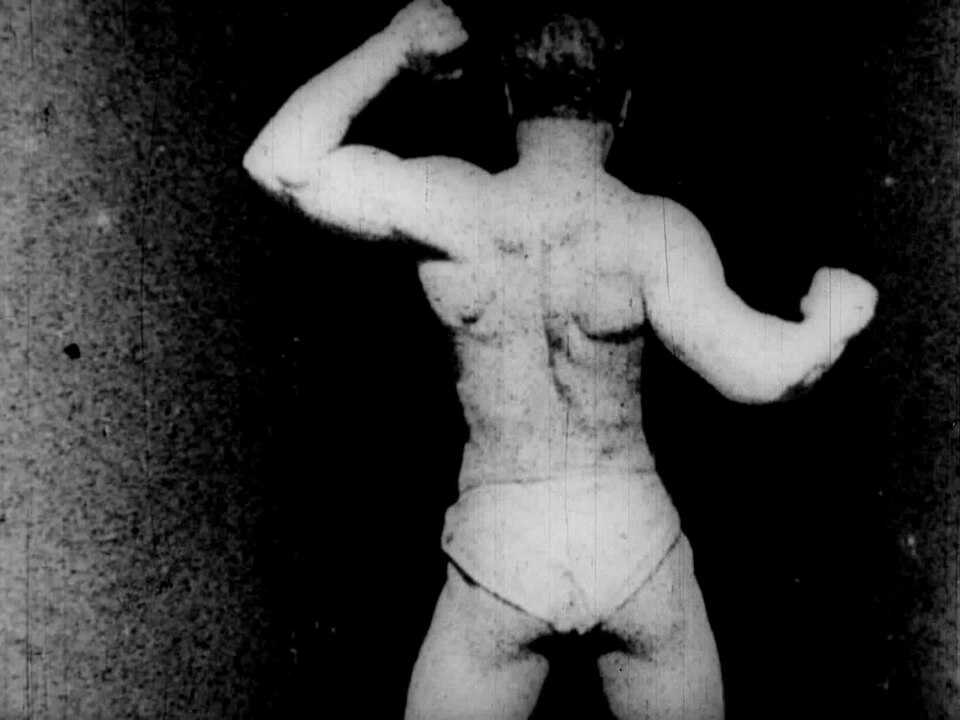
The Library of Congress holds an American Mutoscope film of the strongman, dated approximately 1896, in which the entire attraction is a man presenting his physique to a camera. The catalogue gives its running time as 24 seconds at 16 frames per second. That is enough time to establish a remarkably durable screen genre: an attractive adult man turns slightly, and everybody agrees the technology was worth inventing.
There is a useful distinction here between strength and its presentation. Lifting something proves that a body can do work. Posing makes that body an image. One is a demonstration; the other is an invitation to look. Sandow could supply both, but a camera is particularly good at the invitation.
Look at the period photographs alongside the film. Benjamin J. Falk’s 1894 portrait places Sandow in a classical-looking pose, wearing a fig leaf. Napoleon Sarony’s cabinet portraits similarly turn the performer into a carefully arranged silhouette. Neither photographer is merely recording the circumference of a biceps. The angle of an arm, the distribution of weight and the outline against the background are the product.


The classical reference performs a wonderful little administrative task. A nearly naked man can be introduced as an ideal of physical culture, a study in proportion, a living sculpture. Those descriptions do not make the attraction disappear. They give it a respectable hat. Occasionally the hat is the only substantial garment involved.
That is the point worth keeping from the archive, rather than another argument about who invented the thirst trap. Desire does not arrive after lighting, posture and framing, like an inappropriate guest at an educational event. The arrangement of the image helps produce it. A body becomes a public spectacle through a sequence of choices about how it should be seen.
The vaudeville advertising makes the other half of the business plain. An 1894 Strobridge lithograph promotes Sandow performing a “human dumbell” lift. There is a show to sell, not just an anatomical specimen to admire. The still photographs and the stage poster offer different versions of the same performer: ideal body and extraordinary act.

None of this requires assigning Sandow a sexuality, or pretending every member of his audience looked at him for the same reason. A queer reading belongs to the viewer; it is not a forged entry in the subject’s biography. The pleasure is in noticing how much room the pictures make for looking, despite all the industrious language around them.
The technology has changed. The turn of the shoulder has had a very long career.
look closer
Sandow, American Mutoscope Company, approximately 1896 — Library of Congress. This is not the separate 1894 Edison film.
Falk’s 1894 portrait — Library of Congress image and rights record via Wikimedia Commons.
Sarony’s approximately 1893 portrait.
The Sandow Trocadero Vaudevilles, 1894.
Image credits: Featured image: frame from Sandow (1894), William Kennedy Laurie Dickson / Edison, Library of Congress, public domain. This is the earlier Edison film, not the c.1896 American Mutoscope film discussed above. Body images: Benjamin J. Falk, Eugen Sandow, 1894, Library of Congress, public domain; Strobridge Lithographic Company, The Sandow Trocadero Vaudevilles, 1894, Library of Congress, no known restrictions on publication. Napoleon Sarony, Eugen Sandow, approximately 1893, Library of Congress, public domain in the United States. Original compositions retained.