CHANNEL ARCHIVE

magazines

Dispatches, commentary, and media logs from the open web.

  • 1
    How advertising shaped Thanksgiving as we know it

    How advertising shaped Thanksgiving as we know it

    Libby’s continues to fiercely compete with pumpkin pie peddlers Borden’s, Snowdrift and Mrs. Smith’s for a place on the Thanksgiving table. Jean… Read more

    Libby’s continues to fiercely compete with pumpkin pie peddlers Borden’s, Snowdrift and Mrs. Smith’s for a place on the Thanksgiving table. Jean Beaufort
    Samantha N. N. Cross, Iowa State University

    I have always been intrigued by Thanksgiving – the traditions, the meal, the idea of a holiday that is simply about being thankful.

    For my family, Thanksgiving is all about the food. Some foods, like turkey and mashed potatoes, may be familiar. But there are a few twists. Since I grew up in the Caribbean, I’m allowed a Caribbean dish or two. The reliability of the menu – with a little flexibility sprinkled in – seems to unite us as a family while acknowledging our different cultural backgrounds.

    Chances are you and your family have similar traditions. Filipino-American families might include pancit. Russian-American families might serve a side dish of borscht. That’s what makes Thanksgiving unique. It’s a holiday embraced by people regardless of their religion or ethnicity.

    Yet despite this adaptability, there’s a core part of the meal that almost everyone embraces. How did this come to be? Although few appreciate it, advertisers have shaped the meal as much as family tradition.

    A uniquely broad appeal

    When Sarah Josepha Hale, the editor of Godey’s Lady’s Book, first advocated for Thanksgiving as a national holiday in 1846, she argued that it would unify the country. In our research, my colleagues and I have been able to show that Hale’s vision for the holiday has been largely fulfilled: Inclusivity of people and traditions has been Thanksgiving’s hallmark quality.

    A reason for its broad appeal is that it lacks any association with an institutionalized religion. As one interviewee told us, “There is no other purpose than to sit down with your family and be thankful.” And after interviewing a range of people – from those born in the U.S. to immigrants from countries like South Africa, Australia and China – it became obvious that the principles and rituals they embraced during the holiday were universal no matter the culture: family, food and gratitude.

    But as a relatively new holiday – one not tied to a religious or patriotic tradition – a shared understanding of the celebration and the meal is crucial to ensure its long-term survival.

    While there might be subtle variations, the Thanksgiving meal is the lodestone of the holiday, the magnet that brings people together. Today, familiar items constitute the meal: turkey, cranberry sauce, stuffing, gravy, alcohol, salad, apple pie and pumpkin pie. Many of our interviewees tended to serve some version of this list.

    But why these items and not others? What makes turkey, cranberry sauce and pumpkin pie so special? My colleagues and I studied 99 years of Thanksgiving ads in Good Housekeeping magazine to find out.

    Marketing a ritual

    Starting with Thanksgiving’s early champion, Sarah Josepha Hale, the history of Thanksgiving is rooted in marketing. Marketers not only helped create many of the rituals and cultural myths associated with the Thanksgiving meal, but they also legitimized and maintained them.

    Aladdin Cooking Utensils advertises its double roaster in a 1920 issue of Good Housekeeping. Good Housekeeping

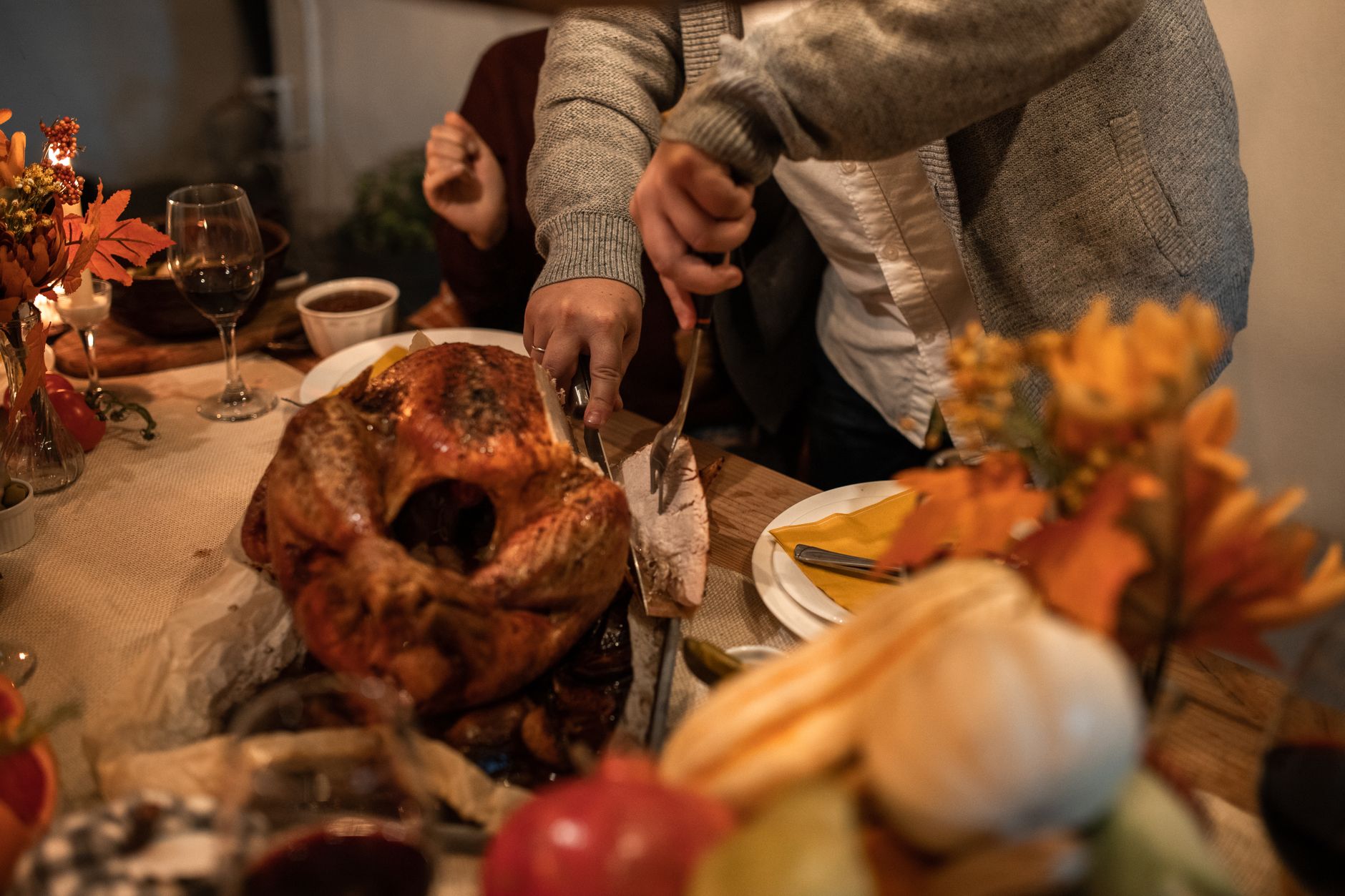
    Initially, the Thanksgiving turkey competed with other meats, like duck, chicken and goose, for centerpiece at the Thanksgiving table.

    But by the 1920s, turkey had become the only meat advertised. Early ads would focus on how to prepare and present the perfect bird, promoting branded tools like roasters, ranges, pop-up thermometers and oven-cooking bags.

    Iconic Swift’s Premium turkey ads focused on the sacredness of the meal by featuring families at prayer, giving thanks before the meal begins. The importance of the turkey to the Thanksgiving celebration dominates, helping to perpetuate the Thanksgiving turkey tradition.

    Meanwhile, early ads for the Eatmor Cranberry Company positioned their whole cranberries as a perfect complement to any and all Thanksgiving meat dishes. This brand dominated until the 1930s when another brand, Ocean Spray, entered with its canned gelatin cranberry sauce.

    Eatmor Cranberries – which used to be the king of Thanksgiving cranberry sauce – advertises in a November 1926 issue of Good Housekeeping. Good Housekeeping

    Ads for both brands implied that cranberry sauce has been around since the first Thanksgiving dinner, which was highly unlikely. However, the brand positioning war successfully promoted cranberry sauce as the natural condiment for the Thanksgiving turkey. Ocean Spray would triumph and, to this day, promotes whole cranberries and canned gelatin.

    Considered by many to be the quintessential Thanksgiving dessert, pumpkin pie also wasn’t present at the first Thanksgiving meal. (The Pilgrims lacked the butter, wheat flour and sugar to make the pastry.) Nonetheless, beginning as early as 1925, a range of brands – for example, Borden’s, Snowdrift, Mrs. Smith’s and Libby’s – have competed fiercely to connect pumpkin pie to the season, the holiday and the meal. It’s a rivalry that continues to this day.

    The role of the consumer

    Not every product category or brand succeeded in becoming a core part of the Thanksgiving meal.

    A Welch’s ad from the 1960s implies that the first Thanksgiving meal included juice made from grapes. In 1928, Diamond marketed their walnuts as an accessory to dress up Thanksgiving dishes. Despite vociferous ad campaigns, few associate Welch’s grape juice or Diamond walnuts with Thanksgiving today.

    But those early 20th-century ads for turkey clearly resonated: Today, nearly 88 percent of U.S. households have turkey on Thanksgiving, and approximately 20 percent of the turkeys consumed in any given year are consumed at Thanksgiving. This is a testament to the enduring influence of marketing on the holiday. For brands like Butterball (formerly Swift’s Premium), Thanksgiving is big business.

    Whether you’re a turkey fan or not, prefer apple pie to pumpkin pie, enjoy canned gelatin over whole cranberry sauce, by celebrating Thanksgiving, you play a role as well. Marketers may have shaped many of the rituals of the holiday. But all Americans – from all backgrounds – certainly do their part to maintain them.

    After all, brands need customers to survive.The Conversation

    Samantha N. N. Cross, Associate Professor of Marketing, Iowa State University

    This article is republished from The Conversation under a Creative Commons license. Read the original article.

    Fediverse Reactions
  • 2
    Spiders, Wires, and Man Meat: Media Diet Omnibus

    Spiders, Wires, and Man Meat: Media Diet Omnibus

    This week has been filled with old habits and trying new things. Join me as I try to take my favorite PS5… Read more

    This week has been filled with old habits and trying new things. Join me as I try to take my favorite PS5 “zone out” game portable, find comfort returning to the magazine aisle, and get drawn back in to my first British soap love thanks to hot shirtless men now that it’s on YouTube.

    Currently Playing: Spider-Man 2

    Screenshot from Spider-Man 2, Spider-Man is in the rain wearing the symbiote suite.

    Starting things off this week, I’m finally playing this year’s Spender-Man sequel. I’ve been dying to play this one, but finding the where for that to happen proved tricky.

    A couple of years ago I got some quality time with a PS5 and PlayStation Plus subscription. The Spider-Man games were on sub at the time, so I decided to try them out. It’s maybe the perfect kind of game for when I just need to zone out and kill some time swinging around the city and collecting stuff.

    But, I had a problem: I no longer had access to a PS5.
    I did get a steam deck last month, though.

    Steam has it listed with a green check-mark for Steam Deck play-ability. But based on the Oblivion anecdotes, I was skeptical. So I head to the sub-reddits and try and see how well (or poor) the game runs and see if it’s feasible. My hopes were seemingly dashed.

    Alas, I think to myself, I guess I’ll just go download the first or second entry and play that instead.

    But then I didn’t. The green check-mark was taunting me and the lax return policy with Steam gave me courage. So, I downloaded it.

    The default settings were trash. The dynamic up-scaling was enabled and left everything looking so rasterized and jagged as I moved that I got where the hate was coming from. And on ultra-low settings?!

    But then I turned that off and everything was fine. I even turned up the settings to the regular “low.”

    There’s occasional slowdown and the quality of the PC port seems to be iffy (though it has apparently improved with patches). But, as someone who’s main driver for all gaming was a Switch for 5+ years, It’s decidedly Fine.

    If I had other means to play this game, I would. But I’m enjoying it. And, one perk of getting it on Steam is that, if (lord willing) I ever manage to get a real gaming rig, I know it’ll look gorge.

    Currently Reading: Wired Magazine

    My favorite thing as a kid–and yes, i suppose this gives a good bit about me away–was the magazine aisle at the store. Oh, mom thought she was getting a little helper for the grocery shop this week? Nah, your boy was in the magazine aisle reading EGM, Wired, and Nintendo Power, trying to decide which one I would beg my mom for.

    photography of a man holding magazine
    Photo by Zay Anyway on Pexels.com

    Usually it was Wired because the neon, over-designed, phone-book-sized periodical really spoke to me. The long-form magazine articles breathed life into technical topics that I’m sure I didn’t quite grasp as an 11 year old standing in front of the brightly lit magazines on aisle 7 of Kroger in Centerville, GA.

    Well, a quarter century has passed, and I’m comforted that Wired has been pretty dedicated to covering how technology is encroaching on society in all aspects. That in addition to political reporting from a tech magazine I didn’t know I would both rely on and cherish led me to buy a physical print subscription to Wired a few months ago.

    My second issue came in the mail last week and it’s very nice to have something to grab, learn about something interesting, and pass the time while not connected to an endless stream of notifications.

    Currently Watching: Hollyoaks

    The Hollyoaks Title Card, "HOLLYOAKS" in white lettering on the background of a canal at sunset.
    Hollyoaks title card

    I have no shame when it comes to my love of British soaps.

    Hollyoaks was actually the first one I ever saw–back when it was streaming on Hulu. It sucked me in by the number of hot, gay men featured in prominent stories. Though, to be fair, there’s plenty of queer love to go around and not just gratuitous man meat.

    I dropped off after Hulu removed the show from its line-up because pirating a soap from across the pond is just too much effort and i couldn’t be asked.

    But, I was in luck! They apparently started uploading all their episodes (and, even better, omnibuses!) to YouTube for global viewing at the same delay they used to post to Hulu.

    This means that I can actually watch the gayest UK soap again!

    Hollyoaks characters Dillon Ray and Lucas Hay in a still from the show. Dillon is holding Lucas's face as Lucas cries.
    Hollyoaks characters Dillon Ray and Lucas Hay in a still from the show.

    The show has been putting a lot of gay stories on as front-burner plots again, and I’m here for it. They also tend to lay on the gratuitous male nudity a little bit, which is even better.

    Bonus Track: Bitch on Heels

    This week’s Bonus Track is “Bitch on Heels” by The Vivienne.

    It’s inexplicably a song written by Diane Warren and it get stuck in my head all the time.

    R.I.P. Vivienne, you were gone far too soon 💜.

    Fediverse Reactions