
Telly on the microphone
ON THE AIR

Hot takes, wrestling rabbit holes, free-streaming deep dives & life on the open web. Welcome to taco ‘bout it—Schwegler’s corner for TV commentary, chaotic internet culture, and fediverse experiments.

  • the cw gives you six months between high school and somebody’s dad

    the cw gives you six months between high school and somebody’s dad

    the worst part about your late thirties is not aging. it’s getting recast from high schooler to somebody’s complicated dad between seasons. Tune in & read →

    the worst part about entering your late thirties is not the back pain or realizing every useful household object has become an acceptable birthday gift. it is knowing the CW may finally stop believing you attend high school and immediately cast you as somebody’s suspiciously young father.

    worst part about being in your late thirties is knowing that you’re almost too old to play a high schooler on a CW show

    — schweg, but spooky (@schwegler.lol) 2026-10-04T11:17:32.982Z

    this is obviously a joke. I am 37, and nobody has asked me to lean against a locker while explaining that the homecoming dance has changed everything. but television has spent decades teaching us that high school is not an age. it is a lighting package.

    give an adult a backpack, remove one day of beard growth, and place him beside a painted cinder-block wall. congratulations: this man has algebra after lunch. he may have a mortgage. he may have strong opinions about lumbar support. none of that matters once the bell rings.

    high school is a set of props

    teen dramas need teenage problems but adult performers. there are practical reasons for that. adults can work longer hours, handle heavier material, and arrive on set without an actual school day competing with the fictional one. the practical decision eventually became an aesthetic: television teenagers are adults with excellent skin who have never been permitted to own a sensible jacket.

    An empty classroom with rows of desks facing a large chalkboard
    High school on television is less an age than a room everybody agrees to recognize. Photo: Ivan Aleksic / Unsplash.

    this distorts the scale at both ends. actual teenagers look unfinished because they are. television teenagers arrive assembled. they have adult faces, adult bodies, adult confidence, and a plot that requires them to run a nightclub after chemistry. viewers learn to accept 25 as 16 because the show has supplied lockers and one deeply overfunded school dance.

    then the lockers disappear.

    one reply to my post got the transition exactly right: “then you immediately become the designated adult.” there is no television category for a person who has stopped passing for fictional high school but does not yet feel like the person who should cancel the field trip. you are either sneaking out of the house or standing in the kitchen waiting for your child to sneak back in.

    the dad role has already read your résumé

    this is how popular culture likes age: sorted, visible, and useful to the plot. youth means possibility. parenthood means authority, disappointment, or a secret that will be revealed during sweeps. the middle is narratively inconvenient. a 37-year-old can spend an entire real day being competent at work, confused in a grocery store, attracted to somebody inappropriate, and worried about an elderly relative. television would prefer to know whether he is going to prom or forbidding it.

    A person holding a clapperboard outdoors on a film set at sunset
    The industry can change your entire age bracket between “action” and the next audition. Photo: Jakob Owens / Unsplash.

    gay culture has its own version of this sorting problem. the internet will let a man remain a “twink” until one birthday causes an emergency board meeting. dating apps ask for an age and convert a gradual human process into a filter boundary. a person does not become fundamentally different at midnight, but the menu needs somewhere to put him.

    I have already written about why I would not let 20-year-old me conduct my performance review. he had more hair, worse judgment, and no idea how often a body can hurt because it slept in a slightly ambitious position. he is not the standard. neither is a casting director deciding whether my face says “senior year” or “principal who knows more than he admits.”

    real adulthood does not have a time jump

    the useful thing about getting older is discovering how little actually changes on schedule. there is no episode where everyone returns after summer and your role has been reassigned. you accumulate knowledge, prescriptions, good pans, bad knees, old jokes, and people who remember previous versions of you. occasionally you look in the mirror and notice the costume department has made an adjustment without consulting you.

    I may be approaching the end of my CW high-school eligibility. fine. I was never prepared for the homework. but I reject the premise that the only available promotion is “hot dad with a secret second family.” television can keep its age brackets.

    I am going to stand beside these lockers until somebody brings me a backpack or a chair with proper lumbar support.
  • the lesbian bar cannot pay rent with ideological consistency

    the lesbian bar cannot pay rent with ideological consistency

    a KN-95 policy can be care. one mask-optional night can also be care. a community space that closes because nobody lets it… Tune in & read →

    a KN-95 policy can be care. one mask-optional night can also be care. a community space that closes because nobody lets it compromise is accessible to absolutely no one.

    I think a bar targeting immunocompromised lesbians is cool but I don’t understand getting mad because, when the bar is struggling with money, they did one day a week with masks not required

    — schweg, but spooky (@schwegler.lol) 2026-10-02T12:28:02.120Z

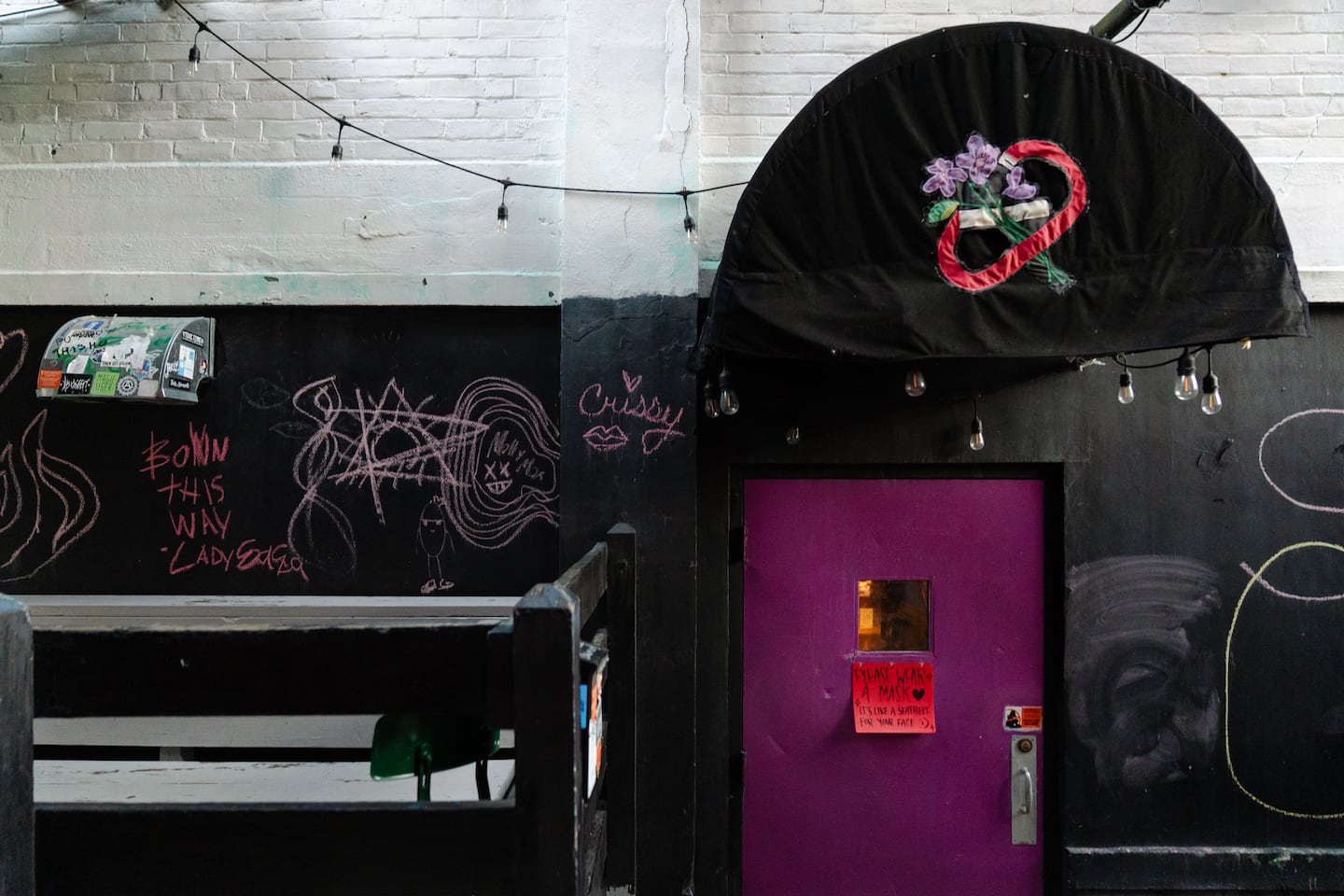
    Last Ditch Bar and Arts Venue opened in Greenfield, Massachusetts, with a very specific promise: a queer community space where patrons wore KN-95 masks or better. that made the bar usable for immunocompromised and COVID-conscious people who cannot simply decide that the pandemic ended when everybody else got bored.

    then the bar started running out of money, because values are free and commercial rent remains stubbornly invoiced in dollars. management announced that Saturday nights would become mask-optional while the rest of its schedule remained masked. the idea was to try ordinary club nights with DJs, themes, and enough paying customers to keep the lights on.

    this was treated in some corners as a moral betrayal instead of a small business making one compromise on one night of the week. and I do understand why people were upset. the entire appeal of Last Ditch was that it had designed the room around people other bars exclude. when an accessibility promise changes, even partially, the people who relied on it are allowed to feel like something was taken from them.

    but a feeling of loss does not magically become a business plan.

    somebody still has to make the number go up

    the Boston Globe’s reporting makes the arithmetic bleak. the founders let people in when they could not afford the cover. workers went unpaid. the remaining owner had lived in her truck, worked four jobs, and was still responsible for a $50,000 business loan. at the end of one three-and-a-half-hour community meeting about the mask change, the landlord wanted $3,900 in back rent by Monday.

    Two patrons wearing KN-95 masks talk during karaoke night inside Last Ditch Bar
    Jackie Matellian talks with Meaghan Cuevas during a masked karaoke night. Photo: Sophie Park for The Boston Globe.

    none of those facts prove that every decision made by the bar was correct. they prove that the argument was not happening in the clean laboratory of discourse, where every value can be preserved if everyone uses enough words like “accountability.” it was happening in a basement with a liquor license, a mostly empty dance floor, and bills.

    small queer spaces get assigned impossible jobs. be a bar, but also a community center. be accessible, but also loud, crowded, and financially viable. welcome poor people, but charge enough to pay workers. provide public-health protections stronger than almost any other venue, but somehow attract customers who do not want those protections. perform all of this perfectly, or become evidence that the whole project was fraudulent.

    the answer cannot be that access stops mattering whenever it becomes expensive. masks are not a decorative little flourish for the mission statement; for some patrons, they determine whether the space is available at all. but that is precisely why keeping six masked nights and trying one mask-optional Saturday reads to me as an attempt to preserve access, not abandon it.

    the revolution has a liquor license

    Last Ditch said it would continue prioritizing masked bookings and hold a recurring masked social. that is not perfect access. neither is shutting the bar down and replacing its calendar with a tasteful Instagram memorial about how important queer spaces are.

    A library corner inside Last Ditch Bar with books, zines, local art, a bulletin board, and a dartboard
    Books, zines, and community art inside Last Ditch Bar. Photo: Sophie Park for The Boston Globe.

    the most revealing part of the whole argument is that the actual villain is boring. it is not immunocompromised lesbians asking for safety. it is not the people who want to dance without a respirator. it is the economic arrangement that makes one exhausted 26-year-old personally responsible for reconciling public health, radical politics, hospitality, and $3,900 in back rent before Monday.

    capitalism loves making community spaces prove their virtue through self-destruction. if the bar raises prices, it excludes poor patrons. if it enforces a cover charge, it betrays its mutual-aid mission. if it relaxes one rule to attract enough customers to survive, it has sold out the people it was built to serve. every available path is framed as harm, while “go bankrupt correctly” remains the only option nobody has to defend.

    a closed bar has a very simple mask policy

    community is not a product you can order with every accommodation preinstalled. it is a pile of people making imperfect choices about shared resources, sometimes badly, while the rent keeps accruing. solidarity should mean arguing for the safest workable version of the space and helping it find the money to exist. it cannot mean demanding that the people running it absorb every contradiction until they disappear.

    if Last Ditch closes, nobody wins the mask argument. immunocompromised patrons lose one of the only bars designed around them. Greenfield loses a queer venue, free store, performance space, and community center. everybody else gets to post a very principled obituary.

    that seems considerably less accessible than Saturday.

  • the head of trust and safety should not have an automated enemies list

    the head of trust and safety should not have an automated enemies list

    a personal block is a boundary. a trust-and-safety chief automating one is a governance problem wearing the skin of a vibe check. Tune in & read →

    a personal block is a boundary. a head of trust and safety automating one is a governance problem wearing the skin of a vibe check.

    this morning, Andrew discovered that Aaron Rodericks had blocked him on Bluesky. Rodericks’s profile identifies him as Bluesky’s Head of Trust and Safety and currently announces, “Automation enabled on interactions — abuse will generate auto-blocks.” Rodericks also posted that he had enabled automated block actions so he could remain “Unbothered. Moisturized. Happy. In my lane. Focused. Flourishing.”

    I didn’t even call the dumb motherfucker out for liking questionable skeets or anything. smdh

    — schweg, but spooky (@schwegler.lol) 2026-09-30T12:11:42.096Z
    Bluesky screen stating that @aaron.bsky.team has blocked Andrew
    The block notice Andrew posted on September 30. Screenshot: @schwegler.lol on Bluesky.

    maybe every account caught by that automation deserved the block. maybe none did. that is not the interesting part, because a user does not owe anybody a hearing before removing them from a feed. the block button exists precisely so ordinary people can stop litigating whether somebody has earned access to them.

    the problem is that this is not an ordinary account. the person pressing—or delegating—the button also leads the team that can label content, restrict visibility, suspend accounts, and decide what counts as abuse across the service. the personal preference and the institutional judgment live inside one profile, and an automated system is apparently helping sort the guest list.

    the block button has two jobs now

    Bluesky’s founding moderation pitch was built around separating powers. instead of one company making every fine-grained decision, users could choose additional labelers, filters, and community rules. the company described moderation as customizable infrastructure where human and automated systems work together, with user agency as the point.

    that is a genuinely better idea than pretending one universal feed can settle every argument on earth. it also makes this particular mess look worse. composable moderation depends on people understanding which layer is acting on them. did a person set a private boundary? did an automated tool classify an interaction as abuse? did a platform official exercise power? when all three wear the same handle, “user choice” begins to resemble the manager personally working the velvet rope.

    Automated block actions on my account, so that I can stay Unbothered. Moisturized. Happy. In my lane. Focused. Flourishing.TBH it was well overdue.

    — Aaron Rodericks (@aaron.bsky.team) 2026-09-30T12:33:40.828Z
    Profile photograph of Aaron Rodericks, Bluesky's Head of Trust and Safety
    Aaron Rodericks identifies himself as Bluesky’s Head of Trust and Safety. Image: @aaron.bsky.team.

    Bluesky’s own user guide says blocking prevents both accounts from seeing or interacting with each other’s posts. that is fine for users. it becomes structurally strange when the blocked person is still subject to the blocker’s professional authority. Andrew put it neatly: if the head of trust and safety blocks you, he also should not get to use moderation tools to inspect your posts.

    it should be a rule that if the head of trust and safety blocks you that he also can’t use his moderating tools to see your skeets

    — schweg, but spooky (@schwegler.lol) 2026-09-30T12:16:22.419Z

    due process cannot be a mood

    this does not require executives to accept unlimited abuse. it requires boring procedures, which is how organizations keep personal conflict from becoming policy. staff accounts can mute freely. blocks can trigger disclosure and recusal. automated lists can be documented, appealable, and separated from enforcement tools. another moderator can review reports involving somebody their boss has personally blocked. none of this is exotic. it is the administrative equivalent of not letting the referee place bets from the field.

    Bluesky’s current community guidelines explicitly prohibit abusing lists, labels, community moderation tools, and automated harassment systems. the company also says baseline enforcement requires careful judgment and that appeals exist when it gets something wrong. those promises need to apply most visibly when the dispute involves the person running trust and safety. otherwise the lesson is that automation creates accountability for users and plausible deniability for management.

    the internet has spent years discovering that content moderation is unavoidable and power without transparency is intolerable. Bluesky was supposed to improve that bargain by making moderation plural, legible, and user-controlled. an automated enemies list attached to the trust-and-safety chief’s personal account moves in the opposite direction. it collapses a private annoyance, a machine judgment, and an institutional hierarchy into one cheerful little “Unbothered” button.

    being unbothered is a reasonable goal for a person. it is not a governance model.

  • black ranch is purple ketchup wearing a spirit halloween uniform

    black ranch is purple ketchup wearing a spirit halloween uniform

    black ranch tastes like ranch. the product is the moment everybody at the party decides whether fries should look haunted. Tune in & read →

    i have now read enough articles about Hidden Valley’s black Halloween ranch to confirm that it is real, which has not made it feel more real. Spooky Ranch is Original Ranch turned black with fruit juice and cocoa, poured into a glow-in-the-dark bottle, and sold exclusively at Walmart for the season. it tastes like ranch. it looks like the ranch has been listening to Bauhaus.

    I’ve read 6 news articles about this because I’m still not believing this is real because now what the fuck is this?

    — schweg, (@schwegler.lol) 2026-09-27T18:14:13.409Z

    Hidden Valley says the bottle can become the centerpiece of a Halloween spread. this is extremely honest marketing because the condiment is not trying to improve ranch. it is trying to become an activity. nobody at a party gathers around ordinary ranch to discuss whether they are brave enough to put it on a fry. black ranch arrives with its own conversation prompt.

    that is the actual product: thirty seconds during which everybody looks at a bowl of edible darkness, one person says absolutely not, another person dips a pizza crust for the camera, and somebody remembers the green ketchup.

    the condiment is doing the icebreaker’s job

    A bottle of Hidden Valley Spooky Ranch with black ranch displayed on a dark Halloween set
    The ranch is black; the flavor is still ranch. Image: Hidden Valley.

    novelty condiments have always understood that a familiar food can become entertainment if you make it look slightly incorrect. Heinz launched Blastin’ Green ketchup in 2000 and Funky Purple followed in 2001. the green version was not an immediate cautionary tale. it was a hit: Heinz said it sold more than 10 million bottles in seven months, increased ketchup sales by 5.4 percent, and pushed its American market share from 55 to 59 percent.

    the bottle had a narrow nozzle so children could draw on their food. this mattered more than the color. Heinz had turned ketchup from a substance into a toy with a hot-dog canvas. the strange color gave parents a reason to buy one bottle; making lunch briefly interactive gave children a reason to ask for it.

    Spooky Ranch is the grown-up seasonal version of the same trick. its label reassures us that there are no artificial flavors because adulthood requires the dare to arrive with paperwork. the product is limited, exclusive, photogenic, and attached to a holiday that already gives us permission to buy decorative garbage for one night. it does not need to become anybody’s permanent ranch. it needs to survive one snack table and appear in several camera rolls.

    your mouth is not color-blind

    Black Hidden Valley Spooky Ranch served with fries on a purple Halloween spread
    The limited-edition sauce is designed to become the center of a Halloween snack table. Image: Hidden Valley.

    the problem is that food color is not packaging. it is part of the instruction. white ranch tells the brain cool, creamy, familiar. black sauce suggests char, squid ink, chocolate, or the consequences of opening an ancient tomb. Hidden Valley can promise that the flavor is unchanged, but the entire fun of the product depends on the body refusing to believe the mouth.

    this is why the green and purple ketchup memories are so durable. people do not remember a subtle reformulation. they remember looking at a normal french fry covered in the wrong visual information. one reply to my post immediately brought up the Ang Lee Hulk-era green ketchup. i remember both green and purple, and i remember them as abominations even though they were still ketchup. the flavor lost an argument with the color before the bottle reached the table.

    brands know this now with considerably better cameras. the ideal limited-edition product does not merely get eaten; it produces proof of purchase. it is engineered to make a person post, “look what i found,” before deciding whether they actually want it. the black ranch gets a photograph, a reaction video, a party debate, and then perhaps some wings. the meal is fourth in the sequence.

    i do not think this means Spooky Ranch will fail. i think it may sell very well, for exactly the same reason purple ketchup sold very well before eventually disappearing: curiosity is powerful, and nobody expects a Halloween prop to earn permanent pantry space. success is one bottle everybody talks about. repeat business can wait for ranch to become white again.

    the black ranch is not a new flavor so much as an old marketing idea dressed for October. it is purple ketchup wearing a Spirit Halloween uniform, standing beside the fries, waiting for somebody to ask what the fuck it is. honestly, that somebody was me. the condiment has already done its job.

  • dating apps think every gay man lives twelve minutes from a tapas bar

    dating apps think every gay man lives twelve minutes from a tapas bar

    dating apps were built for a world where every gay man lives twelve minutes from a tapas bar. outside the metro, the… Tune in & read →

    i asked what dating app works best for gay men in a place where the population density of out gay men is very low. i got an answer almost immediately, although it was not the name of an app: apparently the apps work best when you already live near enough gay men that you could have found one while looking for brunch.

    ⚠️ Attention ⚠️ I need to ask the audience. What’s the best dating app for gay men in an area where the population density of out gay men is very low?Tinder is hit and miss here and I get a lot of “oh you’re 45 miles away how are we gonna hook up” like idk I was in a dating app not a hookup app?

    — schweg, (@schwegler.lol) 2026-09-27T16:02:41.981Z

    in Montgomery, Tinder is hit or miss. Hinge mostly shows me men in Atlanta. Facebook Dating can produce profiles but not, apparently, replies. Coffee Meets Bagel once looked at the surrounding geography and told me there was nobody close enough to show me at all. nothing says “put yourself out there” like software returning an empty set.

    dating apps sell compatibility, chemistry, values, prompts, attachment styles, astrological signs, and whatever personality category can be expressed through six photographs and a sentence about tacos. outside a major city, their most important feature is still population density. the algorithm can weigh every preference i have. it cannot manufacture a gay man on the correct side of a two-hour round trip.

    proximity has been doing all the work

    the standard dating-app experience quietly assumes a metropolitan abundance: enough people nearby to make rejection cheap, enough roads or transit to make meeting casual, enough queer public life that “45 miles away” sounds like a filter problem instead of the next available option.

    An aerial view of a rural community, church, fields, and a winding two-lane road
    A rural community organized along a winding road. Photo: Alex Reynolds / Unsplash.

    that assumption is easy to mistake for a neutral interface. it is not. the cards keep arriving, so the system feels infinite. swipe left; there will be another person. let a conversation die; there will be another match. set the radius tighter; there will still be a city inside it. the app teaches people to treat human beings as abundant because the city made them abundant first.

    outside that density, the same design becomes mean in a very specific way. it does not say, “the available population is small because you are queer in a place where fewer people are out, visible, nearby, and using this particular product.” it just stops showing people. scarcity arrives dressed as feedback.

    straight people in small towns obviously encounter distance too. the difference is that queer dating starts with a smaller pool, then subtracts everyone who is unavailable, closeted, unsafe, incompatible, looking for something else, or using a different app. by the time software applies the normal preference filters, it has occasionally filtered the state down to three men and one of them is visiting from Nashville.

    dating should not require a regional planning commission

    one man on Tinder recently reacted to our 45-mile distance with, “how are we gonna hook up?” fair question, if hooking up is the assignment. i thought i had opened a dating app. this is one of the other ways sparse geography distorts the product: distance stops being a preference and becomes the entire relationship format. a nearby hookup may be practical. a date 45 miles away requires calendars, gasoline, and the confidence that this stranger is worth passing several exits for.

    A long empty highway stretching toward distant mountains under a wide sky
    Distance is not an abstract filter when it is this much road. Photo: Yifu Wu / Unsplash.

    no app can fix the number of gay men in central Alabama. an app could at least stop pretending every user lives in a neighborhood where five miles contains a complete romantic ecosystem. it could treat travel tolerance as more than a radius slider. it could distinguish “far away but open to planning” from “close enough to come over.” it could show drive time instead of drawing a circle that means very different things depending on whether it contains subway stops or soybean fields.

    mostly, it could be honest about what it is measuring. when Hinge shows me Atlanta, that is not a daring expansion of my dating life. it is a relocation suggestion. when Coffee Meets Bagel says there is nobody nearby, that is not evidence that i have failed at being appealing. the software has reached the edge of its map and decided to make the blank space feel personal.

    i still want to know whether one app handles this better. maybe somebody has built a small-town queer dating miracle and hidden it from me. but the larger problem cannot be solved by downloading the correct icon. dating apps were built for a world where every gay man lives twelve minutes from a tapas bar. out here, the algorithm did not reject me. it ran out of gay men before it ran out of road.

  • 1
    bluesky was small enough to reskeet every dick at 10 p.m.

    bluesky was small enough to reskeet every dick at 10 p.m.

    a 10 p.m. dick-pic reskeet ritual was once logistically possible. that says something about the weird, tiny, communal Bluesky of summer 2023. Tune in & read →

    someone asked the Bluesky elders to tell stories about when the place was fun. i have one that sounds made up, and the part that sounds most made up is the math.

    Dear Bluesky Elders,Tell us stories of the days when Bluesky was fun.

    — TwoSense (@twosense.bsky.social) 2026-09-25T16:07:36.545Z

    in the summer of 2023, i used to scroll a fire-hose feed of labeled posts every night at 10 p.m. and reskeet every dick pic i saw. every one. this was an achievable task on a social network, which should tell you roughly how many people were in the room.

    i used to reskeet EVERY dick pic on this platform each night at 10pm–a thing that was doable because of a fire-hose feed of all labeled posts i would scroll through combined with a relatively low volume overall many things i've seen that i can't unsee in that feed

    — schweg, (@schwegler.lol) 2026-09-25T16:51:47.684Z

    the ritual was ridiculous. it was also a pretty good measure of what early Bluesky felt like: small enough to develop customs that were neither product features nor content strategies. you could just decide it was dick o’clock and, for a little while, that became a thing other people might recognize.

    the app was still being assembled around us

    i arrived on June 1, 2023, with an invite from a former coworker. there was a “What’s Hot Classic” feed, an Android app that had several creative interpretations of a swipe, and a thing called Hellthread that turned notifications into an involuntary group chat. the interface had seams. people immediately started living in them.

    A July 2023 Bluesky app screen showing selectable feed tabs above the Popular With Friends feed
    The feed tabs in July 2023, when the place still felt like an experiment you could poke. Screenshot: Bluesky, used for commentary.

    the custom feeds made the network feel less like a single room than a building whose occupants kept knocking holes between apartments. the Hellthread people were making lore and mutual aid and terrible jokes. somebody else could build a feed for an entirely different fixation. mine, apparently, included performing a nightly public service for the labeled-post enthusiasts.

    the original “my month in hell” is the messy, contemporaneous version of what that community meant to me. i wrote it in July 2023, while i was still furious about losing the notification behavior that made Hellthread feel like a chat room. three years later, i’m less interested in claiming the broken app was secretly perfect. it wasn’t. i’m interested in why a broken app gave people enough room to invent an evening.

    nostalgia needs its moderation settings on

    “the good ol’ days” can be an annoyingly selective memory. early Bluesky was chaotic in ways that were funny and ways that were harmful. the problems around moderation, racism, and who got to feel comfortable there were real. small communities can be warm; they can also make every conflict feel like it is happening at your kitchen table.

    Bluesky's June 2023 moderation screen showing controls for nudity and other labeled content
    A June 2023 moderation screen: even the settings were still taking shape. Screenshot: Bluesky, used for commentary.

    i don’t want the site restored to its 2023 bugs, or its 2023 capacity. i want to remember that some of the fun came from people making things together without first asking whether those things could scale. a feed could be a hangout. a notification malfunction could be a gathering place. a stranger could make an incredibly dumb joke and a dozen people would keep it going longer than was medically advisable.

    and, at 10 p.m., the entire labeled fire hose could be small enough for one gay man with a phone to finish his rounds. i saw some things i cannot unsee. i also saw a social network where you could still reach the end.

    Historical app screenshots from Bluesky’s June 2023 beta update and its July 2023 custom feeds post, reproduced with attribution for commentary.

  • the iPad line is a value menu and a luxury car dealership

    the iPad line is a value menu and a luxury car dealership

    the $449 iPad is enough for almost everyone. the $1,199 iPad Pro may be the best tablet money can buy. the middle… Tune in & read →

    Apple sells four kinds of iPad, which sounds like a product line until you look at the prices and realize it is two different stores sharing a hallway.

    At one end, there is a $449 tablet that can handle school, streaming, email, video calls, notes, games, drawing, and most of the other things people mean when they say they want a tablet. At the other, there is a $1,199 slab with a laptop-class chip and a display engineered for people who have opinions about black levels.

    Both are easy to recommend. The middle has been asked to prepare a presentation.

    ipads are weird because the line has both the cheapest decent tablet and the best expensive tablet on the market

    — schweg, (@schwegler.lol) 2026-09-24T14:35:49.232Z

    the cheap one is not a punishment

    Apple’s current lineup starts with the 11-inch iPad at $449. It has the A16 chip, a Liquid Retina display, 128GB of storage at the base price, a landscape front camera, USB-C, and support for a keyboard and Apple Pencil.

    That is not the iPad you buy while apologizing to yourself. It is the iPad most people should buy.

    The screen is not laminated. The chip is not part of Apple’s M-series. The accessory situation contains the usual light administrative cruelty. But none of those facts change the basic experience of opening a browser, watching a movie, reading a comic, playing a game, or moving three apps around while pretending the fourth one is not where the missing document went.

    A cheap Android tablet can be cheaper. A good Android tablet can be more flexible, especially for emulation, file management, or anyone who prefers Android on principle. But the base iPad remains irritatingly complete. It is the rare entry-level Apple product where the compromises mostly wait until after you have started doing something unusually specific.

    the Air is where the explanation begins

    The 11-inch iPad Air starts at $749. The extra $300 buys the M4 chip, a laminated display with P3 color, faster connectivity, Apple Pencil Pro support, and a device with much more performance than ordinary tablet work can currently threaten.

    Current iPad Air models in several colors shown from the front and back
    The iPad Air now uses Apple’s M4 chip and starts at $749. Image: Apple.

    This is the sensible upgrade. It is lighter than the word Pro, more powerful than the word Air has any right to imply, and available in 11- and 13-inch sizes. If you draw, edit video, keep a tablet for years, or simply notice display lamination every time your Pencil touches glass, the Air makes a coherent case.

    The problem is not that the Air is bad. The problem is that rationality has terrible merchandising. If the $449 iPad already does everything you need, $300 is a lot to spend on things you may appreciate but cannot turn into a dramatic sentence. If you are already willing to spend serious-computer money, the Pro is standing nearby wearing a much better screen and looking impossibly thin.

    The Air is the correct answer for a large group of people. It just arrives with homework.

    the expensive one is not pretending to be practical

    The 11-inch iPad Pro starts at $1,199. According to Apple’s comparison page, it pairs the M5 chip with an Ultra Retina XDR display, ProMotion, Thunderbolt and USB 4, and the option for nano-texture glass on higher-capacity models. The 13-inch version moves farther into “please discuss this with your accountant” territory.

    Current iPad Pro models in space black and silver shown from the front and back
    The current iPad Pro pairs the M5 chip with Apple’s Ultra Retina XDR display. Image: Apple.

    It is absurd. It is also probably the best tablet on the market if “best” means the fastest hardware, the strongest display, the thinnest design, and the fewest compromises inside the category.

    Whether iPadOS can justify all of that hardware is the question Apple has been answering with increasingly elaborate window-management demonstrations. But the device itself is not confused. It is a luxury object that can also edit five streams of 4K ProRes footage, which is at least more useful than most luxury objects.

    the lineup makes sense if you stop asking it to be one lineup

    One reply to my post recommended a Surface Pro for school because it can move between tablet and laptop jobs without asking the buyer to choose which kind of computer they are allowed to own. That is the more useful framing. This is less a contest between spec sheets than a question about what problem the object is supposed to solve.

    The base iPad is a very good appliance. The iPad Pro is a very good obsession. The Air lives between them, collecting the people who know exactly which base-model limitation will annoy them but cannot produce a professional reason to spend $1,199.

    Apple did not build one tablet line. It built the cheapest decent tablet and the best expensive tablet, then placed a perfectly reasonable product between them to handle customer-service escalations.

  • Drew picked dad over big sis, and BB28 has its final three

    Drew picked dad over big sis, and BB28 has its final three

    Drew evicted Dee, kept Rick, and sent Taylor, Drew, and Rick to the final three. yay or boo, whichever you prefer. Tune in & read →

    episode spoilers for Big Brother 28 through the final-four eviction on Thursday, September 24.

    Taylor won the HOH that guaranteed her a chair at the end. Drew won the veto that turned the other two chairs into his personal seating chart. then he evicted Dee, kept Rick, and gave us a final three that can be greeted with either “yay” or “boo” without changing the punctuation.

    what happened

    The entire final-four round happened inside Thursday’s two-hour episode. Taylor beat Dee and Drew for HOH, then nominated both of them. Drew won the veto, used it on himself, and forced Rick Devens onto the block beside Dee.

    That made Drew the only voter. He chose to evict Dee, ending the Icons pair and sending Taylor, Drew, and Rick to the final three. Big Brother Network’s final-four results confirm the whole sequence, which is useful because the episode compressed an HOH, nominations, veto, veto meeting, eviction, and several years of emotional aging into two hours.

    Big Brother 28 finalist Drew Campbell wearing a black-and-white striped shirt
    Drew Campbell. Photo: Evan Mulling/CBS, via Parade.

    Drew finally made the move

    Drew spent weeks close enough to the Icons that every decision became a referendum on whether he was playing with them or merely decorating their alliance. He voted out Yash over Dee. He absorbed the jury’s suspicion. He kept insisting there was a point at which loyalty would become timing.

    This was that point, because it could not be any later. Dee could not retaliate, nominate him, or win one more competition. Drew gets to walk into finale night saying that when one vote could finally remove the season’s most established strategic pair, he cast it.

    The complication is that he kept Rick. Cutting Dee breaks the pair, but it does not remove the veteran story from the final three. Rick has survived being visible, targeted, nominated, twist-afflicted, and occasionally dressed like a Morpheus vampire. that is not a small résumé to sit beside at the end.

    Big Brother 28 finalist Rick Devens wearing a blue suit jacket and looking upward
    Rick Devens. Photo: Robert Voets/CBS, via Parade.

    Taylor won exactly enough power to lose control

    Taylor’s HOH was enormous because it guaranteed safety at final four. It was also structurally rude: after she nominated Dee and Drew, the veto winner controlled everything else. Drew won, saved himself, selected the replacement nominee by default, and cast the only eviction vote.

    So Taylor got the thing she needed most—a final-three seat—and then had to watch someone else decide who would occupy the other two. crying with Taylor was not an overreaction. it was the correct amount of crying for winning power in a format designed to immediately explain the limits of your power.

    yay or boo, whichever you prefer

    yay or boo whichever you prefer

    — schweg, (@schwegler.lol) 2026-09-25T01:49:39.188Z

    This final three has three usable stories. Taylor fought her way into the room after losing allies and being treated like a convenient pawn. Drew waited until the last possible vote to prove that waiting was strategy rather than fear. Rick arrived as the obvious returning-player threat and is somehow still inside the building.

    It also has three obvious objections. Taylor may need the final HOH more than either man. Drew may have waited so long that the jury remembers the hesitation better than the move. Rick may be the person everyone spent the season identifying as dangerous and then repeatedly declining to remove.

    The final HOH will decide which two of them face the jury at the 90-minute finale on Thursday, October 1, at 8/7c. Until then: yay. boo. both remain valid and, frankly, rotational.

    Photo attribution: official CBS promotional portraits, used editorially via Parade.

  • spray butter has zero calories if you stop counting immediately

    spray butter has zero calories if you stop counting immediately

    one spray is a serving. six sprays are 5 calories. the bottle contains 1,130 servings. nutrition has become a precision instrument for… Tune in & read →

    There are products you forget because they disappeared, and products you forget because your brain quietly filed them under surely society moved on from this.

    Spray butter, apparently, was the second kind.

    remember margarine in spray bottles? what was that about?

    — schweg, (@schwegler.lol) 2026-09-23T16:22:57.527Z

    I asked what spray margarine was about and immediately learned two things: it still exists, and people have been using it to make grilled cheese this whole time. One person said the spray gives the bread an even coat for toasting. Another warned me that a cold bottle may squirt instead of mist, which is a sentence that makes the product sound less like food and more like a household appliance with a known defect.

    the sandwich defense

    The practical case is annoyingly solid. A very thin, even layer of fat is useful on popcorn, vegetables, a pan, or the outside of a sandwich. The manufacturer recommends basically that list, including sandwiches and quesadillas. If you do not want to tear bread with a knife full of cold butter, a spray bottle is a tiny piece of engineering pointed at a real problem.

    Golden grilled cheese sandwich browning in a black skillet with melted cheese at the edges
    An even coating helps grilled cheese brown consistently. Photo: Good Housekeeping.

    Fine. Spray butter may remain.

    But then I looked at the label.

    one spray is a serving because scale has been abandoned

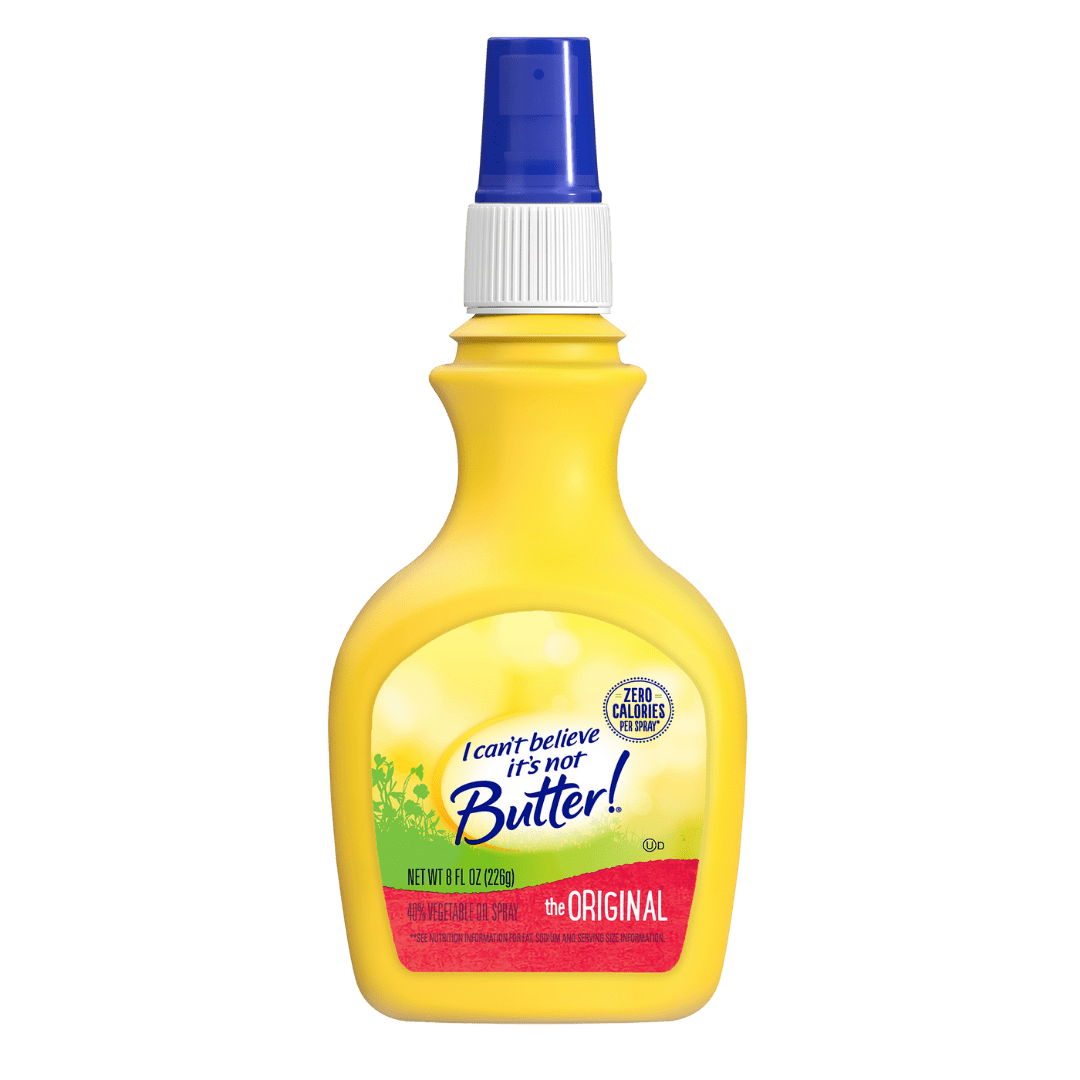
    I Can’t Believe It’s Not Butter says one serving is one spray. One spray weighs 0.2 grams. The eight-ounce bottle contains about 1,130 servings.

    One thousand one hundred thirty.

    Back of I Can't Believe It's Not Butter spray bottle showing the nutrition facts and ingredients
    The back label lists one spray as a 0.2-gram serving. Image: Upfield.

    The company also gives the math that the front of the bottle politely declines to discuss: six sprays contain 5 calories, 0.5 grams of fat, and 15 milligrams of sodium. Up to four sprays contain what it calls insignificant amounts of calories and fat.

    Nothing magical happens between sprays four and six. The soybean oil does not suddenly remember it is oil. We have simply crossed a line where the numbers are no longer allowed to dress up as zero.

    zero is doing administrative work

    Under the FDA’s nutrition-label rules, fewer than 5 calories per serving may be stated as zero. Total fat below 0.5 grams per serving is also expressed as zero. The important phrase is per serving, and the serving is one-fifth of a gram delivered by a single press of a nozzle.

    So the bottle is not claiming that eight ounces of flavored soybean oil contain no energy. It is making a much narrower claim: if you stop counting immediately, the first spray rounds down.

    *hydrogenates vegetable oil*“you’re Not gonna believe this”

    — schweg, (@schwegler.lol) 2026-09-23T16:19:41.695Z

    This is legal. It is also extremely funny.

    A serving size is supposed to help translate a package into human behavior. Here it has become a unit of regulatory geometry: make the slice thin enough and every number disappears. The product can be useful, the label can be technically accurate, and the experience of reading “0 calories” on a bottle whose second ingredient is soybean oil can still feel like being challenged to a duel by arithmetic.

    I now understand why spray butter exists. I understand how it has zero calories. I do not believe either answer has improved me.