

A new essay revisiting Andrew Schwegler’s “DRM and Copyright in the 21st Century,” published on Pale Panda February 11, 2009, after an earlier appearance in StandUp Magazine. This is not a republication of its legal claims or software instructions. Sources checked October 24, 2026.
A collection ought to survive an evening when the internet is down. That seems like a modest requirement. Somehow, it still needs explaining.
Pale Panda’s 2009 DRM essay was angry about a familiar bargain: pay for culture, then discover that using it depends on somebody else’s permission machinery. Its software recommendations have aged. So have some of its legal assertions. The underlying question is worth keeping: after you pay, what do you actually have?
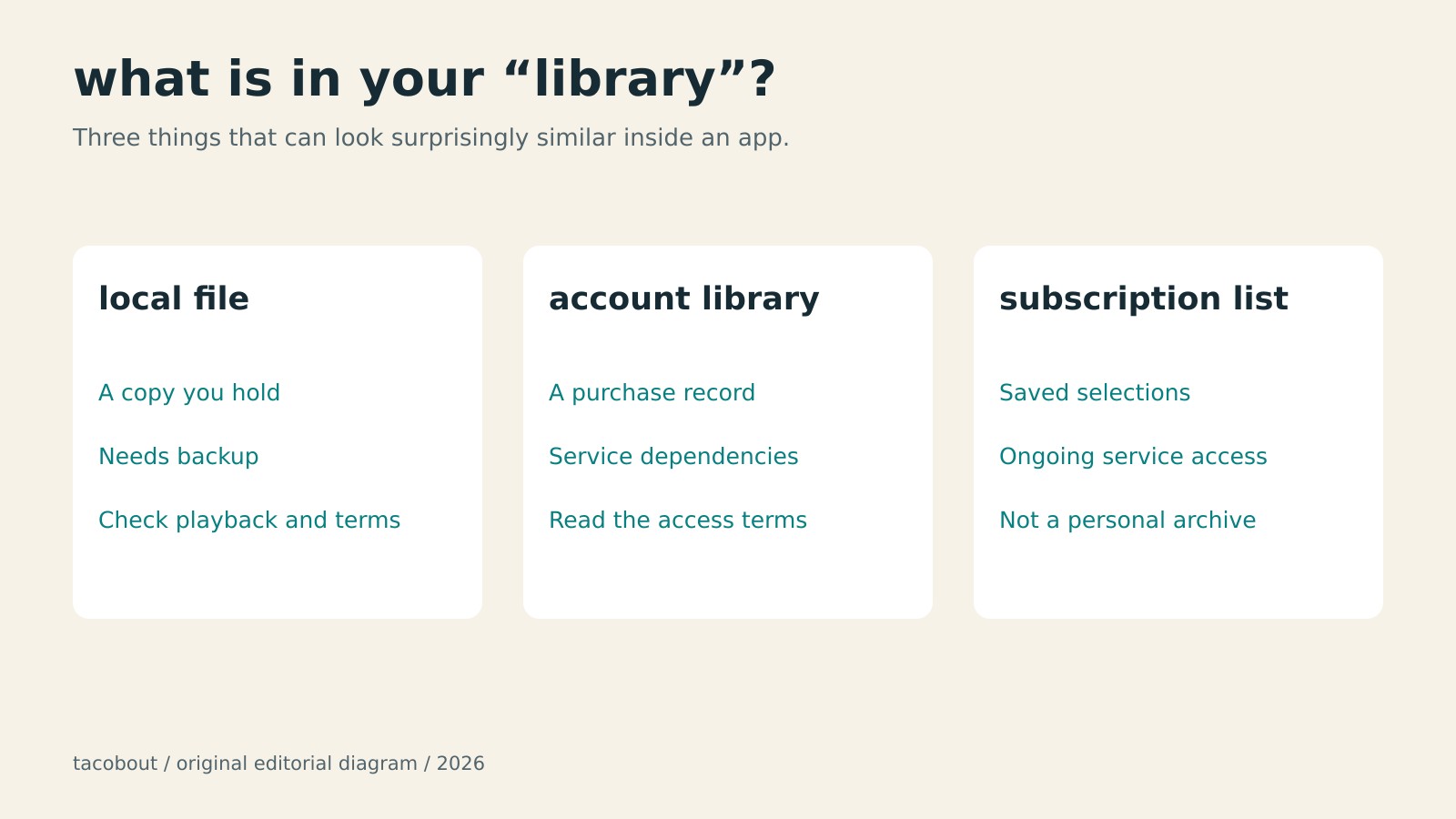
The word “library” is doing an impressive amount of work. It can mean files on a drive, a shelf of discs, a list of purchases attached to an account, or a subscription’s saved-items screen. These may look similar in an app. They have very different failure modes.
start with the file, not the button
Before buying something you want to keep, ask a few boring questions. Does the transaction include a downloadable file? Can an ordinary player open it? Does playback need a particular app, an active subscription, or another authorization check? What does the seller say happens if access changes?
A download button alone does not answer those questions. An app’s offline feature can be useful without providing an independently usable copy. Likewise, having an account entry marked as purchased is different from having the media saved somewhere you control. Check the actual product and terms rather than assuming a familiar interface means a familiar deal.
There are straightforward alternatives. Bandcamp says its downloaded audio files are DRM-free. That is a specific technical promise about the downloads, not a transfer of the artist’s copyright. The distinction matters: fewer playback restrictions do not give you permission to republish somebody’s album.

keep the boring part
Once you have legitimately obtained files you are permitted to retain, actually save them. Keep a second copy separately from the first. Check that the files open. Save the credits, artwork supplied with the purchase, and any accompanying license information. A folder called “Downloads” is a location, not a preservation strategy.
Cloud convenience can coexist with that small amount of maintenance. It just should not be mistaken for the maintenance. Apple explicitly says Apple Music is not a backup service. Its support guidance also accounts for songs becoming unavailable in the catalog. A service can be very good at playing music today without being your personal archive.
Physical media has its own chores: storage, working equipment, damage, missing pieces. The point is to know which dependencies you have accepted. Replacing a shelf with an app does not make dependence disappear. It moves it somewhere less visible.
the legal shortcut is not a shortcut
The old article treated personal copying much too categorically. In the United States, fair use requires a fact-specific assessment; buying a work does not create a blanket fair-use permission for whatever copying you would find convenient.
There is a separate complication around bypassing access controls. Section 1201 addresses circumvention, with statutory exceptions and periodically reviewed exemptions. “I paid for it” does not settle that question either. This essay is about choosing and maintaining a collection, not a set of instructions or legal clearance to defeat restrictions.

Creative Commons also needs a less magical description than it received in 2009. CC licenses work through copyright, granting permissions under stated conditions. They do not simply erase it. Check the particular license: attribution, commercial reuse, and adaptations are separate questions. DRM-free, openly licensed, and public domain describe different things.
None of this requires giving up streaming or turning leisure into a records-management job. Use the convenient service for discovery. For the small corner of culture you would be annoyed to lose, pay attention to the format, the terms, and the copies you actually hold.
Keeping things takes a little work. So does rebuilding a collection from a screen full of unavailable titles. Only one of those chores lets you choose the timing.
credits
Source essay: Andrew Schwegler, DRM and Copyright in the 21st Century, Pale Panda, February 11, 2009; the original credits an earlier StandUp Magazine appearance. Original editorial diagrams created for tacobout. Linked product and legal sources checked October 24, 2026; legal discussion is limited to general U.S. context.


leave a reply