

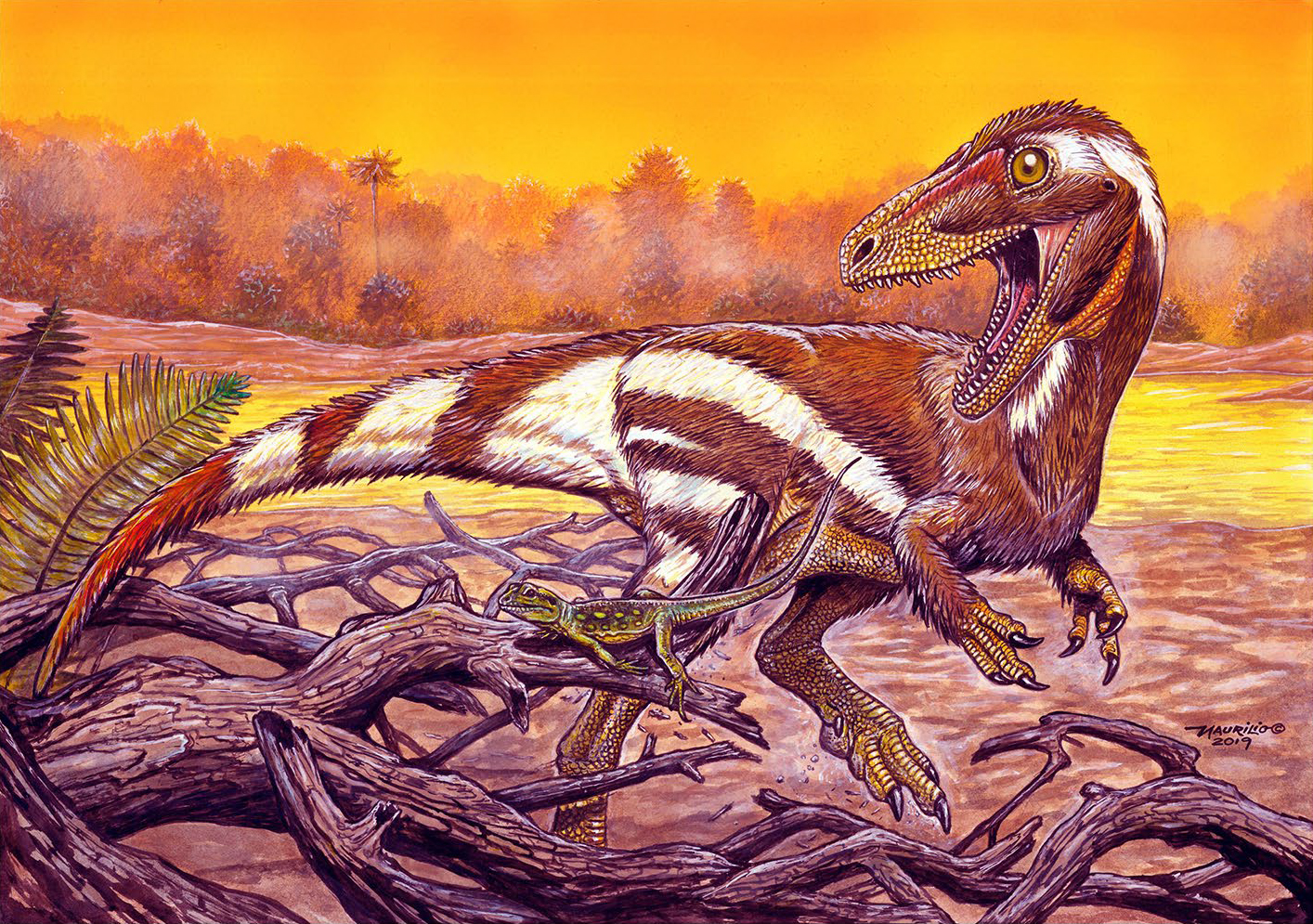
a dinosaur has been dead for 115 million years and has somehow managed to get a more interesting blood test than most living people. unfair, honestly. the rest of us have to make appointments.
Researchers studying the leg bones of Aratasaurus museunacionali, a small meat-eating dinosaur from what is now Brazil, report microscopic structures resembling red blood cells and chemical evidence associated with heme, the molecule connected to hemoglobin. The fossils were recovered from a gypsum mine, not from a secret laboratory staffed by a man who refuses to listen when Jeff Goldblum speaks.

a fossil is not a juice box
Let’s start with the part the more excitable headlines leave in a ditch: nobody has found a lovely fresh sample of dinosaur blood waiting to be put into a test tube. The evidence is mineralized, chemically changed, and very old. The team found cell-shaped features in former blood-vessel channels and signatures of heme-related chemistry. That is an extraordinary claim about what a fossil might preserve. It is not an invitation to start pricing theme-park liability insurance.
The researchers, led by scientists at Curtin University, say a mineral called hausmannite may have helped preserve the structures. Their study appeared in Proceedings of the National Academy of Sciences. If the interpretation holds up, it means that an old bone can carry more information about an animal’s biology than the broad outlines we’ve learned to expect from fossils. Suddenly a leg is not merely a leg; it might also be an archive.
But the skepticism isn’t some grouchy anti-dinosaur lobby. In ABC Science’s reporting, paleontologist Mary Schweitzer questions whether some of the structures actually look like reptilian red blood cells. She finds parts of the chemical evidence more persuasive. That’s an important distinction. A chemical trace and a recognizable cell are different claims, and the science gets better when we don’t pretend they’re interchangeable.

the tyrannosaurus-shaped attention economy
Here’s the especially funny part: just days before this result arrived, Nature reported on an analysis suggesting that dinosaurs and other charismatic fossil animals get an outsized share of the space in high-profile journals. In other words, the dinosaurs are allegedly hogging the scientific spotlight, and then one immediately showed up with suspiciously interesting blood chemistry. Incredible timing from a creature that doesn’t have a publicist.
Of course we love dinosaurs. They were enormous, ridiculous, frequently feathered, and generally constructed like evolution was trying to win a bet. A genuine insight into their ancient tissues ought to make the news. But treating every early finding as a final answer does the work a disservice. It turns the wonderfully weird process of testing an idea into a punchline about scientists finally discovering something they’ve known about since the first movie.
What excites me isn’t that we’ve unlocked a secret pint of prehistoric blood. It’s the possibility that we have underestimated ordinary-looking museum specimens for decades. The same rocks people have cataloged, displayed, and walked past may still have new things to say, provided somebody asks a better question and brings a better microscope.
So yes, this is a blood story, with a large scientific asterisk. It is also a story about patience, preservation, and how to be impressed by evidence without asking it to perform a magic trick. We can allow a dinosaur to be interesting without demanding it come back to life.
Read more: Popular Science’s report, Curtin University’s research announcement, and ABC Science’s skeptical expert interviews.
Image credits: Featured reconstruction by Maurilio Oliveira, CC BY 4.0. Fossil in matrix and leg-bone anatomy by Sayão and colleagues, via Wikimedia Commons (image one; image two), CC BY 4.0. Unmodified.


leave a reply