

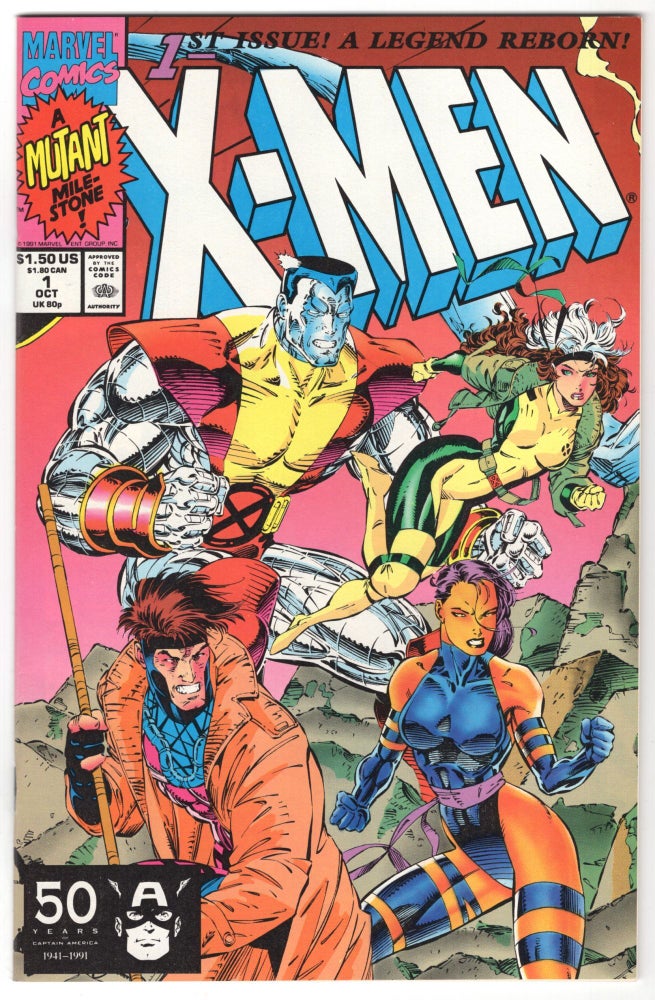
I reposted a Bluesky post tonight that said, “X-Men has been the most consistent interest in my life.” It is a very efficient sentence. Nine words, and suddenly I am thinking about the strange little handful of interests that stop being things you like and become part of the load-bearing structure of your personality.
The X-Men are unusually good at becoming that kind of interest. They are less a single story than a municipal transit system: enormous, occasionally unreliable, redesigned every few years, and somehow still able to take you back to the same place.
continuity is not the point
Trying to explain X-Men continuity is how normal conversations become hostage situations. There are alternate timelines, cloned people, cloned people who did not initially know they were clones, children who are older than their parents, deaths that function more like extended vacations, and at least one island that is also a person. The official history is technically knowable, in the same sense that the tax code is technically knowable.

But continuity is not really what keeps people around. The return is. You can disappear for five years, come back through a cartoon, a movie, a comic run, or one extremely specific Tumblr gifset, and the essential machinery is still there. A group of people has been told that something fundamental about them makes them dangerous. They respond by building a home together, putting on coordinated outfits, and developing interpersonal problems of almost military complexity.
That premise travels. It can be a civil-rights allegory, a queer text, a family drama, a workplace comedy in which the workplace keeps exploding, or an excuse for Wolverine to stand in a forest looking like someone has interrupted the worst cigarette break of his life. Sometimes it is all five before lunch.
the story changes when you do
The durable childhood interests are rarely the ones that remain frozen. Usually, they survive because you keep discovering a different entrance.
When you are young, the X-Men can be about powers, costumes, giant robots, and the objectively correct belief that Storm is the coolest person in any room. Later, the same stories start looking like arguments about respectability, chosen family, assimilation, political exhaustion, and what people owe a society that keeps announcing its intention to destroy them.
As a gay person, none of that requires particularly strenuous decoding. The franchise has never mapped neatly onto one real minority experience, and it gets clumsy whenever it tries to behave as though it does. Still, the emotional grammar is familiar: disclosure as risk, family as something you may have to assemble yourself, public acceptance that vanishes the second people become frightened, and the endless demand that the marginalized person remain calm enough to deserve survival.
You can meet that story before you have language for yourself, then return after you do. The characters have not necessarily become more sophisticated. You have. They were simply patient enough to wait.

a franchise can be a storage device
Long-running fiction accumulates versions of its audience along with versions of its characters. A particular theme song stores the room where you first heard it. A costume design stores the age when you decided someone looked impossibly cool. A revival stores the slightly unsettling discovery that your childhood is now an intellectual property strategy.
X-Men ’97 understood this better than most nostalgia projects. It did not merely put the old action figures back on the shelf and wait for applause. It returned to the visual and emotional vocabulary people remembered, then allowed time to have happened. The result felt familiar without pretending familiarity was sufficient. This is apparently a radical concept in franchise management.
That matters because consistency does not mean consuming every issue, seeing every movie opening weekend, or maintaining a working knowledge of which body Professor Xavier currently occupies. There are years when an interest is central, and years when it sits quietly in the background. It still becomes a way of keeping track of yourself.
I think that is what made the skeet land. “Most consistent” does not mean unchanged. It means the thing kept finding a version of you who could use it.
the things that stay are allowed to be messy
A lifelong fandom is not an endorsement of every choice made under its logo. God knows the X-Men have supplied enough bad movies, baffling retcons, aborted metaphors, and stories where nobody appears to have asked whether women should be allowed one uninterrupted afternoon.
The affection survives because it is bigger than approval. You can love the basic proposition, argue with its execution, ignore an era entirely, and come back when somebody remembers why the whole thing worked. That is a healthier relationship to culture than the modern demand that everything you enjoy also function as a flawless public statement about your moral character.
Some interests are favorites. Some are phases. A few become personal infrastructure: not always visible, not always fashionable, but still quietly holding up part of the building.
The X-Men are especially suited to that job. Reinvention is already built into the premise. The roster changes, the school relocates, the dead return, the future becomes terrible in a slightly different way, and everyone tries again.
Honestly, there are worse things to carry forward.


.jpg)