

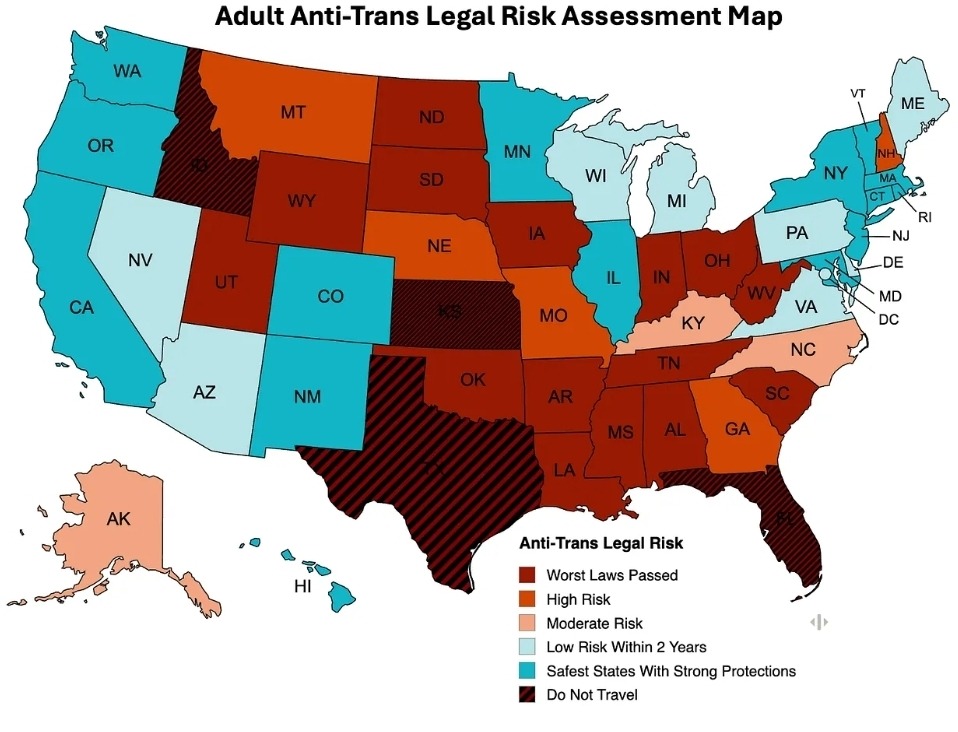
i reblogged a comparison between Erin Reed’s 2023 anti-trans risk map and her July 2026 update because sometimes a picture does exactly what a hundred individual headlines cannot: it shows the direction of travel.
the map is not an official travel advisory, and it should not be treated like one. Reed describes it as a qualitative legal-risk assessment built from five years of tracking bills, hearings, court fights, executive actions, and reports from organizers in each state. that distinction matters. so does the fact that people need this kind of map at all.
the colors did not merely move

in the 2023 version, Florida stood alone in the map’s striped “Do Not Travel” category. the July 2026 adult map puts Florida, Idaho, Kansas, and Texas there. South Carolina moves into “Worst Laws Passed.” Reed’s accompanying report, published July 13, says Idaho’s new bathroom law can expose a trans person to a felony and a prison sentence of up to five years, while South Carolina expanded its bathroom restrictions to colleges and universities.
this is what makes the comparison more useful than treating each new restriction as a discrete piece of bad news. laws do not arrive alone. they stack. a bathroom ban sits beside restrictions on identity documents, health care, schools, public employment, and legal recognition. eventually “can i use this restroom?” becomes “can i safely cross this state?” which is a deranged question for a person to have to answer before filling the gas tank.
and then there is the map for kids

the youth map is the one that stops me. there is no low-risk category left anywhere in the country. Reed writes that federal policy, pressure on schools and hospitals, and the broader spread of state restrictions have pushed every state to at least moderate risk for trans youth.
another useful check is the Movement Advancement Project, which tracks more than 50 LGBTQ-related laws and policies in real time. its current gender-identity policy scores put 22 states, plus three territories, in the negative category. it is a different methodology answering a different question, but the broad shape is familiar: protections are concentrated, penalties are spreading, and geography increasingly decides how much of your ordinary life the government considers negotiable.
maps like these are practical tools, but they are also records of policy failure. the country is being recolored in ways that turn moving, traveling, going to school, getting a prescription, or using a public building into legal-risk calculations. we have somehow rebuilt the trip planner as a civil-rights document. very efficient. extremely normal.
the legal landscape changes quickly. check the dated methodology and state details in Erin Reed’s July 13, 2026 report, and consult qualified local counsel or advocacy organizations for legal advice.