
Tag: trans rights

  • you can just stop buying the wizard stuff

    you can just stop buying the wizard stuff

    loving what a story meant to you does not require an eternal pipeline of purchases, reboots, merchandise, and increasingly strained excuses. Read more →

    I never got into Harry Potter. This was not an act of moral courage. I read some of the first book as a kid, did not like it, and stopped. The Sorting Hat failed to assign me a house because I had already wandered off to look at the X-Men again.

    That means I do not have the same nostalgia to untangle that a lot of people do. I understand why the books matter to them. They found the series at exactly the age when a fictional world can become load-bearing, and it followed them through childhood, adolescence, midnight release parties, movies, friendships, and the period when every personality quiz on the internet needed to know whether you were a Hufflepuff.

    i never got into Harry Potter because I didn’t like the first book and never finished it as a kid. BUT, even if I did like it back then it’s not that hard to just not consume media that directly pays for the creator’s bigoted activism to continue to do massive harm

    schweg, (@schwegler.lol) 2026-09-03T10:49:43.910Z

    But “this mattered to me” and “I must continue buying every new thing made from it” are two different sentences. They have been stapled together by an entertainment industry that would very much prefer nobody notice the seam.

    The seven British-edition Harry Potter books arranged together
    Photo by Mo HH92, via Wikimedia Commons, licensed CC BY-SA 3.0.

    the old books are not asking for more money

    Nobody is coming into your house to confiscate the battered paperbacks you already own. Nobody can retroactively remove the friends you made through fandom, the comfort you found in the story, or the fan fiction that was probably doing more interesting things with the premise anyway. Memory is not a subscription service. It does not stop working when you decline to purchase the reboot.

    The current franchise, however, is a business. New books, games, licensed merchandise, theme-park trips, and television adaptations are transactions. J.K. Rowling remains publicly connected to the Wizarding World, and her own website describes her as a campaigner on sex and gender issues. It also promotes her privately funded legal organization, which finances cases intended to establish and enforce “sex-based rights.” That is not an inference assembled from a haunted corkboard. The fund says what it does on its own website.

    So the familiar defense that buying one game or watching one new series is too indirect to matter feels increasingly unserious. Of course one purchase does not single-handedly finance a court case. That is how mass consumer products work. No individual soda purchase builds an entire bottling plant either, but Coca-Cola has somehow managed to acquire several.

    A transgender Pride flag flying outdoors against the sky
    Photo by the UK Foreign and Commonwealth Office, via Wikimedia Commons, licensed CC BY 2.0.

    there are ways to keep the memory without feeding the machine

    Keep the books you have. Borrow them from the library. Buy a used copy if you absolutely need one. Read old fanfic. Rewatch the DVD that has been sitting in a storage tote since the Obama administration. Those choices are materially different from preordering the newest deluxe edition and then explaining that your money is merely symbolic.

    More importantly, let the fondness be historical. We already do this with thousands of things. A childhood restaurant closes, a television show ends, a band breaks up, or a website disappears because somebody forgot to renew the domain. We are capable of loving what something was without demanding an eternal pipeline of branded content. In fact, adulthood is mostly discovering that everything you loved has either ended or been purchased by private equity.

    I do not think people have to perform a public ritual of shame because they once loved Harry Potter. I do think the insistence that a beloved childhood property must remain an active consumer identity forever is a little bleak. The story already happened. You got what you needed from it. The memories are yours, and the corporation cannot repossess them.

    You can just stop buying the wizard stuff.
  • 2
    we have rebuilt the trip planner as a civil-rights document

    we have rebuilt the trip planner as a civil-rights document

    Erin Reed’s 2023 and July 2026 trans legal-risk maps show more than a bad legislative season. They show ordinary travel becoming a… Read more →

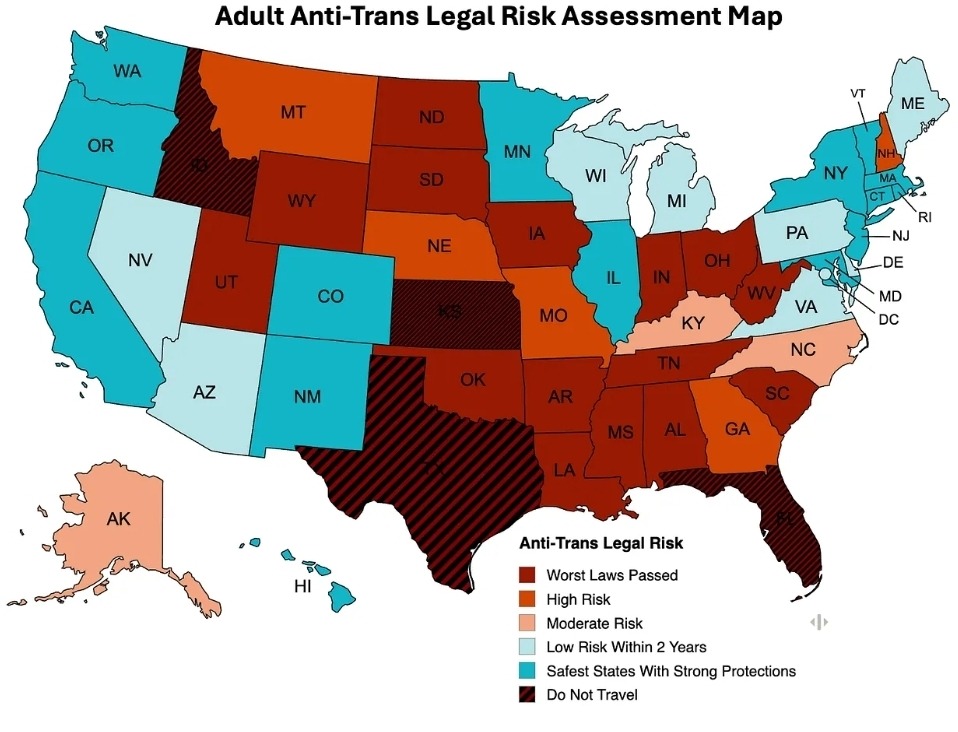
    i reblogged a comparison between Erin Reed’s 2023 anti-trans risk map and her July 2026 update because sometimes a picture does exactly what a hundred individual headlines cannot: it shows the direction of travel.

    the map is not an official travel advisory, and it should not be treated like one. Reed describes it as a qualitative legal-risk assessment built from five years of tracking bills, hearings, court fights, executive actions, and reports from organizers in each state. that distinction matters. so does the fact that people need this kind of map at all.

    the colors did not merely move

    United States map showing Erin Reed's 2023 adult anti-trans risk assessment, with Florida marked Do Not Travel and many states in lower-risk categories.
    Erin Reed’s Adult Anti-Trans Risk Assessment Map, 2023. Source: Erin in the Morning; used for commentary and historical comparison.

    in the 2023 version, Florida stood alone in the map’s striped “Do Not Travel” category. the July 2026 adult map puts Florida, Idaho, Kansas, and Texas there. South Carolina moves into “Worst Laws Passed.” Reed’s accompanying report, published July 13, says Idaho’s new bathroom law can expose a trans person to a felony and a prison sentence of up to five years, while South Carolina expanded its bathroom restrictions to colleges and universities.

    this is what makes the comparison more useful than treating each new restriction as a discrete piece of bad news. laws do not arrive alone. they stack. a bathroom ban sits beside restrictions on identity documents, health care, schools, public employment, and legal recognition. eventually “can i use this restroom?” becomes “can i safely cross this state?” which is a deranged question for a person to have to answer before filling the gas tank.

    and then there is the map for kids

    United States map showing Erin Reed's July 2026 youth anti-trans legal risk assessment; every state is rated moderate risk or worse, and Florida, Idaho, Kansas, and Texas are marked Do Not Travel.
    Erin Reed’s Youth Anti-Trans Legal Risk Assessment Map, July 2026. Source: Erin in the Morning; used for commentary and comparison.

    the youth map is the one that stops me. there is no low-risk category left anywhere in the country. Reed writes that federal policy, pressure on schools and hospitals, and the broader spread of state restrictions have pushed every state to at least moderate risk for trans youth.

    another useful check is the Movement Advancement Project, which tracks more than 50 LGBTQ-related laws and policies in real time. its current gender-identity policy scores put 22 states, plus three territories, in the negative category. it is a different methodology answering a different question, but the broad shape is familiar: protections are concentrated, penalties are spreading, and geography increasingly decides how much of your ordinary life the government considers negotiable.

    maps like these are practical tools, but they are also records of policy failure. the country is being recolored in ways that turn moving, traveling, going to school, getting a prescription, or using a public building into legal-risk calculations. we have somehow rebuilt the trip planner as a civil-rights document. very efficient. extremely normal.

    the legal landscape changes quickly. check the dated methodology and state details in Erin Reed’s July 13, 2026 report, and consult qualified local counsel or advocacy organizations for legal advice.