

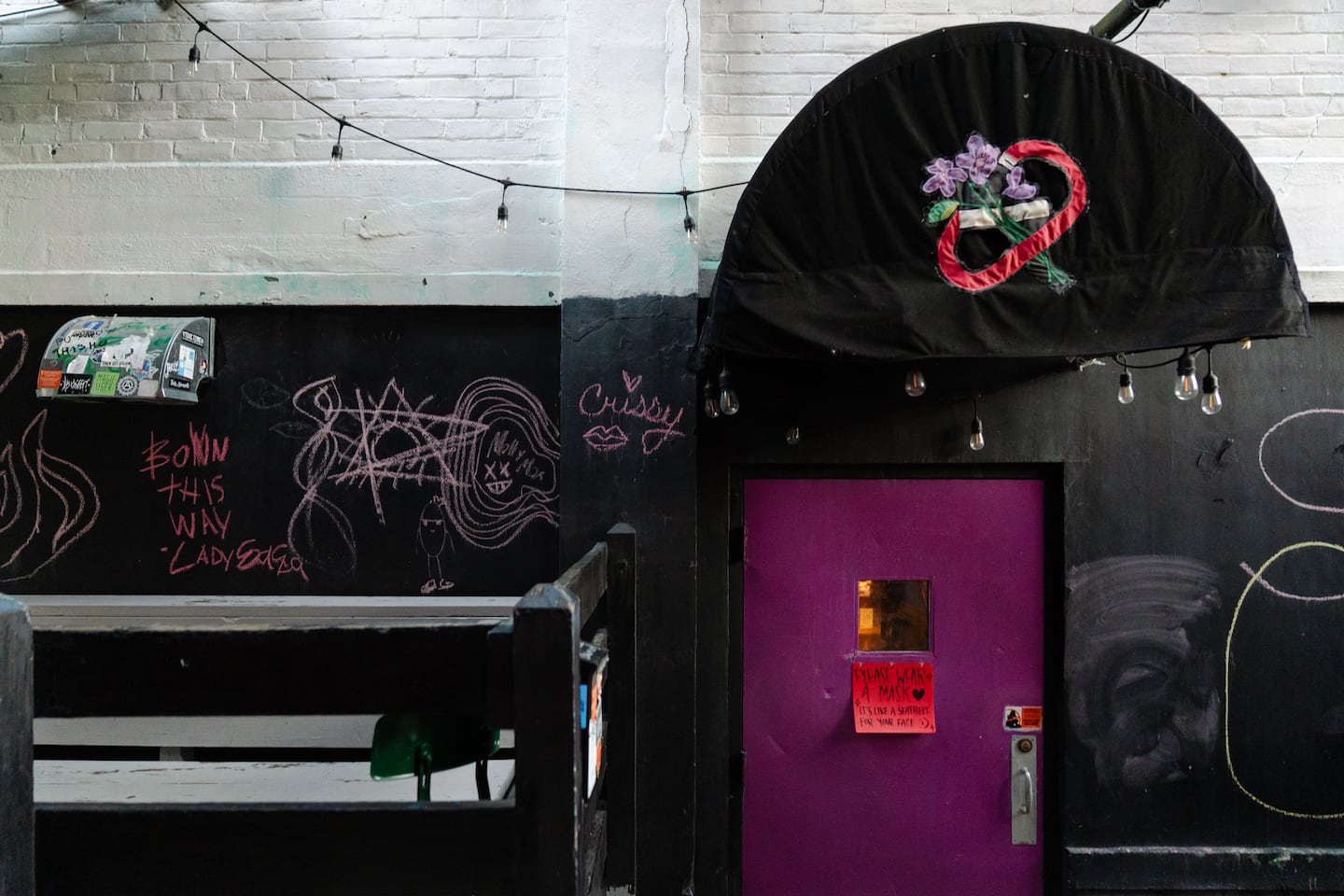
a KN-95 policy can be care. one mask-optional night can also be care. a community space that closes because nobody lets it compromise is accessible to absolutely no one.
Last Ditch Bar and Arts Venue opened in Greenfield, Massachusetts, with a very specific promise: a queer community space where patrons wore KN-95 masks or better. that made the bar usable for immunocompromised and COVID-conscious people who cannot simply decide that the pandemic ended when everybody else got bored.
then the bar started running out of money, because values are free and commercial rent remains stubbornly invoiced in dollars. management announced that Saturday nights would become mask-optional while the rest of its schedule remained masked. the idea was to try ordinary club nights with DJs, themes, and enough paying customers to keep the lights on.
this was treated in some corners as a moral betrayal instead of a small business making one compromise on one night of the week. and I do understand why people were upset. the entire appeal of Last Ditch was that it had designed the room around people other bars exclude. when an accessibility promise changes, even partially, the people who relied on it are allowed to feel like something was taken from them.
but a feeling of loss does not magically become a business plan.
somebody still has to make the number go up
the Boston Globe’s reporting makes the arithmetic bleak. the founders let people in when they could not afford the cover. workers went unpaid. the remaining owner had lived in her truck, worked four jobs, and was still responsible for a $50,000 business loan. at the end of one three-and-a-half-hour community meeting about the mask change, the landlord wanted $3,900 in back rent by Monday.

none of those facts prove that every decision made by the bar was correct. they prove that the argument was not happening in the clean laboratory of discourse, where every value can be preserved if everyone uses enough words like “accountability.” it was happening in a basement with a liquor license, a mostly empty dance floor, and bills.
small queer spaces get assigned impossible jobs. be a bar, but also a community center. be accessible, but also loud, crowded, and financially viable. welcome poor people, but charge enough to pay workers. provide public-health protections stronger than almost any other venue, but somehow attract customers who do not want those protections. perform all of this perfectly, or become evidence that the whole project was fraudulent.
the answer cannot be that access stops mattering whenever it becomes expensive. masks are not a decorative little flourish for the mission statement; for some patrons, they determine whether the space is available at all. but that is precisely why keeping six masked nights and trying one mask-optional Saturday reads to me as an attempt to preserve access, not abandon it.
the revolution has a liquor license
Last Ditch said it would continue prioritizing masked bookings and hold a recurring masked social. that is not perfect access. neither is shutting the bar down and replacing its calendar with a tasteful Instagram memorial about how important queer spaces are.

the most revealing part of the whole argument is that the actual villain is boring. it is not immunocompromised lesbians asking for safety. it is not the people who want to dance without a respirator. it is the economic arrangement that makes one exhausted 26-year-old personally responsible for reconciling public health, radical politics, hospitality, and $3,900 in back rent before Monday.
capitalism loves making community spaces prove their virtue through self-destruction. if the bar raises prices, it excludes poor patrons. if it enforces a cover charge, it betrays its mutual-aid mission. if it relaxes one rule to attract enough customers to survive, it has sold out the people it was built to serve. every available path is framed as harm, while “go bankrupt correctly” remains the only option nobody has to defend.
a closed bar has a very simple mask policy
community is not a product you can order with every accommodation preinstalled. it is a pile of people making imperfect choices about shared resources, sometimes badly, while the rent keeps accruing. solidarity should mean arguing for the safest workable version of the space and helping it find the money to exist. it cannot mean demanding that the people running it absorb every contradiction until they disappear.
if Last Ditch closes, nobody wins the mask argument. immunocompromised patrons lose one of the only bars designed around them. Greenfield loses a queer venue, free store, performance space, and community center. everybody else gets to post a very principled obituary.
that seems considerably less accessible than Saturday.





leave a reply