

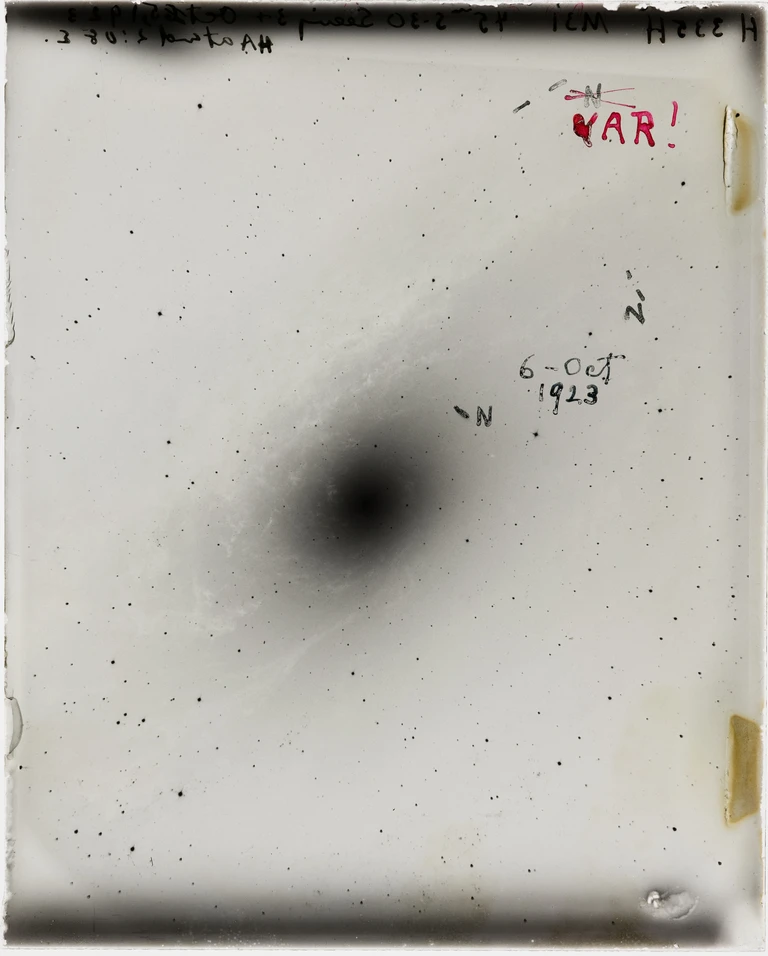
one of the history posts I re-skeeted this week was a glass photographic plate with an excited “VAR!” written on it. astronomical evidence, but also the energy of somebody discovering that a spreadsheet cell has been wrong for years.
the plate came from Edwin Hubble’s observations of Andromeda at Mount Wilson in October 1923. the important object was a Cepheid variable star: a star whose brightness changes in a way that can help measure distance. the resulting work established that Andromeda lay beyond our Milky Way. the universe had considerably more real estate than the neighborhood map suggested.
Carnegie Science preserves the plate and its history. the annotation is irresistible. a neat heroic discovery story can fit in three letters and an exclamation point. man looks through telescope. man notices star. cosmos expands. roll credits.
the credits should be longer
except the measurement depended on work Henrietta Swan Leavitt had already done. she established the relationship between the periods of Cepheid variables and their luminosities. that supplied the basis for using them as distance markers. Carnegie’s account explicitly credits that contribution.

I like the discovery better with that part left in. not because Hubble needs to be demoted or because every achievement is secretly a theft. the actual story is more interesting than the one-man version. one person establishes a relationship. another applies it to an observation made possible by a huge instrument, a collection of records, and people who keep the whole operation functioning.
the telescope is an impressive object. the method is less photogenic. you can pose next to the telescope. you cannot pose next to a relationship between a star’s pulsation period and its intrinsic brightness without somebody arranging a deeply unfortunate PowerPoint.
that imbalance follows us around. public credit gravitates toward the moment with a face, a date, and a dramatic verb. the enabling work is easier to reduce to background. a discovery becomes something that happened to a great man instead of something he could do because other people had made it possible.
maintenance does not arrive with an exclamation point
I spend my working life around databases. this probably explains why an old plate with an annotation activates the same part of my brain as an unusually informative audit record. it is a physical trace of someone noticing that the previous description no longer fits the evidence. keep the record. change the interpretation. do not pretend you always knew.

most useful work has a much less cinematic version of that structure. somebody kept the data. somebody made it comparable. somebody established what a value meant before somebody else used it to announce an insight. the final presentation may contain one name and a very nice chart. that does not mean the chart generated its own evidence.
this is not an argument against celebrating discoveries. please celebrate discoveries. I would much rather have the internet get excited about an astronomical plate than another executive describing a chatbot as a new species of colleague.
it is an argument for noticing what the celebration leaves outside the frame. precision takes work. records take care. a method can outlive the person who developed it and become the quiet foundation for something enormous. that is an achievement even when nobody puts an exclamation point beside your name.
keep the wonder. improve the attribution.
the comforting part of this story is not that one extraordinary person had the right idea. it is that knowledge can accumulate across people and time. the first contribution does not have to finish the entire project to matter. the next person can do something with it that the first person never had the chance to see.
I want the glass plate, the telescope, the excited annotation, and the woman whose work made the measurement possible in the same story.
the universe got bigger. our account of how that happened can manage to get a little bigger too.
Featured image: VAR! plate: Carnegie Science / Carnegie Observatories. https://carnegiescience.edu/about/history/archives/plate-archives/m31var

leave a reply