

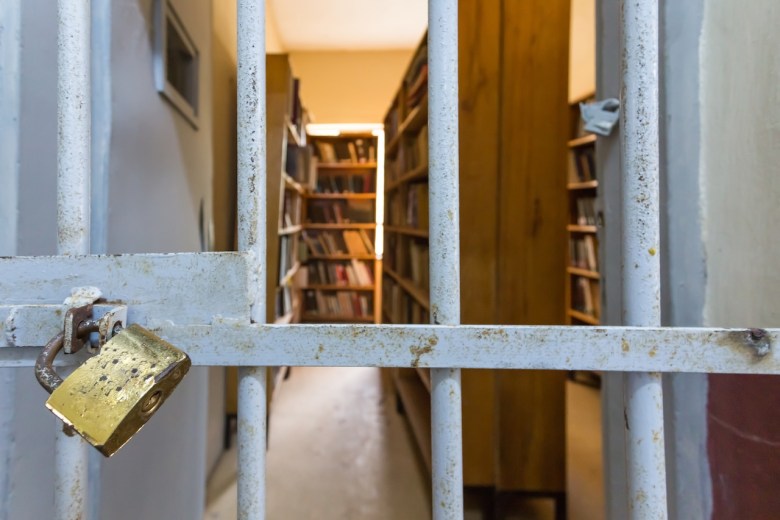
i reposted this because the list of new rules at the Craighead County Jonesboro Public Library reads less like library policy and more like terms of supervised release.
minors cannot use the self-checkout kiosks. children under 13 are limited to the children’s collection. teenagers can use the children’s and teen sections, but not the adult collection. nobody under 18 may check out a DVD. minors are also barred from entering or buying anything from the Friends of the Library bookstore.
the state has not technically replaced the library card with an ankle monitor. it has merely arranged the experience so that borrowing a movie, browsing outside your assigned age habitat, or purchasing an old paperback requires adult intervention. freedom has been preserved in the sense that there are still books inside the building.

the threat works before anybody gets arrested
these changes follow the Eighth Circuit’s July 30, 2026, decision allowing Arkansas to enforce Act 372. the law exposes librarians and booksellers to criminal liability for furnishing material deemed “harmful to minors,” and it gives local governing bodies final authority over challenged library material. a federal district judge had blocked the law as unconstitutionally vague and overbroad; the appeals court reversed that judgment.
the Arkansas Times reported on September 3 that libraries were already redesigning ordinary circulation around the possibility that a librarian might be charged. Independence County stopped minors from checking out manga and adult graphic novels. in Pulaski County, the outgoing director of the Central Arkansas Library System urged the board to minimize employees’ exposure to prosecution.
this is the part censorship advocates get to pretend is administrative. nobody has to march through the stacks with a cardboard box labeled FORBIDDEN IDEAS. you threaten the person behind the desk with criminal charges, then let the institution calculate how small it needs to become to feel safe.
the chilling effect is not a side effect. it is the product.

a library is supposed to permit wandering
i understand that libraries organize material by age. a picture book, a young-adult novel, and a tax manual are trying to do different jobs. but a useful library is not a set of sealed departments. it is one of the few places where curiosity is allowed to make an unscheduled turn without first becoming a purchase.
a 12-year-old can wander from mythology into archaeology. a teenager can look up the novel referenced in a movie, read a cookbook, or discover that the adult shelf contains both James Baldwin and fourteen books about fixing a deck. sometimes the great danger is literature. sometimes it is home improvement.
the Craighead County library’s own history says its regional system gives patrons access to more than 164,000 physical items, plus a large digital collection. that is what public infrastructure looks like when it trusts people: abundance, shared access, and room to find something nobody thought to assign you.
Act 372 turns that trust inside out. the child is treated as a liability, the librarian as a potential defendant, and the shelf as evidence waiting for a prosecutor to develop an opinion.
parental rights, except for everyone else’s parents
supporters sell laws like this as parental control, but the practical result is government control applied to every family at once. a parent who wants their teenager to browse the adult collection cannot make that choice through the teenager’s library card. a family that permits DVDs cannot reverse the blanket ban. the state has defended parental authority by preempting it.
EveryLibrary has called for Arkansas to repeal and replace Act 372, arguing that libraries already have collection policies, challenge procedures, and ways for parents to guide their own children. that is the boring answer because boring answers are usually what functional public institutions use: professional standards, due process, and individual families making individual decisions.
the exciting answer is threatening librarians until the self-checkout machine becomes contraband.
the Eighth Circuit opinion explains what the law permits. the policies now appearing around Arkansas show what it produces. the distance between those two documents is where censorship likes to claim it did nothing.
meanwhile, children may continue enjoying the library in the approved biome, during authorized browsing, with an adult nearby to operate the dangerous machinery.


leave a reply